

Business
THE LADY OF NOVELS
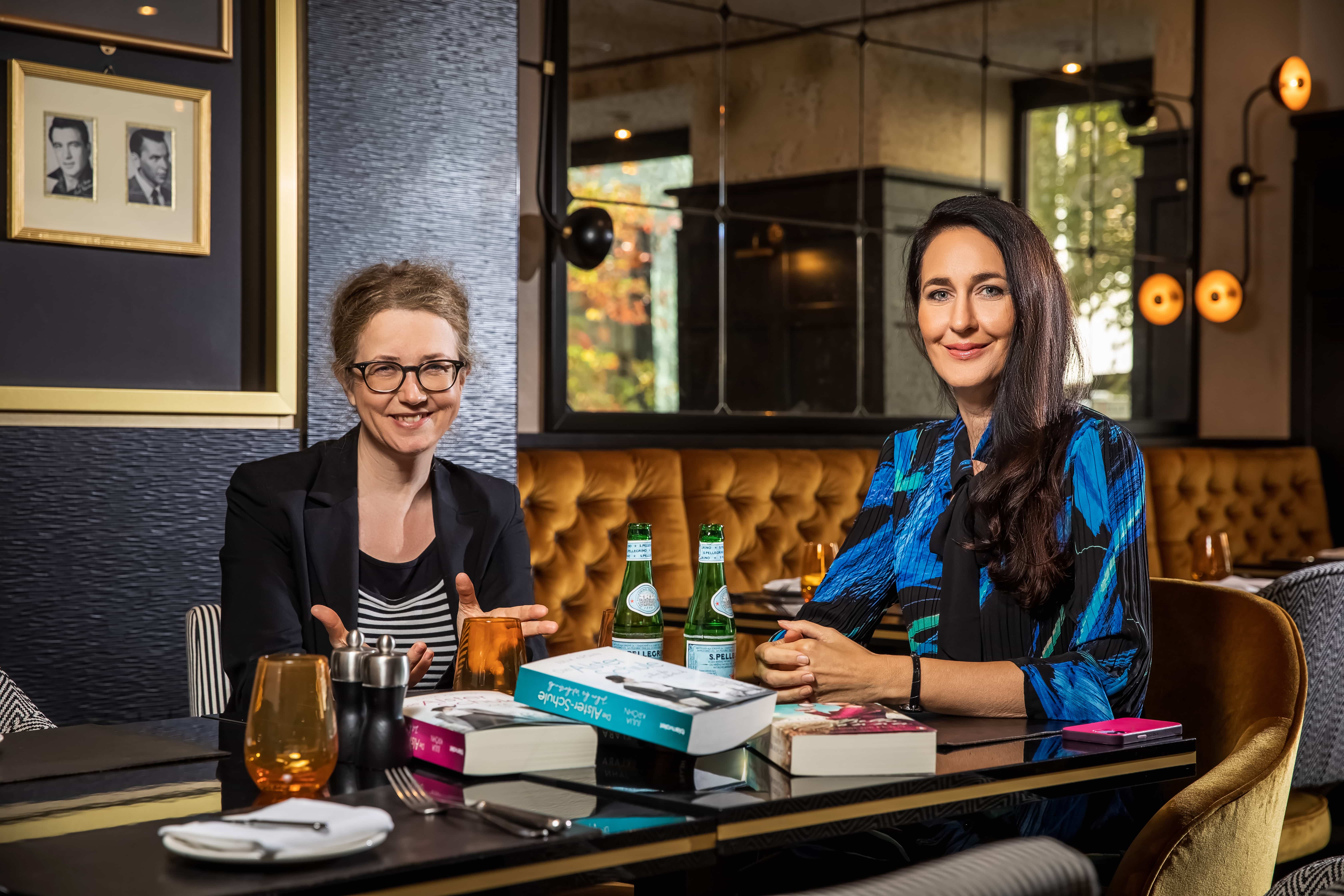
One million books sold worldwide. Novelist and historian Julia Kröhn writes the page-turners that take readers back to earlier, exciting times. An adopted Frankfurter with Austrian roots, she loves meticulous research and stories with heart and fighting spirit. Over lunch at the Brasserie Oscar’s in the Steigenberger Frankfurter Hof, she talked to Dr Jutta Failing about the art of storytelling.
Text Dr. Jutta Failing Photos Nikita Kulikov
HAPPY WORKAHOLIC
The woman with many names – she uses a different pseudonym for each genre – has the eyes of a novel’s heroine with a kingdom to defend. Pearl grey like flashing steel, almost hypnotic. Only her warm Austrian lilt breaks the spell. As always when I meet Julia Kröhn, she is writing a new novel. She is enormously hard-working – with the greatest self-discipline, she lives up to her reputation as a bestselling author year after year. When one novel is nearing its end, research for the next is already under way.
Her desk in the historic railway workers’ estate in the Nied district, where she has lived for years, is a gateway to the past, to love, pioneering spirit, the clash of swords and family secrets on storm-lashed coasts – in other words, to what the arts pages like to scorn as popular fiction but the public adores and devours. Mind you, these are not penny dreadfuls. That would be like comparing artisanal wholegrain rolls with cheaply produced white rolls; the former, like Julia Kröhn’s novels, have weight and bite. Not infrequently they end up running to as many as 1,000 pages – she is simply a “workaholic”, she sums up with a smile.
She has just finished “Das Lied des Waldes”, which will be published in March 2022 under the pseudonym Klara Jahn. As she talks about the content – it deals with the modern longing for the forest and the beginnings of forestry under the Nuremberg patrician family Stromer in the 14th century – it is clear that this, too, is a subject that has held her completely captive for months. The historian never writes at random; she always first tracks down in libraries everything that underlies a historical event or an era.
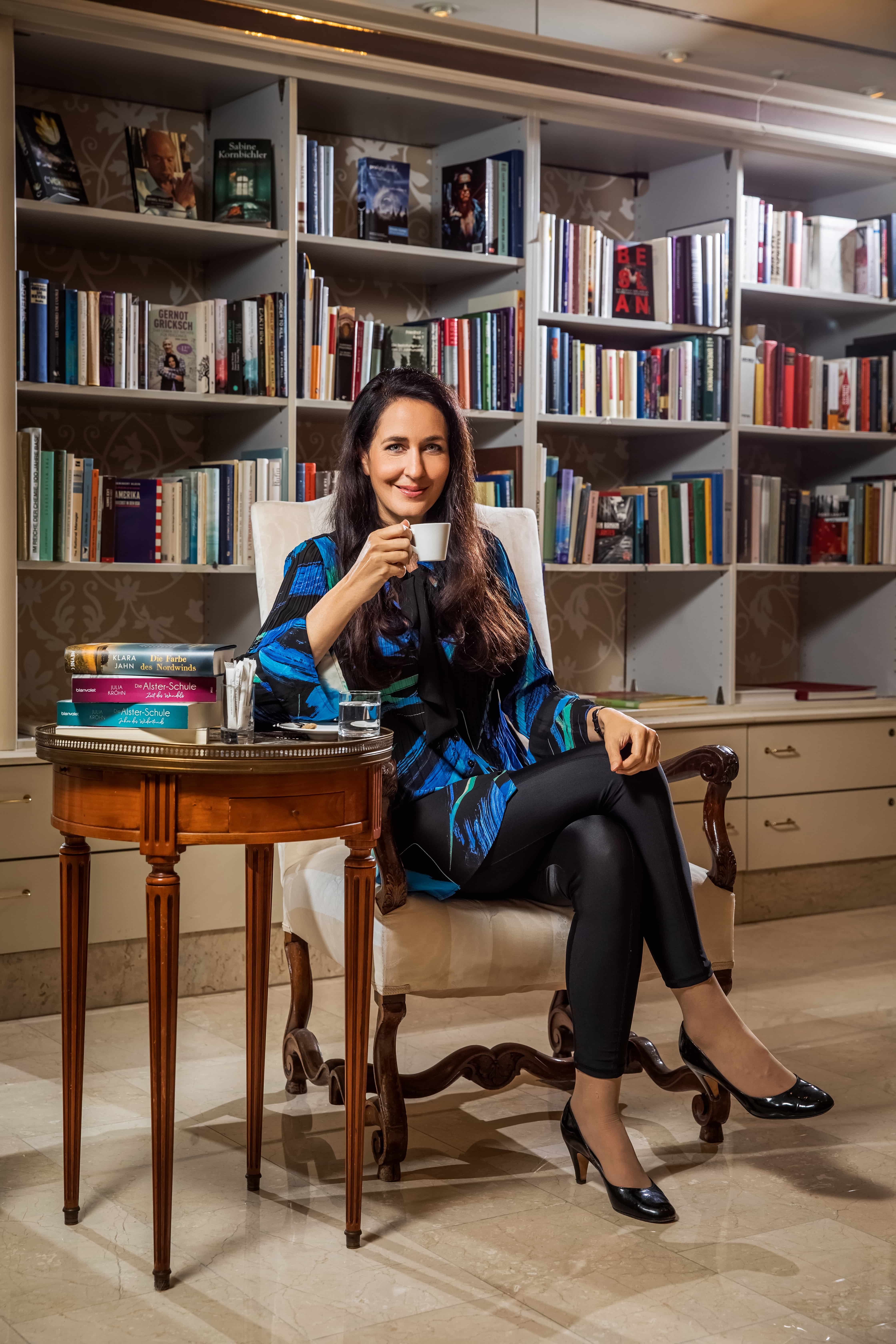
WHERE YOU WILL LIVE TO BE 100 YEARS OLD
Lonely, inaccessible or fateful, even cursed places attract Julia Kröhn. Often they are the settings of her novels, to which she makes extended trips, such as to the Irish monastic island of Skellig Michael or to the Rock of Monaco, scene of the Grimaldis’ violent intrigues. “Most recently I was on the Danish Faroe Islands with my ten-year-old daughter. There is very little tourist infrastructure there. In the remotest villages I looked at cemeteries and was astonished at how many centenarians are buried there. What might make these people on the islands live so long? Death in childbirth and accidents among the men were usually the causes of death among the younger ones.” It takes a little daring to expose oneself to this rugged solitude when travelling, when one could be far more comfortable in a spa retreat. “I’m more of a hermit; I’m good at being alone, even when I’m not travelling. But when life calls, I answer,” she sums up what defines her world. Sport also balances out the brainwork. She uses climbing sessions at a high-ropes course in the Taunus, for example, to leave her “ivory tower”, as she puts it, from time to time.
MORE THAN JUST MEDIEVAL
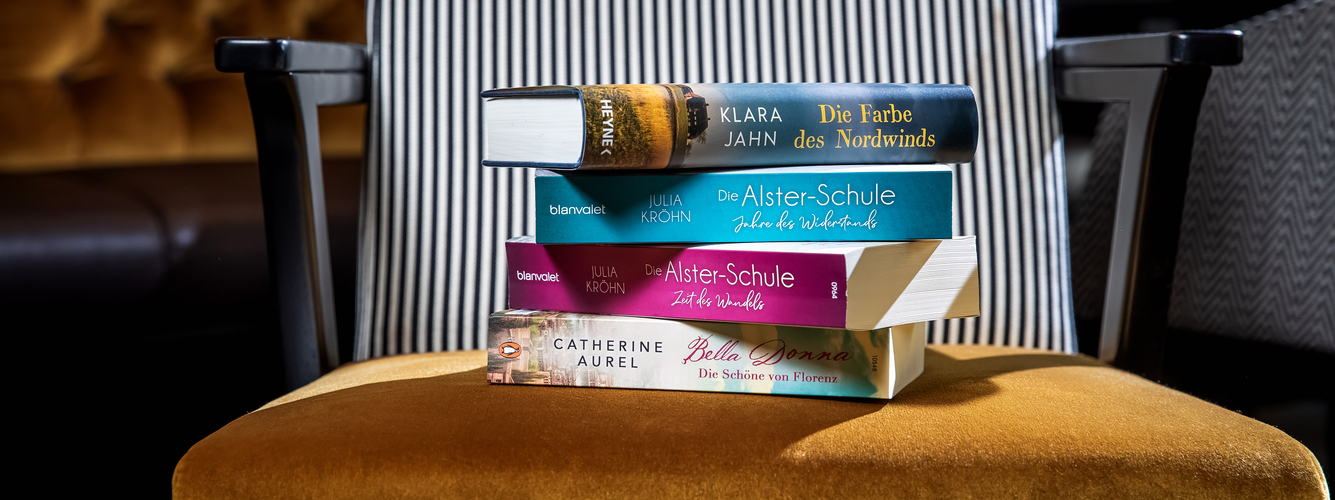
Of course Julia Kröhn knows the Frankfurter Hof. During the Book Fair, the grand hotel’s famous authors’ bar is a magnet and the end point of a long day at the fair for her too. This is where book people hold court and celebrate; it is a tradition. Would she like to write a hotel novel some time? She waves the idea away: “There has been a glut of books set in hotels lately. The book market has become incredibly fast-moving; new releases come thick and fast.” Subjects have to appeal not only to her but also to the publishers. Some of her most recent books, such as the two volumes of the “Alsterschule” – the heroine is a young teacher inspired by the ideals of progressive education who falls into danger under the swastika – and “Das Modehaus”, set in Frankfurt, struck exactly the right chord. “When I started writing full-time 15 years ago, the Nazi era was not a subject at all in historical popular fiction; it wasn’t given a chance. Practically everything was set in the Middle Ages; the limit was the end of the First World War. Now there are numerous successful novels set in the 20th century. These are subjects that come ever closer to our present. Nobody can say how long this boom will last. At any rate, the current trend can also be observed abroad. The Spanish translation of ‘Das Modehaus’ (La casa de modas) did incredibly well – my most successful foreign licence.”
FROM DISHWASHER TO WRITER
She tells me about her schooldays: “Because I did my Abitur at a school with practical training in home economics, I also got to know the hospitality trade, washed dishes and waited tables. That gave me a view of life that makes you humble.” Her parents were teachers, a lasting influence. “I see myself less as a writer than as a history teacher. In my novels I tell stories from which you can learn a lot, and which perhaps put your view of your own life and goals into perspective or call it into question,” she explains. In recent years she seems to have shed a skin, as it were. “My novels have an even more topical, more urgent, political message. Whereas they used to be like a hot chocolate, warming and comforting, now and in future they are more like a workout, more strenuous, more demanding. But afterwards you feel fit.”
When life calls, I answer.
— Julia Kröhn, bestselling author
During the lockdown she began to deepen her knowledge of Hebrew, practising daily with an app. “I have dealt with so many Jewish subjects in my books. I think the accusation of cultural appropriation levelled at authors is wrong. You are obliged to do intensive research, always and especially here.” Anyone who knows Julia Kröhn – tenacious, diligent, a self-assured researcher – knows she won’t stop until she speaks the language fluently.
More stories








GET IN TOUCH