
Art
SOUND AND SPACE - CASALS FORUM KRONBERG
With the Casals Forum in Kronberg, opened in 2022, the Rhine-Main cultural region gains a new landmark. The impressive chamber music hall can hold its own with the best in the world. A visit.
Text Benjamin Pfeifer Photos Kronberg Academy/Marcus Ebener, Kronberg Academy/Andreas Malkmus, Kronberg Academy/Patricia Truchsess von Wetzhausen
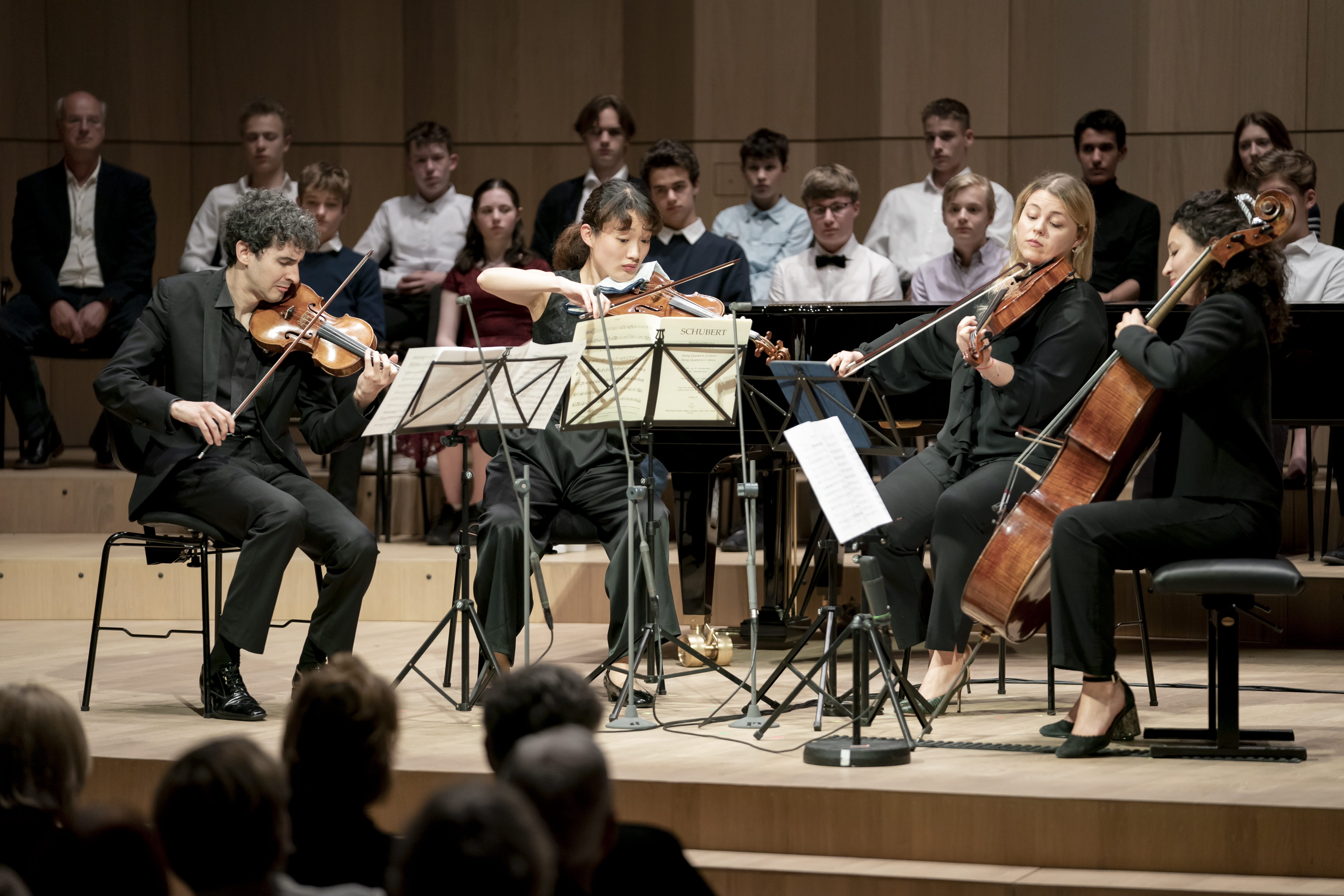
And suddenly there is silence in the great hall. The audience in the packed Casals Forum gazes spellbound at the still empty stage. Finally it greets the musical duo of this song recital, baritone Thomas Hampson and pianist Christoph Eschenbach, with warm applause. On the programme are the 24 songs that Franz Schubert combined in the autumn of 1827, a year before his death, into one of the best-known cycles of the Romantic era. Wandering and the homelessness of human existence are the recurring motifs of “Winterreise”, which already resonate in the first line: “Fremd bin ich eingezogen, fremd zieh’ ich wieder aus” (A stranger I arrived, a stranger I depart). As gloomy as the underlying tone is, Hampson and Eschenbach’s interpretation on this evening is weightless and floating, and after an hour and a half the evening ends with frenetic cries of “bravo” and a (partial) standing ovation. All this even though, musically, the performance had not been beyond reproach from the start; it was carried not least by the outstanding acoustics and the intimate atmosphere of the hall.
VINEYARD AND SHOE BOX
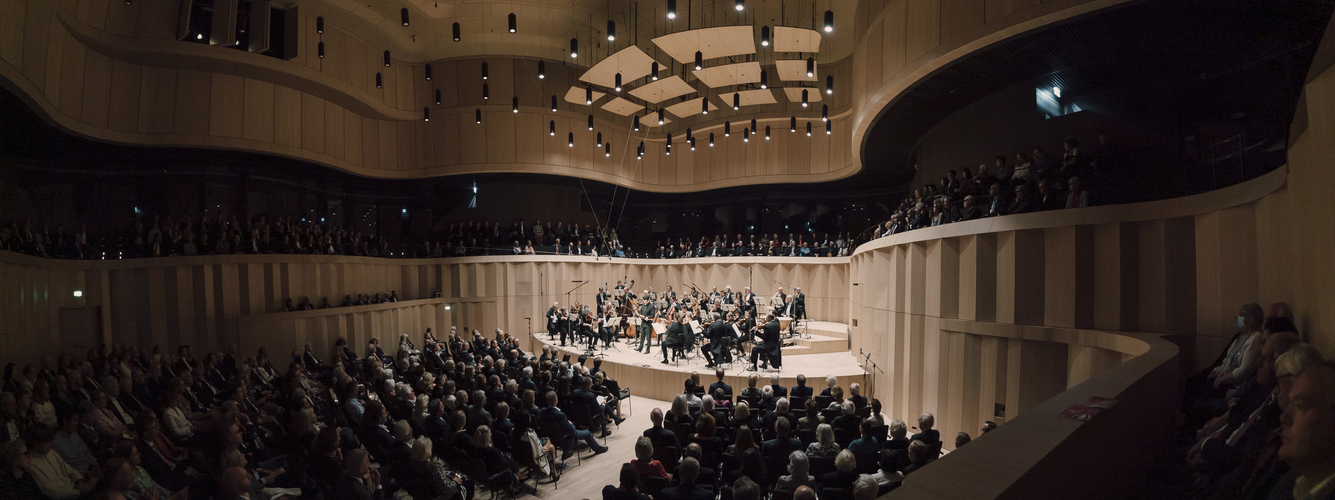
It is precisely this hall, the 550-seat chamber music hall, that has been the heart of the new Casals Forum in Kronberg since it opened. Its qualities have been received with enthusiasm, and not only among experts. First, there are the acoustics, which are the result of the intensive collaboration between the Berlin practice Staab Architekten, already responsible for the new building of the Jüdisches Museum in Frankfurt, and the acoustician Martijn Vercammen. The result is a combination of two acoustic design principles: the vineyard and the shoebox. Whereas in a “vineyard hall” the rows of seats are terraced around the central stage (a democratic idea that goes back to Hans Scharoun and was taken up again at the Elbphilharmonie in Hamburg, for example), in a “shoebox” they are aligned in parallel towards a stage located in front of the audience in a rectangular room (think of the auditoriums of the Alte Oper in Frankfurt or the Staatsoper Berlin). The acoustic ideal of the vineyard hall is a crystal-clear, analytical sound; that of the shoebox is a warm, enveloping sound. In Kronberg the stage is surrounded by terraced tiers, but these are located not in the middle but at the edge of the hall, whose shape resembles an elongated hexagon with rounded corners. The entire hall is made up of concave and convex, bent and folded surfaces that ensure optimal acoustics. Together with delicate elements such as the suspended ceiling spotlights, the organically curved form of the hall also creates an architectural impression of dynamism and musicality – almost as if you were inside a musical instrument, which in a certain sense is actually true.
NEW MUSIC QUARTER
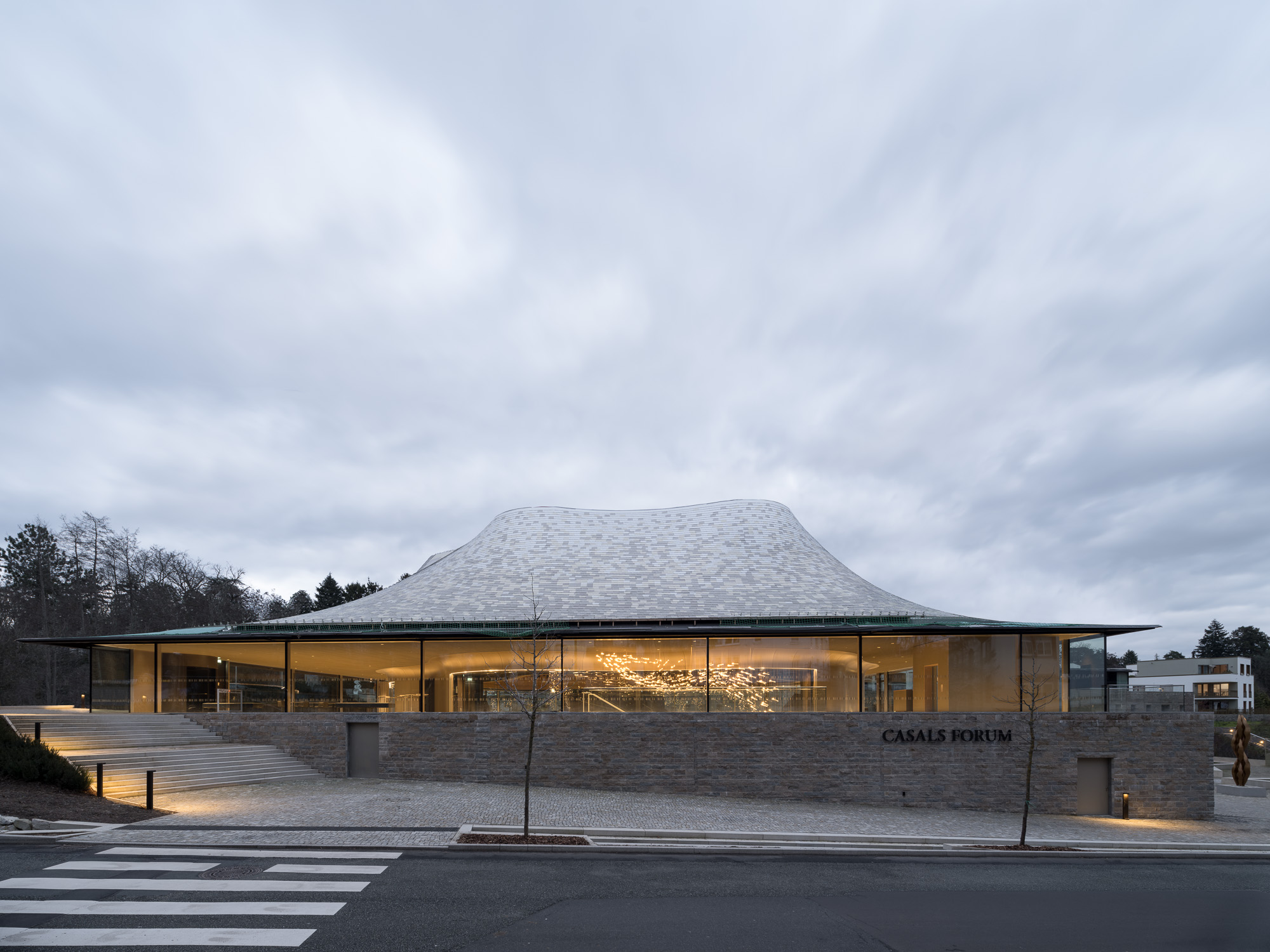
Spatially, the chamber music hall is composed of two vertically mirrored, wood-panelled shells. The offset between the two elements accommodates not only the gallery but also a continuous band of glazing that encircles the hall like a ribbon and establishes a relationship both with the surrounding urban space and with the upper foyer. The image of the glass band also defines the architecture from outside. Here the building rests on an angular plinth of natural stone. The horizontal structure is reinforced by the roof of the concert hall. With its wide overhang and cladding of anodised metal shingles, you might mistake it for a tent structure by Frei Otto. To anyone approaching from the north-west, from Viktoriapark, the Casals Forum thus appears as a natural continuation of the parkland. Further east the terrain falls away increasingly and the buildings become denser. Two further buildings were realised here, again to plans by the same architecture practice: an L-shaped hotel (“Vienna House”), five storeys high along Bahnhofstraße, and, behind it, the two-storey linear building of the Kronberg Academy, cleverly integrated into the side of the slope, which houses the study and administrative centre. Through their volumes and architectural language, the three buildings form an ensemble. In the area between them, Beethovenplatz has emerged as a new public space that also serves as the Casals Forum’s formal entrance. The group, also known as the music quarter, is linked by steps, terraces and paths.
STUDENTS AND GREAT ARTISTS IN EXCHANGE
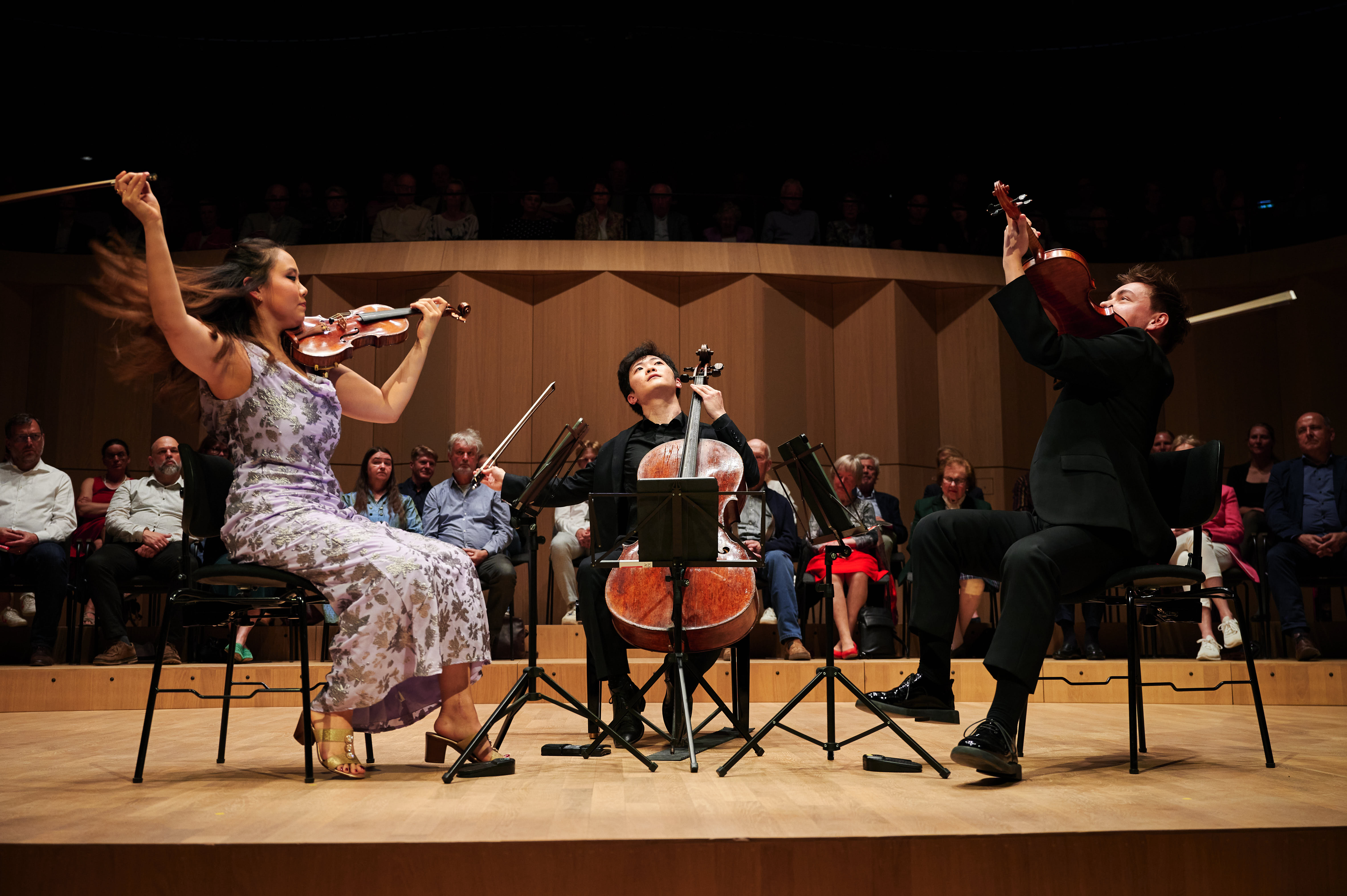
With the opening of the Casals Forum and the new study centre, a long-cherished dream has come true for the Kronberg Academy. The foundation, established in 1993, is dedicated to nurturing top musical talent and each year trains between 20 and 30 students, mainly on string instruments (violin, viola, cello) and piano. The performance and training venues, united at one site in Kronberg for the first time since 2022 – alongside the large chamber music hall there is also a smaller hall with 150 seats – enable exchange between students and the great artists of our time. Not least, the audience benefits from this exchange, experiencing classical music from soloist to orchestra in a space that is as much a pleasure to hear as to see.
More stories








GET IN TOUCH