
 Lukas Kirchgasser.jpg)
Food
3-STAR CHEF JUAN AMADOR
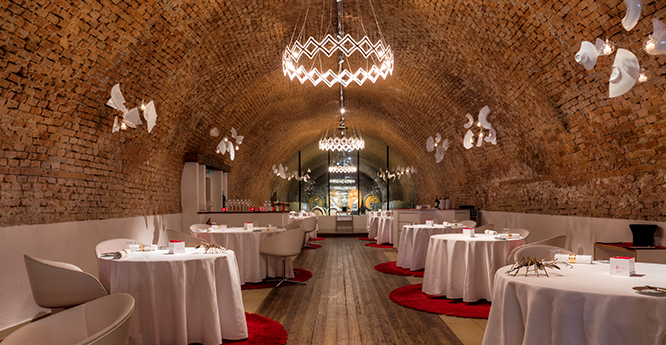
Juan Amador and Frankfurt are inseparable. His time in Langen, in Frankfurt’s East End and at the Kempinski Hotel Gravenbruch with Sra Bua by Juan Amador has not been forgotten. Today the three-Michelin-starred chef seems less restless, though by no means quiet. We visited him in his new home, Vienna.
Text Michael Wanhoff Photos Lukas Kirchgasser, Inge Prader
For me, regionality is about the flavour, not the produce.
— Juan Amador
Few chefs have shaped Germany’s culinary landscape as much as Juan Amador. A good 15 years ago, the Swabian-born chef brought the methods of molecular cuisine to Germany and, alongside the leading chefs of the day, Ferrán Adrià and Juan Mari Arzak, was regarded as one of the best-known exponents of this revolutionary style of cooking. At his restaurant in Langen and his atelier in Frankfurt’s East End, he experimented with state-of-the-art equipment more reminiscent of a chemistry lab than a kitchen. The reward: four years after opening, Amador was awarded three Michelin stars.
“Per aspera ad astra” – “through hardships to the stars” – is his motto in life, and it almost seems as if he takes it all too literally. The son of Catalan-Andalusian guest workers has a mind of his own, and it has brought him difficulties and successes in turn. For all his success as a chef, Juan Amador found the road to commercial success a difficult one.
In August 2011 he moved his restaurant to Mannheim, won three stars again and held them for four years – until he had to file for insolvency. Anyone who knows Amador knows that this setback did not send him into lethargy. The Swabian Spaniard is the “now more than ever” type, so he went to Vienna and opened his restaurant there together with his partner, the top Viennese winemaker Fritz Wieninger. The new restaurant was awarded two stars from the outset, and this year Amador achieved what no other chef in Austria had managed before: his restaurant was awarded three Michelin stars.
The move from Germany to Vienna has clearly done you good. You seem very relaxed. Has anything changed in your cooking too?
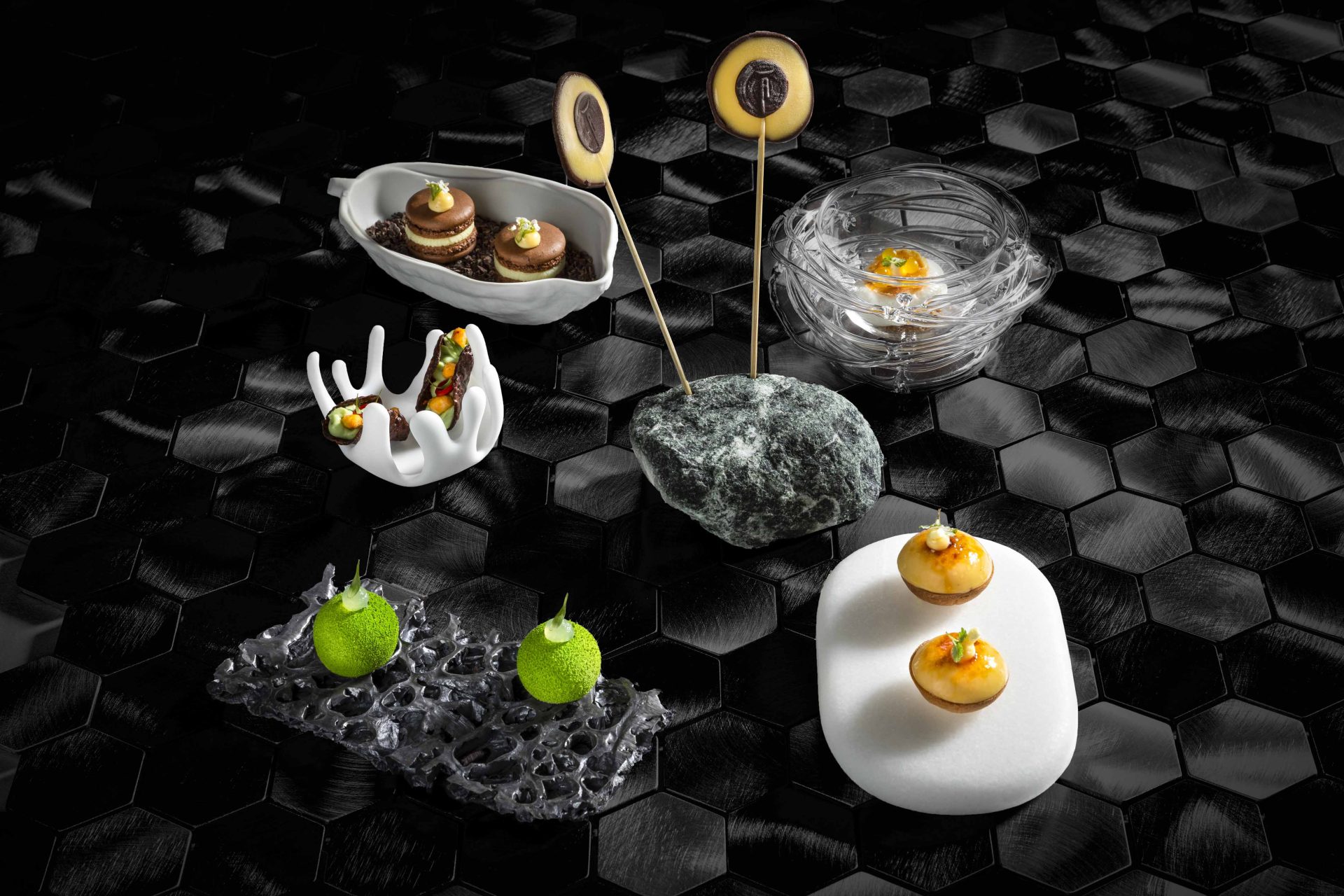
I’m completely relaxed, and that shows in the cooking as well. It has become more relaxed too. But it also has something to do with age. Look, I’ve been doing this for 35 years now. Nobody in my kitchen is 35 years old. I got my first star in 1993, at the Petersilie, aged 24. So that’s 26 years at full throttle. Today I’m much less playful, more focused and clearer. Less frippery on the plate. In Langen, technique was at the forefront; we’ve moved away from that now, although the technique is still there – you just don’t see it any more.
 Inge Prader.jpg)
 Lukas Kirchgasser.jpg)
 Lukas Kirchgasser.jpg)
So the plates look boring now?
What we do now could be called neoclassical. I’ve become calmer, and I no longer like those acrobatics on the plate that take a thousand steps and ten lads with tweezers to plate up. I mean, we’ve become much clearer.
You’ve always been a produce fetishist, which isn’t necessarily sensible from a business point of view. Has that changed? Have you become wiser?
There’s hardly anyone in Austria with better produce. That’s why our prices are high, but they’re justified. For the chicken we serve as a main course, I pay 25 euros wholesale.
Back to your menu: many classics are associated with Amador, such as the tree frog, iced beurre blanc, the pigeon with purple curry or Brick in the Wall. Are these signature dishes now history too?
Absolutely not! They’ll always be there, just slightly reworked. Not offering them any more would be like going to a Rolling Stones concert and them not playing “Satisfaction”. Then you go home and think: fuck! Something was missing!
I noticed Austrian influences on your menu, such as the Tafelspitz. But Spanish elements as well. You can’t quite shed the Spaniard, it seems.
When everyone is blowing the regionality trumpet, I say: OK, that’s perfectly fine for Austrians. But I’m a Spaniard, born and raised in Germany and travelling all over the world. So where is my region? My region is the fucking planet, all of it! There are Asian influences in my dishes too, for example in the Mieral pigeon. That came about, by the way, when I was on a flight to Bangkok with Ingo Holland. He showed me his purple curry, a blend with hibiscus. In Bangkok we then worked a lot with mangoes, and that’s how the dish was born. The craziest and best spice merchant in Germany flies to Asia with a Spanish chef, and the result is a dish that is world-famous today. That wouldn’t work with regionality. For me, regionality is about the flavour, not the produce.
 Lukas Kirchgasser.jpg)
Can regionality even be pursued rigorously?
Just look at the people who claim it for themselves. The menu lists trout from the pond next door, and what do they slap on top? Yuzu, ponzu, ginger and whatnot. What does that have to do with the region? I’d rather take Ozaki beef and do it the Viennese way, like a Tafelspitz with horseradish, a cracking bouillon and chives. To me that’s regional, because the dish picks up the flavour. The produce has to be the best for me, and then I pair it with the flavour of the region.
While we’re being critical: when you eat out, what bothers you?
I notice that maybe eighty per cent of dishes are lukewarm, cold or even raw. What’s the point? Or sauces: a sauce is the soul of a dish, not some juice or stock from it. Everything’s runny, nothing is bound any more – how is that supposed to cling to the produce? That really makes me angry. I really have to stop now! (laughs).
Speaking of things that bother you: it has been written that guests aren’t allowed to take photos while eating at your restaurant.
There’s no photo ban at our place. I only said that there’s no need to take photos of the food at our restaurant. Full stop. What matters to me is that people eat first and then enjoy looking at the photos afterwards. Then you have the plate in your head and understand what it all means. We’re also happy to provide the pictures. There are quite a few people who do the rounds of all the three-Michelin-starred restaurants, take pictures and post them without having a clue what they actually ate. They have to dig out the pictures first to find out. Or they keep taking photos for so long that the food goes cold.
Why do we never actually see you at the many culinary symposia where top chefs show off their skills?
Why should I stand up there and explain what we do? Some of them don’t care anyway, the others are just desperate to copy you. For me it isn’t about the copying at all. It’s about creating something yourself in your job! You can’t tell plates apart any more these days, they’re all swots’ plates. You can’t recognise anyone’s signature. I do think it’s good that fine dining has been democratised, that you no longer need silver cutlery, that newcomers have it easier. But you don’t see any differences – I don’t, at least.
More stories








GET IN TOUCH