
Style
CLUB CULTURE MADE IN FFM
Text Dr. Jutta Failing Photos Knut Wörner
 Play video
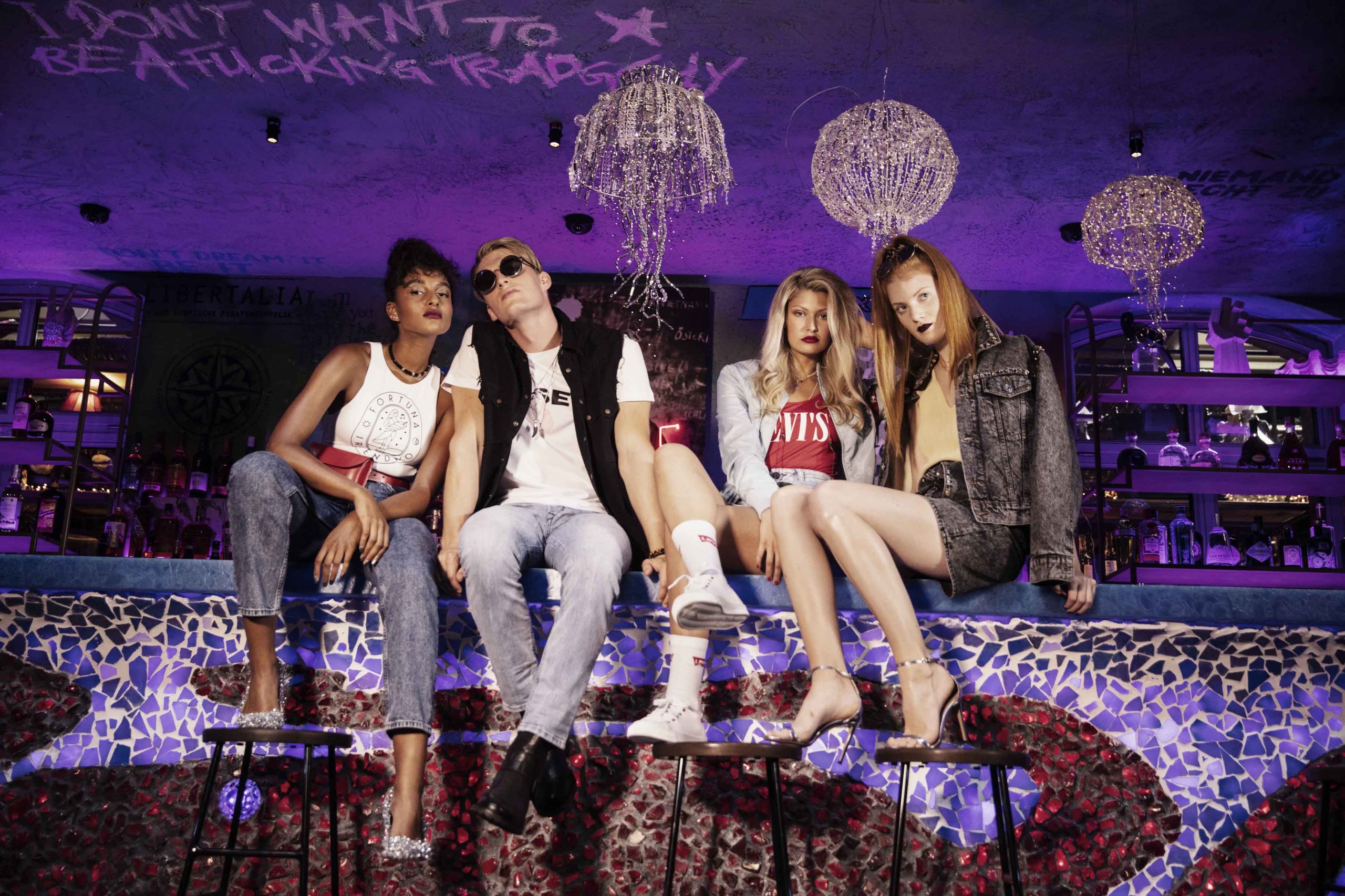
Frankfurt is one of the important places in Europe where electronic music, DJ and club culture have thrived and constantly evolved. We talked to protagonists of the past and today’s movers and shakers about that special club feeling – and for our cover shoot we celebrated – at least in front of the camera – Frankfurt’s most eagerly awaited club opening, which fell victim to the spring lockdown. Look forward to exciting insights and magnificent pictures in Ardi Goldman’s FORTUNA IRGENDWO!
Frankfurt’s club culture. A broad field. Without it, many a cool seed in art, design, dance and fashion would never have sprouted. In this city’s clubs, music genres of their own were forged and lives shaped. Corona brought drought; the clubs had to close. Ardi Goldman’s experimental “sanatorium for the emotionally and nervously ill”, as the investor and inventor of “King Kamehameha” describes his new club “Fortuna Irgendwo”, is finally set to open on 5 May next year, with the Heidelberg band DePhazz, in an exotic interior featuring a pool, a cuddle grotto and an octopus bar. “Music and light are no longer enough today,” he is convinced: “People have stopped dreaming. A club has to tell stories that create different images for everyone. The fact that there is no common thread is the common thread.” What hard beats used to achieve – creating inner journeys and community in black dance caves – is to be done here by inspiring spaces and things. “A friend from Berlin recently said I was still too attached to the club idea. Yet, following the example of Cirque du Soleil, I want to usher in a new era with my new concept. I believe in clubs!”
As a DJ, I’m banned from working. ‘Robert Johnson’ may not be able to reopen until mid-2021.
— Ata Macias
I WANNA GO BANG!
“Technoclub”, “Music Hall”, Snap! producer Michael Münzing’s “Omen”. In the late eighties and early nineties, people came from all over the world to party in the city’s discos. Frankfurt was the techno capital before Berlin, London and Detroit overtook it. Democratic free dancing to the pounding sound, faster than house, peaceful, excessive – a way of life. Sweat dripping from the ceiling. And the dream that society could be different. Names like DJ Talla 2XLC, Mark Spoon and DJ Dag became legendary. Labels came, and “Delirium”, the cult shop for records and clubwear, eventually went. Today there are still two purely electronic clubs: the “Robert Johnson” at the Kaiserlei, run by Athanassios Macias alias DJ Ata, and the “Tanzhaus West” in the Gallus, on the premises of a former printing ink factory. Both are currently closed. Old hand Macias is delighted by the great solidarity: “Our fundraising campaign ‘See You Soon’ is going incredibly well. Everyone is buying art, many are giving more.” He owes this to the close connection between the internationally known club and the Städelschule and the Offenbach HfG.
CARAVAN OF EMOTIONS
A new venue for living subculture, the Museum of Modern Electronic Music (MOMEM), promises steady rain after the drought. The experience space and vibrant hotspot at the Hauptwache is due to open in 2021 at the latest (see interview). The opening show is dedicated to Sven Väth. Väth, the techno figurehead who brought ambitious club sounds to Ibiza and made history in Frankfurt with the “Cocoon Club”, knows how club culture could be preserved today, as he tells THE FRANKFURTER: “Best to ban smartphones, because that’s the only way to preserve privacy and the true clubbing feeling.”
THE CLUB IS THE STAR
Anyone who wanted to get in had to ring the bell and then get past Jackson, the bouncer. It was actually always far too stuffy in the small “Unity”, because of the many guests who wanted to dance to funk and soul. Party promoter Mengi Zeleke, who had worked behind the bar at the “Batschkapp”, one of the first alternative centres for rock music in Germany, ran the “Unity” with his brothers. DJ Shantel played here regularly. “It was always about soul; like attracts like,” Zeleke recalls of those wonder years. The restaurateur and networker still listens to his heart. Today it beats in his “Café Herz”, for whose façade Tobias Rehberger created a neon sign.
GIRL, YOU KNOW IT’S TRUE!
Prince came. Sat quietly in the corner at the “Funkadelic”. When he slipped the DJ a cassette with a new song, the funk fans went wild. The club was founded in 1983 in the middle of the hip-hop and breakdance wave and for many years was the flagship for Black music of all kinds. Snoop Dogg and the Rolling Stones are said to have been spotted at “Cooky’s”. The nights of the clubs: “Monza”, “Stereobar”, “Plastik” and other places with cult status. A melting pot of creativity, a piece of cultural history. Many who were active here went from pioneers to successful label bosses, artists, designers and also restaurateurs such as Julian Smith. Ardi Goldman now wants to give it another go. Telling new stories at FORTUNA IRGENDWO. “Hedonistic, lusty and dissolute,” is how he describes the vibe. Slowing down is the magic word; the “patients”, i.e. guests, are to relax to experimental music, “no hip-hop, no electro”. A skull made of neon tubes smiles behind the bar: memento mori. Remember that everything is transient. Except, hopefully, club culture.
.jpg)

‘Unity’ – the name said it all. Today there’s a lot of talk about community; in this club we lived it without even realising.
— Mengi Zeleke
Alex Azary, DJ, musician, producer, music publisher and director-designate of the Museum of Modern Electronic Music (MOMEM), in an interview.
No sooner did the opening seem certain and a partnership with the Musikmesse was a done deal than the coronavirus pandemic struck. What happens now?
“Unfortunately we already had to cancel the opening show planned for last year, ‘Electro. From Kraftwerk to Daft Punk’, which drew tens of thousands in Paris and is currently on show at London’s Design Museum. We actually wanted to open in spring 2020, then came the lockdown. We are preparing for the possibility that we will not be able to launch the MOMEM until 2021. The conversion of the 900-square-metre space is complete; the fittings come next. We expect 3,000 to 5,000 visitors for the opening; a big party at the Hauptwache was actually planned too, but that isn’t possible in its planned form at the moment.”
What awaits visitors at the museum?
“Strictly speaking, we are not a pure museum. We see ourselves more as an art and cultural centre that documents club culture in a lively rather than strictly museum-like way, but also highlights its ongoing points of contact with other fields, such as art. There will be many events in the dedicated event space. Artists can present their new albums, and we also offer an academy programme with workshops and seminars. In the museum shop, fans will find selected books, CDs and records as well as merchandise.”
.jpg)
Do you have exhibits on your wish list?
“Daft Punk helmets and a ‘Kraftwerk’ robot would be great; our collection is just getting started. When I went to the ‘Dorian Gray’ for the first time, ‘Kraftwerk’ was playing, mixed with another track. I went over to the DJ, felt the bass and knew – this is where the future is happening! But we don’t just want to show relics; I find it more exciting to ask about the new generation on the decks and young formats, DJs and artists such as Lionel Ludwig Röhrscheid, Sami Woeller or, on the event side, the Bam-Bam Sessions, to name just a few from Frankfurt.”
You DJed with Sven Väth at the legendary airport disco “Dorian Gray”, which from four in the morning turned into an experimental laboratory for electronic music. Where does your enthusiasm for music come from?
“I went to my first concert at around eight; my friend’s mother came along. Alice Cooper, Supertramp, Status Quo and many other bands played. My parents were tolerant; my pocket money went on records and concerts. In the seventies, going to concerts was what club nights are today. In 1991 I then opened the ‘XS’, in 2003 the ‘Royal’. Overall, this youth and cultural movement opened up new perspectives and led many to rethink how they wanted to live.”
In cooperation with our partners:
Models: www.eastwestmodels.de
Styling: www.wertheimvillage.de
Hair&MakeUp: www.famous-face-academy.com
Venue: www.fortuna-irgendwo.de
Photographer: www.knutwoerner.com
More stories








GET IN TOUCH