
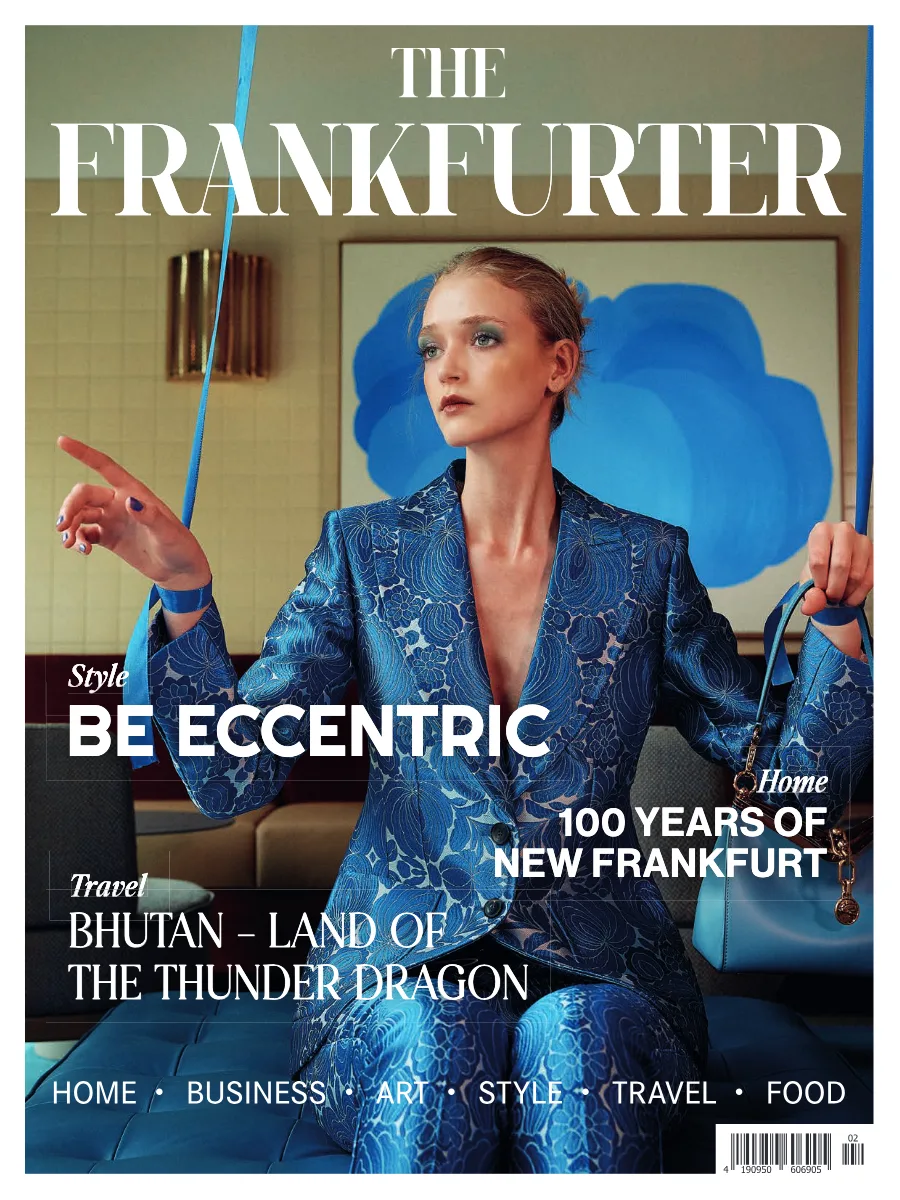
THE FRANKFURTER Magazine
Travel
HomeHomeHome
100 YEARS OF
NEW FRANKFURT
StyleStyleStyle
BE ECCENTRIC
TravelTravel
BHUTAN – LAND OFBHUTAN – LAND OF
THE THUNDER DRAGONTHE THUNDER DRAGON
4
Die 1. Oldtimer-Rallye
zwischen Reben & Rhein
10.10. – 12.10.2025
Erleben Sie eine einzigartige Rallye voller Fahrkultur, kulinarischer
Höhepunkte und handverlesener Etappen. Genießen Sie traumhafte Strecken,
exklusive Zwischenstopps und den stilvollen Austausch unter Gleichgesinnten.
Jetzt Startplatz sichern:
Scannen Sie den QR-Code und melden Sie sich
direkt zur Riverside Classics 2025 an. riverside-classics.de
Photo: Johann BindewaldPhoto: Johann Bindewald
Robin Zabler, Managing Partner & Founder
In einer Welt, die nach Anpassung verlangt, kann es eine
Herausforderung sein, die Einzigartigkeit zu bewahren.
Gleichzeitig, und das ist die gute Nachricht, ist Exzentrik,
das bewusste Anderssein, als Motor für Kreativität mehr
denn je gefragt – in Fashion, Architektur, Produktdesign
und (Küchen-)Kunst. Unsere etwas provokante Fotostrecke
ist ein Plädoyer dafür.
Einzigartig will man heute auch reisen. Bhutan heißt hier
der neue Sehnsuchtsort. Wir berichten vom Land, in dem
Glück als Staatsziel in der Verfassung verankert ist. An-
ders bauen zum Wohle vieler Menschen war das, was im
Neuen Frankfurt vor 100 Jahren Stadt und Gesellschaft
veränderte – in einer Interview-Strecke widmen wir uns
diesem spannenden Thema.
Exzentrik hat so viele bunte Facetten – genießen Sie in dieser Ausgabe einige Farben davon.
Viel Freude – und be (more) eccentric!
Ihr Robin Zabler
In a world that demands customisation, maintaining uniqueness can be a
challenge. At the same time, and this is the good news, eccentricity, consciously
being different, is more in demand than ever as a driver of creativity - in
fashion, architecture, product design and (kitchen) art. Our somewhat pro-
vocative photo series is a plea in favour of this.
Today, people also want to travel uniquely. Bhutan is the new place of longing.
We report on a country where happiness is enshrined in the constitution as
a national goal. Building differently for the benefit of many people was what
changed the city and society in New Frankfurt 100 years ago - in an interview
series, we explore this exciting topic.
Eccentricity has so many colourful facets - enjoy some of them in this issue.
Have fun - and be (more) eccentric!
Yours, Robin Zabler
Editorial
THE FRANKFURTER SHOP
Bekomme jetzt dein
Lifestyle-Magazin bequem
nach Hause geliefert!
6
7
08COVER STORY:
BE ECCENTRIC
32MUST-HAVES
32MUST-HAVES
FOOD
038 TASTE FOR THE EXTRAORDINARY
046 PEYSK: FRANKFURT BY THE SEA
BUSINESS
052 AI HUB FRANKFURT
056 @ LUNCH: ACTOR MICKY JUKOVIC
060 BEHIND THE BRAND: PIRELLI
ART
068 STEFANIE SCHNEIDER IN CALIFORNIA
074 ANNEGRET SOLTAU
078 SPOTTED: LAURA BRICHTA
STYLE
008 COVER STORY: BE ECCENTRIC
016 MONTANINI’S VIEW
018 THE FUTURE OF FASHION
026 WORLD DESIGN CAPITAL: OMC°C
032 MUST-HAVES
036 FASHION IS FREEDOM
00BELEK – PEARL OF
THE MEDITERRANEAN
Photos: CHLOÉ, Knut Wörner, Ela Excellence Resort Belek, DIOR, HEM, Sebastian Heindorff, Courtesy of Alchemist
3838TASTE FOR THE
EXTRAORDINARY
THE
FRANKFURTER
SHOP
Bekomme jetzt dein
Lifestyle-Magazin
bequem nach Hause
geliefert!
HOME
080 COPENHAGEN: 3DAYSOFDESIGN
086 INTERVIEW: 100 YEARS OF NEW FRANKFURT
TRAVEL
092 BHUTAN – LAND OF THE THUNDER DRAGON
104 BELEK – PEARL OF THE MEDITERRANEAN
114 INSIDE BAD GASTEIN
120 BADEN-BADEN
74ANNEGRET SOLTAU
126 NEWS & DATES
130 EVENTS
138 IMPRESSUM
80COPENHAGEN:
3DAYSOFDESIGN
BE
ECCENTRIC
STYLE - COVER STORY10
In a world characterized by norms, we are currently
experiencing a fascinating phenomenon: the return to
eccentricity. We are on the threshold of an era in which
being different is actually celebrated. We staged our
photo series in the new luxury lifestyle hotel Kimpton
Main Frankfurt, where a self-confident signature meets
the elegant Bauhaus era.
In a world characterized by norms, we are currently
In einer Welt, die von Normen geprägt ist, erleben wir ein
faszinierendes Phänomen: die Rückkehr zur Exzentrik. Wir
stehen an einer Schwelle zu einer Ära, in der das Anderssein
gefeiert wird. Inszeniert haben wir unsere Fotostrecke im
neuen Luxus-Lifestyle-Hotel Kimpton Main Frankfurt, in
dem eine selbstbewusste Handschrift auf die elegante
Bauhauszeit trifft.
B Y D R . J U T T A F A I L I N G
Photos by Knut Wörner
10
11
Wer bewusst den Weg des Außergewöhnlichen wählt, wer Stan-
dards hinterfragt und – möglichst ohne anderen zu schaden –
Grenzen überschreitet, ist exzentrisch. In der Geschichte wimmelt
es von solchen Persönlichkeiten. Besonders in der Kunst. Provo-
kante Werke und Lebensläufe, bei denen einem der Atem stockt. In
höchstem Maße kultiviert werden Eigenarten und eine unkonven-
tionelle Lebensführung bekanntlich in England. Das hat Tradition.
Die Brit:innen lieben ihre Exzentriker:innen. Vivienne Westwood
etwa war bekannt dafür, ihre geniale Exzentrik in gewagten Mode-
designs auszuleben. Aristokrat:innen toben sich bis heute beim
Einrichten ihrer Schlösser, Cottages und Londoner Apartments
aus und scheren sich keinen Deut darum, was andere von ihrem
eigenwilligen Stil halten. Und ja, die Brit:innen lieben schräge Auto-
mobile. Die ganz exzentrischen Modelle nennen sie übrigens
„Marmite Cars“ – wie den auf der Insel beheimateten Würzextrakt,
den man entweder liebt oder hasst. Auto-Fans aufgepasst: Mit
einem Roadster wie dem Morgan 3-Wheeler Replica steht einem
der Ruf als Exzentriker:in der alten Schule nichts mehr im Wege.
Anyone who deliberately chooses the path of the extraordinary, who
questions standards and crosses boundaries – if possible without
harming others – is deemed eccentric. History is simply teeming
with such figures. Especially in the field of art. Provocative works
and biographies that simply take your breath away. It’s a well-known
fact that idiosyncrasies and an unconventional lifestyle are culti-
vated to the highest degree in Britain. It’s a tradition. The British
are very fond of their eccentrics. Vivienne Westwood, for example,
was famous for expressing her ingenious eccentricity through her
bold fashion designs. To this day, aristocrats go wild when fur-
nishing their castles, cottages and London apartments and don’t
give a damn what others might think of their idiosyncratic style. And
yes, the Brits love quirky cars, too. Incidentally, they call very
eccentric models “marmite cars” – referring to the spread made
from concentrated yeast extract that’s native to the island and
which you either love or loathe. Car lovers take note: with a roadster
like the Morgan 3-Wheeler Replica, nothing will stand in the way
of you gaining a reputation for being an old-school eccentric.
STYLE - COVER STORY
Photos: Knut Wörner
12 STYLE - COVER STORY
Eccentricity has become democratic: Everyone is now allowed
to be eccentric. More individual, more striking and even a
little flashier. The pleasure of being different is something
everyone can enjoy. In a modern world, however, eccentricity
means far more than mere extravagance or decadence.
Eccentricity opens up surprising perspectives, whether in
design, fashion or art, and can be a social driver for greater
freedom and tolerance. The Pinakothek der Moderne in
Munich recently presented painting, sculpture, installation
art, video and design that was “outside the center” (i.e. ex
centro) in its special exhibition “Eccentric: Aesthetics of
Freedom” and broadened the view of the potential of eccen-
tricity to be an aesthetic expression of freedom. This is
based on the conviction that eccentricity is an intellectual
attitude that rejects all kinds of ideologies. Rather, it’s based
on the freedom of thought and design and so advocates
the freedom of democracy and humanism, which, in turn,
releases energies of that have the power to transform.
THE ART OF OTHERNESS
Exzentrik ist demokratisch geworden: Jede:r darf exzent-
risch sein. Einzigartiger, auffälliger und gern auch ein biss-
chen schriller. Das Vergnügen, anders zu sein, ist für alle da.
In einer modernen Welt bedeutet Exzentrik aber weit mehr
als Überspanntheit oder Dekadenz. Exzentrik eröffnet über-
raschende Perspektiven, ob beim Design, in der Mode oder
Kunst, und kann ein gesellschaftlicher Motor sein für mehr
Freiheit und Toleranz. Kürzlich zeigte die Pinakothek der
Moderne in München in der Sonderschau „Eccentric –
Ästhetik der Freiheit“ Malerei, Skulptur, Installations-
kunst, Video und Design „außerhalb der Mitte“ (ex centro)
und weitete den Blick auf das Potenzial der Exzentrik als
einer Ästhetik der Freiheit. Das fußt auf der Überzeugung,
dass Exzentrik eine intellektuelle Haltung ist, die sich Ideo-
logien jeglicher Art verweigert. Vielmehr basiere sie auf der
Freiheit des Denkens und Gestaltens und trete damit für die
Freiheit der Demokratie und des Humanismus ein, was
wiederum Energien von transformativer Kraft freisetzt.
13STYLE - COVER STORY
PRODUCTION
Check out some
insights and
behind the scenes
impressions
WHAT
WE
DO
Photo: Knut Wörner
14 STYLE - COVER STORY
„I KNOW YOU WANT IT“
Inspirierend, klug und ein Fest für das Auge war diese Münchner
Schau – und bei allem ein Ansporn für mehr persönliche und
gesellschaftliche Freigeistigkeit, insbesondere bei Themen wie
Identität, Körper, Umwelt und Humanität. Zu den Publikumslieb-
ling gehörte die Eisbärenskulptur „I know you want it“ der italie-
nischen Künstlerin Paola Pivi, die einen ausgelassenen Tanzbären
zeigt, der statt weißem Fell grell pink eingefärbte Hühnerfedern
trägt, auf einem Bein balanciert und die Tatzen ausgelassen in
die Höhe reckt. Weitere Bären im Federkleid schlagen Salti. Pivis
Bären tanzen lustvoll aus der Reihe, jede wissenschaftliche Zu-
schreibung verpufft. Hinter all dem steckt eine Botschaft: Plötz-
lich werden aus tonnenschweren Raubtieren federleicht wirken-
de empfindsame Wesen. Das Exzentrische öffnet (wieder) mehr
Perspektiven. Die Künstlerin setzt sich zusammen mit der Um-
weltorganisation Polar Bears International für den Schutz der be-
drohten Eisbären ein. In Alaska, wo sie lebt, kamen Grizzlys bis
an ihre Haustür.
This Munich show was inspiring, clever and a feast for the eyes –
as well as an incentive for more personal and social freedom, es-
pecially when it comes to topics such as identity, one’s body, the
environment and humanity. One of the public’s favorites was the
polar bear sculpture “I know you want it” by Italian artist Paola Pivi,
which shows an exuberant dancing bear covered with bright pink
chicken feathers instead of white fur, balancing on one leg and
exuberantly waving its paws in the air. Other bears in neon plumage
are doing somersaults. Pivi’s bears are dancing with relish, out of line,
no longer conforming with their usual scientific attributions. There’s
a message behind all this: Suddenly, predators that can weigh tons
transform into sensitive creatures that appear to be as light as a
feather. The eccentric opens up more perspectives (again). The artist
is working together with the environmental organization Polar
Bears International to protect endangered polar bears. In Alaska,
where she lives, grizzlies used to come right up to her front door.
1919
155
15
FOREVER BAUHAUS
Mit der Eröffnung des Kimpton Main Frankfurt positioniert sich
das Luxus-Lifestyle-Hotel als Zentrum für Kultur und Design,
inspiriert von der Bauhaus-Ikonografie. Gleichzeitig würdigt das
155-Zimmer-Haus die Designgeschichte des Nachkriegs-Frankfurt.
Das Gebäude in der Junghofstraße diente einst als Deutsche
Bank Hauptquartier. Das Brasserie-Restaurant „Anni“ ist eine ge-
stalterische Hommage an die bedeutende Bauhaus-Textilkünst-
lerin Anni Albers, im Skyline-Restaurant und in der leuchtend
blauen Hotelbar „Lazuli“ kommt zum Bauhaus ein Bohemia-Touch.
Die vielschichtige Diversität der Studierenden und Meister am
1919 in Weimar gegründeten Bauhaus muss exzentrisch ge-
wirkt haben. Gerüchte von einer Sekte machten gar die Runde.
Die Bauhaus-Bewegung setzte dazu an, die Barrieren zwischen
Kunst und Handwerk niederzureißen und die Kunst- und Archi-
tekturschule wurde bald zur Heimstätte der Avantgarde. Etwas
Neues, die Moderne Realität, begann – und wirkt bis heute fort.
Das Modell Bauhaus und der damit verbundene Perspektivwech-
sel sind selbst nach über 100 Jahren noch nicht veraltet. Radi-
kal neu formulierte man auch das Lebenskonzept fern jeglicher
Konvention. Allerdings war das Bauhaus tatsächlich weit entfernt
vom damaligen Begriff der Exzentrik. Den verband man noch eng
mit ausschweifender Geldzersplitterung und verruchter Ekstase.
The opening of the Kimpton Main Frankfurt has positioned the
luxury lifestyle hotel as a center for culture and design, one that’s
inspired by the Bauhaus iconography. At the same time, the 155-room
building pays tribute to the design history of post-war Frankfurt.
The building in Junghofstrasse once served as the headquarters of
Deutsche Bank. The design of the “Anni” brasserie is a homage to
the important Bauhaus textile artist Anni Albers, while the Skyline
restaurant and the bright blue “Lazuli” hotel bar add a bohemian
touch to the “Bauhaus” style.
The multi-layered diversity of the students and masters at the
Bauhaus, founded in Weimar in 1919, must have seemed eccentric.
It was even rumored that they were a cult! The Bauhaus movement
set out to tear down the barriers between the arts and crafts, and
the school of art and architecture soon became the home of the
avant-garde. Something new, the “Modern Reality”, began – and
continues to have an impact to this day. The Bauhaus model and
the associated change of perspective have not become outdated,
even after more than 100 years. The concept of living was also
radically reformulated, far removed from any conventions. How-
ever, the Bauhaus movement was in fact far removed from the
concept of eccentricity at the time, which was still closely asso-
ciated with debauched spending sprees and wicked ecstasy.
STYLE - COVER STORY
16
THANK YOU!
CREATIVE DIRECTION
THE FRANKFURTER
MODEL
Hannah Heise
PHOTOGRAPHER
Knut Wörner
knutwoerner.com
FASHION
ETRO Boutique, Frankfurt
HAIR & MAKEUP
Pia Valeska
LOCATION
Kimpton Main Frankfurt
IT’S A PLEASURE TO BE DIFFERENT
Anders sein darf sein. Exzentriker:innen leben glück-
licher, deutlich länger und gesünder als regelkonforme
Menschen. Das will eine Studie bewiesen haben. Man kann
es sich nur so erklären: Die Befreiung von Konventionen
und damit weniger sozialer Stress müssen eine heilsame
Wirkung haben. Exzentriker:innen seien außerdem krea-
tiver und durch ihre Neugier motivierter. In der Mode-
und Stylingbranche machen das manche zur Marke. Das
Wichtigste aber: Exzentrik ist kein Spleen und keine
psychische Störung, sondern ein Persönlichkeitsmerkmal.
Und damit lässt sich die Welt bunter, toleranter, lust-
voller und einfallsreicher machen. Alles kann, alles muss,
sagen die wahren Exzentriker:innen.
Being different is allowed. Eccentrics live happier, signifi-
cantly longer and healthier lives than people who conform
to the rules. At least, this is what a study claims to have
proven. It can only be explained as follows: Being liberated
from conventions and thus subjected to less social stress
must have a therapeutic effect. Eccentrics are also more
creative and are motivated by their curiosity. In the fashion
and styling industry, some people turn this into a brand. But
the most important thing is that eccentricity isn’t a quirk
or a mental disorder, but a personality trait. And this can
make the world more colorful, more tolerant, more fun and
more imaginative. You can do everything, you have to do
everything – as the true eccentrics say.
Photo: Knut Wörner
17
INNER FIRE COLLECTION
COPENHAGENLUCERNE BERLINPARIS NEW YORK VIENNA LONDON
Photos: Knut Wörner
18
Was ist schon normal? Das Streben nach der Norm im Nachkriegs-
deutschland war die Sehnsucht nach einer neuen Ordnung und
nach Normalität. Die Einbauküche, der Fernsehschrank, der
Schrebergarten als Maß aller Dinge.
Und heute? Die Welt scheint aus ihren Angeln gehoben. Gewohnte
Regeln gelten nicht mehr. Der Kompass kreiselt, verliert scheinbar
die Orientierung. Künstliche Intelligenz schleicht sich in unser Le-
ben und erobert Schritt für Schritt Aufgaben im Alltag, die wir tat-
sächlich gern überlassen. Wir geben Kontrolle ab zugunsten der
freien Entfaltung. Wir sollen mehr, aber wollen weniger arbeiten.
Die Balance zwischen Geld verdienen, anlegen, sparen und dem
Ausgeben, Investieren und Konsumieren wird neu justiert. Die
Schönheit des Moments scheint relevanter als die Perspektive
auf Erfolg, Wohlstand und Wohlergehen.
Der Mensch ist bei allem Streben nach Gleichheit und nach Regeln
(aus Selbstschutz) ein Individuum (aus Selbstbestimmung). Er
möchte frei sein und die Chance auf ein Anderssein wahren. Wer aus
der Norm ausbricht macht dies bewusst: in der Mode, im Lebens-
stil, bei den sozialen Kontakten. Oder sowie die Vielfalt in der Kuli-
narik, die schon länger aufregende Varia tionen zeigt. Oder die
Auswahl an exotischen Reisedestinationen.
Exaltiertheit als höchste Stufe des Anderssein symbolisiert diese
Sehnsucht nach non-konformer Verwirklichung: Eccentric Style
statt Business Chic oder Haute Couture oder New Normal. Verrückt-
heit im Ausdruck und Mut zum Anderssein sind wahrscheinlich
auch der Konterpunkt zur unsicheren Lebenswirklichkeit. Aus-
druck einer Radikalität, die wir uns sonst nicht auszuleben trauen.
Insofern darf Exzentrik gern auch als politisches Statement inter-
pretiert werden – man muss ja nicht hinsehen, wie Lady Godiva
nackt durch Coventry reitet.
Exzentrik darf aufregen, berühren und sogar schockieren. Das
erleben wir beim Swipen durch die sozialen Medien, beim Streifen
durch die großstädtischen Szenen und bei den zahlreichen Events
in Frankfurt. Nicht als Massenphänomen, sondern als individu-
ellen Ausdruck von Persönlichkeit in jeweiligen Rollen. Exzentrik
ist extrem, exotisch, hedonistisch, auch egoistisch, immer pola-
risierend – und damit auch irgendwie faszinierend. Achten Sie
mal beim Besuch der nächsten THE FRANKFURTER Release Party
oder Grand Gala darauf. Sie werden feststellen, wie bunt, wild,
schrill, anders, eben exzentrisch das Leben sein kann.
Ihr
Claudio Montanini
DEFINITELY DIFFERENT
STYLE - MONTANINI’S VIEW1818
Photo: Knut Wörner
19
Just what is normal? The striving for the norm in post-war Germany
was a yearning for a new order and normality. The fitted kitchen,
the TV cabinet, the allotment garden were the measure of all
things.
And today? The world seems to be unhinged. The usual rules no
longer apply. The compass is spinning, seemingly losing its
bearings. Artificial intelligence is creeping into our lives and
gradually conquering everyday tasks that we are, indeed, happy
to surrender. We are relinquishing control in favor of free self-
development. We’re expected to do more, but want to work
less. The balance between earning, investing and saving money
and spending, investing and consuming is being recalibrated.
The beauty of the moment seems more relevant than the actual
prospect of success, prosperity and well-being.
For all their striving for equality and rules (for reasons of self-
protection), people are individuals (for reasons of self-deter-
mination). They want to be free and preserve the possibility of
being different. Those who break out of the norm do so consciously:
with regard to fashion, lifestyle and social contacts. Or like the diver-
sity in the culinary world, which has been offering exciting variations
for some time now. Or the choice of exotic travel destinations.
Exaltation as the highest level of otherness symbolizes this
longing for non-conformist realization: eccentric style rather than
business chic, haute couture or the new normal. A bit of craziness
in the way you express yourself and the audacity to be different
probably also form a counterpoint to the uncertain reality of life.
An expression of a radicalism that we would otherwise not dare to
embody. In this respect, eccentricity can also be interpreted as a
political statement: you don’t have to actually watch Lady Godiva
ride naked through Coventry.
Eccentricity can excite, touch and even shock people. We can ex-
perience this when we swipe through social media, wander through
metropolitan streets and attend the numerous events in Frankfurt.
Not as a mass phenomenon, but as an individual expression of
personality in each respective role. Eccentricity is extreme,
exotic, hedonistic, even egotistical, always polarizing – and thus
somehow fascinating. Pay attention to this when you visit the
next THE FRANKFURTER Release Party or Grand Gala. You’ll see
just how colorful, wild, shrill, different and eccentric life can be.
Yours truly
Claudio Montanini
Owner of the communications agency PSM&W,
President of the Federal Association of Marketing
Clubs (BVMC), board member of the Cluster of
Creative Industries in Hesse (CLUK).
CLAUDIO MONTANINI
Inhaber der Kommunikationsagentur PSM&W,
Präsident Bundesverband Marketing Clubs (BVMC),
Vorstand Cluster der Kreativwirtschaft in Hessen
(CLUK).
1919STYLE - MONTANINI’S VIEW
20 STYLE - THE FUTURE OF FASHION2020
The Future
Yudai Anna Tanaka,2022
Photo: Massimo Gardone
INSPIRATION
Check out insights
and extra content
READ
MORE
STYLE - THE FUTURE OF FASHION 21
Future Faces of Fashion
of Fashion
B Y V I V I A N W E R G
ITS Contest 2025Held in the picturesque Italian town of Trieste, far from
the major fashion capitals, the annual ITS Contest brings
together the world’s most promising young talents. This
impressive event showcases how a new generation of de-
signers is conceiving, shaping, and radically redesigning
the fashion of tomorrow. Our fashion expert Vivian Werg
was there.
Im malerischen Triest, abseits der großen Fashion-Metro-
polen, versammelt der ITS Contest jährlich die vielver-
sprechendsten Nachwuchstalente der Welt. Hier zeigt
sich eindrucksvoll, wie eine neue Generation von
Designer:innen die Mode von morgen denkt, formt und
radikal neu gestaltet. Unsere Fashion-Expertin Vivian
Werg war vor Ort.
Triest selbst ist wie ein gut gehüteter Geheimtipp: Die etwa
50-minütige Fahrt vom Flughafen ins Zentrum führt vorbei an Pi-
nienhainen, eleganten Palazzi und dem schimmernden Blau der
Adria. Schon der Weg zum Hotel Savoia Excelsior lässt erahnen,
dass die kommenden Tage besonders werden. Eine salzige Brise
liegt in der Luft, das Licht fällt weich über die Uferpromenade. Am
Hafen herrscht entspannte Grandezza, auf den weitläufigen Plätzen
flanieren Menschen, umgeben von neoklassizistischer Architektur.
Einmal im Jahr wird die Stadt zum internationalen Treffpunkt der
Modewelt. Seit 2002 hat sich ITS (International Talent Support) zu
einer der bedeutendsten Plattformen für die Förderung junger De-
signtalente weltweit entwickelt. Zehn aufstrebende Kreative wer-
den jährlich ausgewählt, die den Zeitgeist ihrer Generation präzise
reflektieren. Viele von ihnen haben später Karriere bei Marken
wie Chanel, Gucci oder in der Haute Couture gemacht. Darunter
so begehrte Namen wie Matthieu Blazy, Richard Quinn und Demna
Gvasalia. Auch Jury, Beirat und Sponsoren sind eine erlesene
Riege aus Branchenprofis: von Matteo Ward, Entrepreneur, CEO
und Co-Gründer von WRAD, über Luca Rizzi, Consulting Director
bei Pitti Immagine, bis hin zum Celebrity Stylist Tom Eerebout
und Andrea Rosso, Nachhaltigkeitsbotschafter der OTB Group.
Doch neben der Frage, wer dieses Jahr besonders herausragte,
schwang auch etwas Grundsätzlicheres mit: Welche Hürden stellen
sich jungen Designer:innen heute und wie können wir sie gemein-
sam überwinden?
Trieste itself is like a well-kept secret: the roughly 50-minute drive
from the airport to the city center takes you past pine groves,
elegant palazzi and the shimmering azure of the Adriatic Sea.
Even the way to the Hotel Savoia Excelsior gives you an idea that
the days ahead will be something special. There’s a salty breeze
in the air; the light falls softly over the promenade. Laid-back
grandeur reigns at the harbor: people stroll along the spacious
squares surrounded by neoclassical architecture. Once a year,
the city is transformed into an international meeting place for the
fashion world. Since 2002, ITS (International Talent Support) has
become one of the most important platforms for the nurturing
of young design talent worldwide. Every year, ten up-and-coming
creatives who accurately reflect the zeitgeist of their generation
are selected. Many of them have gone on to have careers with
brands such as Chanel, Gucci or in haute couture. They include
such coveted names as Matthieu Blazy, Richard Quinn and Demna
Gvasalia. The jury, advisory board and sponsors also comprise
a select group of industry professionals: from Matteo Ward,
entrepreneur, CEO and co-founder of WRAD, to celebrity stylist
Tom Eerebout and Andrea Rosso, sustainability ambassador for the
OTB Group, via Luca Rizzi, Consulting Director at Pitti Immagine.
But alongside the question of who stood out this year, something
more fundamental also resonated: What hurdles do young de-
signers face today and how can we overcome them together?
22
Photo: Giovanni Aiello
“ Borderless
is how we should
feel when we
create, love,
dare or dream.”
STYLE - THE FUTURE OF FASHION
Der ITS Contest wurde von Barbara Franchin gegründet – einer
Frau mit klarem Blick, unermüdlicher Neugier, leidenschaftlicher
Hingabe und einem feinen Gespür dafür, was Mode sein kann:
Ausdruck, Haltung, Utopie. Von Anfang an ging ihre Vision über
die Idee eines klassischen Wettbewerbs hinaus. ITS sollte ein
Raum für Austausch, kreative Diversität und echte Gemeinschaft
sein. Ein Ort, an dem Offenheit, Akzeptanz und Inklusivität gelebte
Werte sind. Werte, die für sie nicht nur Haltung, sondern auch
schöpferische Kraft bedeuten. Gerade in Zeiten globaler Unsicher-
heiten sind diese Prinzipien essenziell: Sie nähren den kreativen
Geist, der radikale Ideen und neue Perspektiven hervorbringt.
Seit über zwei Jahrzehnten hat ITS zahlreiche Karrieren geprägt –
von unabhängigen Labels bis hin zu den Kreativspitzen großer
Modehäuser. Auch in diesem Jahr bleibt die Plattform diesem An-
spruch treu. Das diesjährige Motto: „Borderless“ – ein Aufruf, Gren-
zen nicht nur zu hinterfragen, sondern bewusst zu überschreiten.
„Grenzenlos, so sollten wir uns fühlen, wenn wir etwas erschaffen,
lieben, wagen oder träumen“, sagt Franchin. Kreativität, so ihre
Überzeugung, entfaltet sich genau dort, wo Begrenzungen fallen.
ITS bietet weit mehr als Sichtbarkeit: Die Finalist:innen profitieren
von Mentoring-Programmen, Stipendien, Ausstellungen in der ITS
Arcademy, Italiens erstem Museum für zeitgenössische Mode,
sowie der Chance, mit einflussreichen Persönlichkeiten und Part-
nern wie Swatch und Vogue Eyewear in Kontakt zu treten.
The ITS Contest was founded by Barbara Franchin – a woman
with a clear vision, tireless curiosity, passionate dedication
and a keen sense of what fashion can be: expression, attitude,
utopia. From the outset, her vision went beyond the mere idea
of a classic competition: ITS was to be a space for exchange,
creative diversity and genuine community. It was to be a place
where openness, acceptance and inclusivity are lived values –
values that, for her, not only represent attitude, but also
creative power. Particularly in times of global uncertainty,
these principles are essential: They nurture the creative spirit
that spawns radical ideas and new perspectives. For over two
decades, ITS has shaped numerous careers: from independent
labels to the creative heads of major fashion houses. This year,
the platform remains true to this mission. This year’s motto is
“Borderless” – a call to not only question boundaries, but to
deliberately cross them, too. “Borderless is how we should feel
when we create, love, dare or dream”, Franchin says. She is
convinced that creativity flourishes precisely where boundaries
are removed.
ITS offers much more than just visibility: Finalists benefit
from mentoring programs, scholarships, exhibitions at the ITS
Arcademy, Italy’s first museum for contemporary fashion, and
they have a chance to network with influential personalities and
partners such as Swatch and Vogue Eyewear.
Designers who dare to discrupt
ITS Contest Gründerin Barbara Franchin
2222
BARBAR A FR ANCHIN
„Grenzenlos,
so sollten wir uns
fühlen, wenn wir
etwas erschaffen,
lieben, wagen
oder träumen.“
Photo: Massimo Gardone
Für junge Designer:innen kann die Suche nach einem Mentor
oder einer Mentorin wie die nach der sprichwörtlichen Nadel im
Heuhaufen sein. Umso wichtiger seien Plattformen wie ITS, betont
Sara Sozzani Maino, Kreativdirektorin der Fondazione Sozzani
und eine der wichtigsten Stimmen in der Nachwuchsförderung.
Denn Formate wie dieses bieten nicht nur Sichtbarkeit, sondern
auch gezieltes Mentoring – beides essenziell, um den Weg in die
Branche zu ebnen. Mainos Engagement ist keine Aufgabe, sondern
Überzeugung. Was braucht es heute, um sich wirklich zu behaupten?
„Storytelling und eine klare Botschaft“, sagt sie. „Mode muss etwas
hinterlassen – Spuren oder den Wunsch nach Veränderung“. Was
sie an Talentwettbewerben besonders beeindruckt: ihre Authen-
tizität. Damit meint sie die Geschichte, die Botschaft, die sie
vermitteln wollen, die Werte und die Treue zur eigenen Vision.
Ihr Rat an junge Talente: „Seid mutig und frei. Habt keine Angst
Haltung zu zeigen, starke Werte zu vertreten und Grenzen zu
durchbrechen“. Auch Andrea Rosso bestätigt: „Kreativität kennt
keine Grenzen. Die spannendsten Designer entführen uns in an-
dere Welten“. In der Jury herrscht Einigkeit: Wer in der heutigen
Modewelt bestehen will, muss mehr bieten als Ästhetik. Mode
braucht Haltung – und eine Geschichte.
For young designers, the search for a mentor can be like looking
for the proverbial needle in a haystack. This makes platforms
such as ITS all the more important, as Sara Sozzani Maino,
Creative Director of Fondazione Sozzani and one of the most
important voices in the promotion of young talent, stresses.
After all, formats like this not only offer visibility, but also
targeted mentoring – both of which are essential to help pave
people’s way into the industry. Maino’s commitment is not a
task, but a conviction. What does it take today to really stand
out? “Storytelling and a clear message”, she replies. “Fashion
has to leave something behind – traces or the desire for change.”
What particularly impresses her about talent competitions is
their authenticity. By this she means the story, the message
they want to tell and staying true to one’s own vision. “Be bold
and free. Don´t be afraid to take a stand, to stand up for strong
values and break barriers.” Andrea Rosso agrees: "Creativity
knows no borders. The most exciting designers take us to other
worlds.” The jury is unanimous: If you want to survive in today’s
fashion world, you have to offer more than mere aesthetics.
Fashion needs attitude – and a story.
STYLE - THE FUTURE OF FASHION
Fashion needs Attitude and a Story
23
“ Be bold and free.
Don´t be afraid
to take a stand,
to stand up for
strong values and
break barriers.”
Flora Miranda, 2015
SAR A SOZZANI MAINO
„Habt keine Angst,
Haltung zu zeigen,
starke Werte zu
vertreten und Grenzen
zu durchbrechen.“
Photos: Giuliano Koren
The finalists provided some impressive examples: In his collection,
Patrick Taylor draws on childhood memories of skiing and sailing
with his family. Naya El Ahdab tells the story of her journey as a
woman with a disability. And Macy Grimshaw dedicates her
collection to the issue of Alzheimer’s disease, inspired by the
progression of her grandmother's illness. When fashion tells
stories and touches and connects people, it becomes more than
just something to wear. It becomes relevant.
Unsurprisingly, sustainability was also a central theme for all
ten ITS participants. In “Chinese Garden Journey”, Zhuen Cai
poetically combines man and nature – assisted by experimental
materials. Qianhan Liu works almost exclusively with recycled
leather, while Mijoda Dajomis deals with the collection of
rainwater in her designs. “Sustainability is no longer an option;
it’s a necessity”, says jury member Matteo Ward. And what does
he expect from the next generation? “Fashion has the power to
change behavior and habits. I would like to see designers who
inspire people and show them what fashion can do for the world.”
STYLE - THE FUTURE OF FASHION
Die Finalist:innen lieferten eindrucksvolle Beispiele: Patrick Taylor
verarbeitet in seiner Kollektion Kindheitserinnerungen ans Ski-
und Segelfahren mit der Familie. Naya El Ahdab erzählt ihren
Weg als Frau mit Behinderung. Und Macy Grimshaw widmet ihre
Kollektion dem Thema Alzheimer, inspiriert vom Krankheitsver-
lauf ihrer Großmutter. Wenn Mode berührt, erzählt und verbindet,
wird sie mehr als tragbar. Sie wird relevant.
Auch Nachhaltigkeit war, wenig überraschend, ein zentrales
Thema aller zehn ITS-Teilnehmer:innen. Zhuen Cai verbindet in
„Chinese Garden Journey“ poetisch Mensch und Natur – gestützt
durch experimentelle Materialien. Qianhan Liu arbeitet fast aus-
schließlich mit recyceltem Leder während sich Mijoda Dajomis in
ihren Entwürfen mit dem Sammeln von Regenwasser auseinan-
dersetzt. „Nachhaltigkeit ist längst keine Option mehr, sondern
eine Notwendigkeit“, bringt es Juror Matteo Ward auf den Punkt.
Und was erwartet er von der nächsten Generation? „Mode hat
die Kraft, Verhalten und Gewohnheiten zu verändern. Ich wün-
sche mir Designer und Designerinnen, die inspirieren und zeigen,
was Mode für die Welt tun kann“.
Touch and tell
Patrick Taylor Naya El Ahdab
24
Zhuen Cai
25
Ein Novum in diesem Jahr: Alle zehn Finalist:innen wurden zu
Gewinnern erklärt. Ein bewusster Schritt, der den kollaborativen
Geist von ITS unterstreicht. Statt Konkurrenz stehen kreative
Sichtbarkeit, Vielfalt und gemeinsames Weiterdenken im Mittel-
punkt. „Borderless“ ist mehr als Motto. Es ist ein Manifest für die
Überwindung kultureller und geografischer Grenzen zugunsten
neuer Ideen und inspirierender künstlerischer Kollaborationen.
„Junge Designer brauchen die Unterstützung der Branche, um zu
wachsen“, betont Barbara Franchin. „Die Herausforderungen, vor
denen sie stehen, lassen sich am besten gemeinsam meistern“.
Auch die italienische Senatorin Lucia Borgonzoni vom Kultur-
ministerium lobte das Engagement: „Es geht nicht nur um die
großen Namen wie Gucci oder Valentino. Wir müssen jungen
Talenten Raum geben, um zu glänzen.“
Parallel eröffnete die ITS Arcademy – Museum of Art in Fashion – die
Ausstellung „Fashionlands – Clothes Beyond Borders“, kuratiert
von Olivier Saillard und Emanuele Coccia. Sie stellt avantgar-
distische Entwürfe von 25 aufstrebenden Designer:innen alltäg-
lichen Kleidungsstücken gegenüber – als Einladung, Mode als Spie-
gel gesellschaftlicher Veränderung und Ausdruck individueller
Identität zu begreifen.
For the first time ever, all ten finalists were declared winners this
year. A conscious step that underlines the collaborative spirit
of ITS. Instead of competition, the focus is on creative visibility,
diversity and thinking ahead together. Borderless is more
than just a motto. It’s a manifesto for overcoming cultural and
geographical boundaries in favor of new ideas and inspiring
artistic collaborations.
“Young designers need the support of the industry in order to
grow”, Barbara Franchin points out. “The challenges they face
can best be overcome together.” Italian Senator Lucia Borgonzoni
from the Ministry of Culture also praised the commitment: “It’s
not just about the big names like Gucci or Valentino. We need to
give young talents the space to shine.”
At the same time, the ITS Arcademy – Museum of Art in Fashion –
opened the exhibition “Fashionlands – Clothes Beyond Borders,”
curated by Olivier Saillard and Emanuele Coccia. It juxtaposes
avant-garde designs by 25 up-and-coming designers with every-
day items of clothing – as an invitation to see fashion as a
mirror of social change and an expression of individual identity.
STYLE - THE FUTURE OF FASHION
United in Creativity
“Young designers
need the support
of the industry
in order to grow.”
Ausstellung „Fashionlands – Clothes Beyond Borders“
25
BARBAR A FR ANCHIN
„Junge
Designer:innen
brauchen die
Unterstützung
der Branche,
um zu wachsen.“
Photos: Massimo Gardone
26
Mit dem ITS Contest und der ITS Arcademy bietet Triest eine
Plattform, die junge Talente fördert, gesellschaftliche Fragen auf-
greift und die Modewelt herausfordert, über den Tellerrand hin-
auszublicken. In einer Zeit, in der Mode sich oft selbst genügt,
zeigt ITS mit den Nachwuchstalenten wie relevant und kraftvoll
sie sein kann – wenn sie Haltung zeigt.
Der ITS Contest 2025 war kein Wettbewerb. Er war ein Manifest
für Gemeinschaft, für Diversität, für ein Denken jenseits von
Kommerz und Konvention. Für eine Mode, die Haltung zeigt und
sich traut, unbequem zu sein. Zwischen Ausstellungen und Preis-
verleihungen wurde deutlich: Die Zukunft ist nicht nur tragbar.
Sie ist transformativ.
Als ich auf dem Weg zum Flughafen im Auto sitze, bin ich bewegt.
So viel Talent, so viel Leidenschaft, so viel echte gegenseitige
Unterstützung. Begegnungen, Gespräche, Impulse – all das gibt
Hoffnung: Dass wir nicht nur können, sondern müssen – unsere
eigene neue Realität gestalten. Ich denke an das Manifest, das die
Finalist:innen gemeinsam verfasst haben. In Reimform beschreibt
es, wie diese neue Generation von Kreativen das Paradigma der Mode
verändern will. Das „Ich“ soll zum „Wir“ werden. „Community is
more than me. Community is we. I made this, but who made me.“
With the ITS Contest and the ITS Arcademy, Trieste offers a
platform that promotes young talent, addresses social issues
and challenges the fashion world to think outside the box. At a
time when fashion is often self-contained, the ITS and its young
talents demonstrate how relevant and powerful it can be – when
it takes a firm stand.
In 2025, the ITS Contest was not a competition. It was a manifesto
for community, for diversity, for thinking beyond commerce and
convention. For a fashion that takes a stand and dares to be
awkward. Between exhibitions and award ceremonies, it became
clear that the future isn’t just wearable: It is transformative.
As I sit in the car on the way to the airport, I am deeply moved
by what I’ve seen. So much talent, so much passion, so much
genuine mutual support. Encounters, conversations, inspiration –
all this gives me hope that we not only can, but must shape our
own new reality. I think of the manifesto that the finalists wrote
collectively. In rhyming form, it describes how this new generation
of creatives wishes to change the paradigm of fashion. “I” should
become “we”. “Community is more than me. Community is we.
I made this, but who made me.”
“Community is we”
“ Community is
more than me.
Community is we.
I made this,
but who made me.”
Photos: Giuliano Koren
STYLE - THE FUTURE OF FASHION2626
ITS Finalist:innen
ITS CONTEST 2025
27STYLE - THE FUTURE OF FASHION
© Wertheim Village 2025 06/25
110 Shops und viele neue internationale Marken
Dauerhaft reduziert, nur 45 Minuten von Frankfurt entfernt
SO MUCH MORE
THAN SHOPPING
Es grünt so grün! Doch nicht nur das. Das
Frankfurter Start-up OMC°C leistet mit seinen
Projekten einen Beitrag zu den drängenden kli-
matischen Problemen unserer Städte. In un-
serer Reihe „World Design Capital Frankfurt
RheinMain“ stellen wir diesmal ganz besondere
Schatten spender vor.
Everything is so green! But that’s not all. With its
projects, the Frankfurt-based start-up OMC°C is
helping to tackle the urgent climate problems fa-
cing our cities. In our series “World Design Capital
Frankfurt RheinMain”, we take a look at some very
special ways to keep the sun off.
28 STYLE - WORLD DESIGN CAPITAL
Everything
is so
green!B Y M A R C P E S C H K E
Photos/Renderings: OMC°C
VERD° FACADE
Gesundheit, Bewegung, Mischnutzung, Nachhaltigkeit, Ökologie
und Flexibilität sollen bald, so ist die Hoffnung, im Zentrum der
Stadt der Zukunft stehen. Die Städte werden grüner sein. Es wird
mehr Wasserflächen geben. Arbeiten und Wohnen werden zusam-
menwachsen. So die Vision. Und in dieser lebenswerten urba-
nen Zukunft könnten auch die Begrünungssysteme von OMC°C,
des Frankfurter „Office for Micro Climate Cultivation“, eine wich-
tige Rolle spielen.
Dessen Idee ist substanziell: „VERD°“ ist ein bewachsenes Pflan-
zensegel, ein vertikales Begrünungssystem, das es ermöglicht,
Pflanzen großflächig in den urbanen Raum zu bringen. Ein Modul,
das schnell und unkompliziert installiert ist.
Health, exercise, mixed use, sustainability, ecology, and flexibi-
lity are all expected to be at the heart of the city of the future.
Cities will be greener. There’ll be more water areas. Working and
living will merge. At least, this is the vision. And in this livable
urban future, the greening systems developed by OMC°C, the
Frankfurt-based “Office for Micro Climate Cultivation”,could al-
so play an essential role.
Its idea is compelling: VERD° is a vegetated ‘plant sail’, a vertical
greening system that makes it possible to bring plants into the
urban space on a large scale. A module that’s quick and easy to
install.
STYLE - WORLD DESIGN CAPITAL 29
VERD° SPACE
VERD° SPACE
INSPIRATION
Check out insights
and extra content
READ
MORE
Das Interesse an begrünten Fassaden und Dachbegrünungen,
aber auch an den Pflanzensegeln von OMC°C ist groß – in Zeiten,
in denen das städtische Mikroklima ein immer dringlicheres The-
ma ist. Solche Projekte schützen Gebäude und Städte vor Über-
hitzung, fördern die Artenvielfalt, reinigen die Luft, dämmen den
Verkehrslärm und senken den Energieverbrauch.
Die Module von OMC°C spenden Schatten, wirken sich positiv auf
das Mikroklima aus und binden CO2 . Auch Fassadenanwendungen
sind möglich, die über Drahtseile getragen werden. Es sind schnell-
wachsende, einjährige Kletterpflanzen, die hier zum Einsatz kom-
men, an einer mit Netzen aus Flachs bestückten Leichtbau-
konstruktion. Diese greift kaum in den Boden ein und stellt
somit geringe Anforderungen an den Standort.
Das Konzept ist durchdacht, denn auch die Bewirtschaftung der
Pflanzensegel wird dem Kunden angeboten: Im Herbst wird die Bio-
masse aus Pflanzen und Netzen geerntet und in den Wirtschafts-
kreislauf zurückgeführt. Derzeit kann man aus etwa 25 Arten von
Kletterpflanzen wie Prunkwinde, Käseblatt oder Sternwinde mit
sehr unterschiedlichen Eigenschaften auswählen, die je nach
Standort auch kombiniert werden können. Die textilen Pflanzgefäße
werden automatisch gewässert und sind mit einem Bio-Substrat
gefüllt, womit keine weitere Düngung notwendig ist.
There’s considerable interest in green façades and green roofs,
as well as in OMC°C’s plant sails – at a time when the urban
microclimate is becoming an increasingly urgent issue. Such
projects protect buildings and cities from overheating, promote
biodiversity, clean the air, reduce traffic noise and cut energy
consumption.
The OMC°C modules provide shade, have a positive impact on
the microclimate and bind CO2 . Façade applications supported
by wire ropes are also an option. Here, fast-growing, annual
climbers are used on a lightweight structure that’s covered with
flax nets. It barely encroaches on the ground, which makes it un-
demanding as regards its location.
The whole concept is well thought out, as the company also offers
to manage the plant sails for its customers: In the fall, the bio-
mass from the plants and nets is harvested and returned to the
economic cycle. You can currently choose from around 25 types
of climbing plants such as bindweed, cheese vine or firecracker
vine with very different characteristics, which can also be combined
with each other depending on the location. The textile planters are
watered automatically and are filled with an organic substrate, so
no further fertilization is required.
CLIM BING PL A N TS
STYLE - WORLD DESIGN CAPITAL30
VERD° SPACE auf dem London Design Festival 2024
Photos/Renderings: OMC°C
Das Unternehmen hat in Alt-Bornheim seinen Sitz und wurde 2020
gegründet. Carlotta Stoll und Nicola Stattmann – die über 20 Jahre
Erfahrung in der Produktentwicklung von Industriegütern hat – sind
die Gründerinnen und Direktorinnen. Die beiden Produkt designer-
innen werden unterstützt von Sophie Oberle, Tamara Lücking und
Thea Griep. Seit dem Jahr 2023 sind Prototypen ihrer Rankmodule
hinter dem Senckenberg Museum – und im niedersächsischen
Bersenbrück – installiert. Das Projekt wurde unter anderem von
der Wirtschaftsförderung Frankfurt, dem Deutschen Wetterdienst
und der Senckenberg Gesellschaft für Naturforschung unterstützt.
„Wir haben Expert:innen aus
Architektur, Design, Inge-
nieurwesen und Botanik zu-
sammengebracht, um unse-
re Vision von einer grüneren
und biologisch vielfältigeren
Stadt zu verwirklichen“, sagt
Stattmann, die einen großen
„Bedarf nach mehr Grün in
unseren Städten“ konsta-
tiert. „Seit unserer Gründung
haben wir enormes Interesse erfahren. Unsere Vision ist es,
so viel Grün wie möglich in die Städte zu bringen, nicht nur in
Deutschland, sondern in ganz Europa.”
The company is based in Alt-Bornheim and was founded in 2020.
Carlotta Stoll and Nicola Stattmann — who have over 20 years
of experience in industrial product development — are its foun-
ders and directors. The two product designers are supported by
Sophie Oberle, Tamara Lücking, and Thea Griep. Since 2023,
prototypes of their climbing modules have been installed behind
the Senckenberg Museum and in Bersenbrück, Lower Saxony.
The project was supported by the Frankfurt Economic Develop-
ment Agency, the German Weather Service, and the Senckenberg
Society for Nature Research, among others.
“We’ve brought together ex-
perts from the spheres of
architecture, design, engi-
neering, and botany so we
can realize our vision of a
greener and more biologi-
cally diverse city”, says
Stattmann, who sees a gre-
at “need for more green
spaces in our cities.” “Since
our foundation, we’ve expe-
rienced huge interest. Our vision is to bring as much greenery as
possible into cities, not just in Germany but throughout Europe.”
Vision sowie intensive Forschung und Entwicklung haben sich ge-
lohnt, denn vor kurzem ist der Markteintritt erfolgt: Es wurden zwei
Frankfurter Rechenzentren des Unternehmens Equinix mit den
Begrünungssystemen ausgestattet, was die Energieeffizienz der
Gebäude deutlich verbessern soll. Equinix ist der erste Industrie-
partner des Start-ups, das auch von der Stadt Frankfurt unter-
stützt wird. Man kann auf dem Campus des „FR7 International
Business Exchange“ ein freistehendes Modul in Augenschein
nehmen. Und an der Fassade des „FR2.6 International Business
Exchange“ wurde ein Fassadenmodul in einer Größe von 210 Qua-
dratmetern installiert.
Die Fassadenmodule, so erklären es die Macherinnen, können bis
zu 350 Kilogramm CO2 pro Jahr speichern, was etwa der doppelten
Menge einer 80-jährigen Linde entspricht. Und gleichzeitig wird
hier in großem Maßstab Biodiversität gefördert, denn die Module
sind Nahrungsquelle für Insekten, reduzieren Feinstaub und Lärm
und produzieren auch noch Frischluft.
Their vision and intensive research and development have paid
off, as the brand has recently entered the market: Two Equinix
data centers in Frankfurt have had the greening systems installed;
they are expected to significantly improve the energy efficiency of
the buildings. Equinix is the first industrial partner of the start-up,
which is also supported by the City of Frankfurt. You can take a
look at a free-standing module on the “FR7 International Business
Exchange” campus. And a façade module measuring 210 square
meters was installed on the façade of the “FR2.6 International
Business Exchange”.
According to the makers, the façade modules can store up to 350 kg
of CO2 a year, which is approximately twice the amount of an
80-year-old lime tree. At the same time, they help to promote
biodiversity on a large scale, since the plants in the modules are
a source of food for insects, reduce fine dust and noise, and also
produce fresh air.
SENCK EN BERG M USEU M
FOOD SOU RCE FOR INSECTS
STYLE - WORLD DESIGN CAPITAL 31
Carlotta Stoll (l.) und Nicola Stattmann
Carlotta Stoll, who studied at the University for Art and Design
in Offenbach and the Oslo School of Architecture and Design,
says of the project: “After the successful testing of our prototype
last year, we’re delighted that things are finally getting off the
ground. Equinix’s trust in us and its decision to use our modules
is a big boost to our vision of bringing more greenery into urban
environments.”
At present, three versions are available: the freestanding and
flexibly expandable “VERD° SPACE” systems; the “VERD° FACADE”
modules, which can be attached to façades, even those of listed
buildings, in a modular fashion; and the smaller, also freestanding
“VERD° UNIT” version for shading small squares, schoolyards, and
daycare premises.
The interdisciplinary team consists of Malte Just from Just
Architekten; the engineering firm Bollinger + Grohmann; Wurst
Stahlbau; Dieter Gaissmayer from the organic market garden of
the same name; the Garden Culture Foundation in Illertissen, and
designer Stefan Diez with his team from Diez Office in Munich.
Together, they aim to use their innovative, modular, and scalable
product solutions to create a great deal of urban green space in
the future, acting as pragmatic players between product design
and urban planning in an ecologically challenging time with in-
creasingly hot summers, especially in cities. Their goal? To make
cities greener. And all of this was invented in Alt-Bornheim.
Carlotta Stoll, die an der Hochschule für Gestaltung Offenbach
und an der Oslo School of Architecture and Design studiert hat,
sagt über das Projekt: „Nach der erfolgreichen Erprobung unse-
res Prototyps im letzten Jahr freuen wir uns, dass es nun endlich
richtig losgeht. Dass Equinix uns sein Vertrauen schenkt und auf
die Module setzt, bestärkt uns in unserer Vision, mehr Natur ins
städtische Umfeld zu bringen.“
Aktuell werden drei Varianten angeboten, nämlich die freistehen-
den und flexibel erweiterbaren Anlagen „VERD° SPACE“, die an
Fassaden auch von denkmalgeschützten Bestandbauten ungebun-
den und modular angebrachten Module „VERD° FACADE“ sowie die
kleinere, ebenfalls freistehende Version „VERD° UNIT“ zur Ver-
schattung von kleinen Plätzen, Schulhöfen und Kita-Geländen.
Das interdisziplinär zusammenarbeitende Team besteht aus: Malte
Just von Just Architekten, das Ingenieurbüro Bollinger + Grohmann,
die Wurst Stahlbau, Dieter Gaißmayer von der gleichnamigen
Bioland-Gärtnerei, die Stiftung Gartenkultur in Illertissen und der
Designer Stefan Diez mit seinem Team von Diez Office aus München.
Zusammen wollen sie mit ihrem innovativen, modularen und ska-
lierbaren Produktlösungen zukünftig sehr viel Stadtgrün realisie-
ren, als pragmatische Akteur:innen zwischen Produktdesign und
Städtebau, in einer ökologisch immens herausfordernden Zeit
mit immer heißeren Sommern vor allem in den Städten. Ihr Ziel:
mehr Natur in der Stadt. Und das alles: erfunden in Alt-Bornheim.
IN V EN TED IN A LT-BOR N H EIM
32
VERD° UNIT Der erste VERD° Prototyp im Innenhof des Senckenberg Instituts, Frankfurt
Photos/Renderings: OMC°C
STYLE - WORLD DESIGN CAPITAL
33
at Sea
LOST Ein Hauch von Meer: Klassische Codes neu interpretiert
und nautische Farbspiele zeigen sich im stilvollen Mix aus
zeitloser Raffinesse und moderner Leichtigkeit.
Bracelet, LIÉ STUDIO,
www.lie-studio.com
Lipstick, NARS,
www.narscosmetics.de
Denim Shorts, TEURN,
www.teurnstudios.com
Bag, PLAN C,
www.plan-c.com
GIORGIO ARMANI MARE 2025
Photo: Vito Fernicola
Sandals, ECOALF,
www.ecoalf.com
Hat, ARKET, www.arket.com
Repairing Face Mask, LE RUB,
www.lerub.com
Breton Shirt, ARMEDANGELS,
www.armedangels.com
Bag charm, LOEWE,
www.loewe.com
Bathing Suit, FILIPPA K,
www.filippa-k.com
Dress, MSGM,
www.shop-msgm.com
zeitloser Raffinesse und moderner Leichtigkeit.
www.narscosmetics.de
Bathing Suit, FILIPPA K
www.filippa-k.com
LIÉ STUDIO,
www.lie-studio.com
ARMEDANGELS,
www.armedangels.com
Sunglasses, ALAÏA,
www.maison-alaia.com
34 STYLE - MUST HAVES
Photos: Hersteller
STYLE - MUST HAVES
Shades
SUNSET Von Sonnengelb über spritziges Vitamin C bis hin
zu satten Tomatentönen – der Sommer 2025 strahlt
in stimmungsaufhellenden Sonnentönen.
Eyeshadow, NARS,
www.narscosmeti cs.deBlush & Glow Duo Stick,
KESS BERLIN,
www.kessberlin.de
Hand-Carry Case, RIMOWA,
www.rimowa.com
Clogs, SCHOLL x PHILOSOPHY,
www.scholl-shoes.com
SPRING/ SUMMER 2025 RTW
ETRO, MIU MIU, LACOSTE
City Guides, LOUIS VUITTON,
www.louisvuitton.com
Polo Longsleeve, CLOSED,
www.closed.com
Shirt, MAX MARA,
www.maxmara.com
Dress, PLAN C,
www.plan-c.com
Denim Shorts, FILIPPA K,
www.filippa-k.com
Blanket, HERMÈS,
www.hermes.com
Bag, DIOR,
www.dior.com
Leather Pouch, LOEWE PAULA´S IBIZA,
www.loewe.com
Sunglasses, CHLOÉ,
www.chloe.com
www.filippa-k.com
35
Knits
SUMMER
Der weiche Sommerstrick ist wunderbar wandelbar und
verleiht jedem Outfit eine elegante, aber lässige Note.
Sandals, HERMÈS,
www.hermes.com
Belt, DIOR, www.dior.com
Knit Sweater, MSGM,
www.shop-msgm.com
Spring/ Summer 2025 RTW
DIOR, HERMÈS
Knit Sweater, THE ROW,
www.mrporter.com
Opti cal frame, BOSS,
www.hugoboss.com
Vest, MARNI,
www.mrporter.com
Trousers, FILIPPA K,
www.filippa-k.com
Scented Candle, LOEWE,
www.perfumesloewe.com
Wallet, MARNI,
www.marni.com
Watch, LOUIS VUITTON,
www.louisvuitton.com
MSGM,
www.shop-msgm.com
Shorts, FILIPPA K,
www.filippa-k.com
Knit Sweater, THE ROW
www.perfumesloewe.com
www.mrporter.com
LOUIS VUITTON
Belt,Belt, DIORDIOR
Spring/ Summer 2025 RTW
DIOR, HERMÈS
Wallet,Wallet, MARNIMARNI
www.marni.com
Photos: Hersteller
36 STYLE - MUST HAVES
STYLE - MUST HAVES
Breezy
EASY
Ikonische Designklassiker in unbeschwerter Perfektion:
bequeme Texturen und klare Linien, die nie zu kompliziert werden.
Spring/Summer 2025 RTW
HERMÈS
Skateboard, HERMÈS,
www.hermes.com
Polo Shirt, FILIPPA K,
www.filippa-k.com Pen, MONTBLANC,
www.montblanc.com
Oversized Shirt, THE ROW,
www.mrporter.com
Shorts, AMOMENTO,
www.mrporter.com
Sandals, JIMMY CHOO,
www.jimmychoo.com
Bag, LOUIS VUITTON,
www.louisvuitton.com
Bracelet, DIOR,
www.dior.com
Sunglasses,
OLIVER PEOPLES x ROGER FEDERER,
www.oliverpeoples.com
Soap, MATIERE PREMIERE,
www.matiere-premiere.com
Apple Watch, HERMÈS,
www.hermes.com
37
38
Exzentrische Designs und Accessoi-
res lassen sich leicht in den Alltag
integrieren – und sind, wie Personal
Shopper Anderson Junghans weiß,
eine Art von Freiheit. In Wertheim
Village berät der Brasilianer Kund:-
innen, die ihren Stil authentisch
unterstreichen möchten und das
auch gern mal mit mutigen Ele-
menten. Im Gespräch verrät er uns
auch gleich Packing-Hacks für die
nächste Reise.
BECAUSE
FASHION IS
FREEDOM
Wertheim Village
PRODUCTION
Check out some
insights and
behind the scenes
impressions
WHAT
WE
DO
STYLE - FASHION IS FREEDOM
„ Don’t be afraid
to be eccentric.“
Anderson Junghans,
Personal Shopper Wertheim Village
39
Photos: WERTHEIM VILLAGE
„Ein Steamer hilft enorm. Durch den Dampf werden
die Textilien aufgefrischt und geglättet. Unkompliziert
sind Seidenstoffe und solche aus luxuriösem Poly-
ester. Hier hängen sich die Falten leicht raus.“ Außer-
dem: Seidenpapier verwenden und die Kleidung rollen
statt falten. „Ich reise im Flieger meist mit Hand-
gepäck und wähle wenige zeitlose Stücke, die sich
bestens kombinieren lassen“, so Junghans. Slides und
Sandalen, die tagsüber sowie abends funktionieren,
empfiehlt er für Strandurlaube.
NEW IN THE VILLAGE
Veränderungen gibt es auch im Village. So präsentiert
sich ab Spätsommer das Restaurant „La Piazza“ mit
neuem Interior und Karte. Geöffnet haben bereits der
„Saigon Social Club“ mit vietnamesischer Streetstyle
Küche und der Barista-Spot „Gardens Café“, in dem
immer donnerstags Sunset DJ-Vibes, Tattoo Artists
oder Barista Workshops das Shoppingerlebnis im
Village abrunden.
THE ART TO BE DIFFERENT
Kund:innen finden in den Village-Boutiquen eine
große Auswahl an Essentials, It-Pieces und Lieblings-
marken. Anderson Junghans hilft ihnen, die individu-
ellen Vorlieben, die favorisierten Farben und Brands
für stylische Looks zusammenzustellen: „Wir haben
im Village einige Brands, in deren Kollektionen sich
subtile bis offene Exzentrik widerspiegelt, etwa
Versace oder das französische Label Zadig & Voltaire.
Auch Diesel ist bekannt für seinen provokanteren
Look.“ Exzentrik geht immer: „Schon kleine Acces-
soires können die ganze Idee eines Outfits ändern.
Schuhe in Gold oder Metallic zu einem komplett
schwarzen Outfit beispielsweise. Mit einer Vintage-
Brosche, Handtasche oder auffallenden Sneakers ist
dieser Twist ebenfalls da.“
PACKING-HACKS
Personal Shopper Anderson Junghans kennt die
Tricks, wie Kleidung auch auf Reisen knitterfrei bleibt.
Anderson Junghans war lange in der internationalen
Modeindustrie tätig und arbeitete für ein promi-
nentes italienisches High End-Label. Seine Expertise
im Luxus-Segment ist in Wertheim Village gefragt,
wo nahe Frankfurt über 110 Boutiquen deutsche und
internationale Luxusmarken mit Ersparnissen von
bis zu 60 Prozent auf den Originalpreis bieten. „Ich
bin Brasilianer. Wir leben eine gewisse Exzentrik
aus, das ist typisch für uns“, lacht er, und erklärt:
„Bei exzentrischer Fashion, die sich sichtbar mehr
Freiheiten herausnimmt, geht es vor allem darum,
der eigenen Persönlichkeit treu zu bleiben. Man
kann zeigen, wie man sich fühlt und wer man ist.
Und das ist keine Frage des Alters.“
Anderson Junghans, Personal Shopper Wertheim Village
Photo: Søren Gammelmark
40 FOOD - TASTE FOR THE EXTRAORDINARY40
ExtraordinaryB Y V I V I A N W E R G
TASTE FOR THE
ALCHEMIST, Copenhagen
40
FOOD - TASTE FOR THE EXTRAORDINARY 4141
MORE THAN A MEAL
WAS WÄRE, wenn ein Restaurant
mehr tut, als nur zu servieren – wenn es Geschichten
erzählt? THE FRANKFURTER geht auf eine Reise zu
einigen der ungewöhnlichsten Tischen der Welt:
dorthin, wo Kulinarik und inszenierter Raum zum
unvergesslichen Erlebnis werden.
WHAT IF a restaurant did more than just
serve food – what if it told stories, too? Let THE
FRANKFURTER take you on a journey to some of
the most unusual tables in the world, to places
where culinary delights and staged spaces unite
to form an unforgettable experience.
Kein klassisch gedeckter Tisch, keine vorhersehbare Choreogra-
fie aus Gängen. Manchmal beginnt eine außergewöhnliche Mahl-
zeit nicht mit dem ersten Bissen – sondern mit dem Raum. Mit
Licht. Mit der Geschichte, die erzählt wird, noch bevor ein Teller
den Tisch berührt. Überall auf der Welt entstehen Orte, an de-
nen Kulinarik nicht mehr für sich alleinsteht, sondern Teil einer
größeren Erzählung wird. In den Metropolen des Nordens, auf La-
vagestein, unter Wasserkuppeln oder hinter diskret polierten Tü-
ren entstehen Konzepte, die sich jeder Schublade entziehen. Mal
radikal reduziert, mal opulent inszeniert. Sie alle nähren mehr als
den Appetit. Was sie eint, ist der Wille, Erwartungen zu verschie-
ben – und „Esskultur“ wörtlich neu zu denken.
No classically laid tables, no predictable choreography of courses.
Sometimes an extraordinary meal doesn’t begin with the first bite:
it begins with the room. With light. With the story that is told even
before a plate actually touches the table. All over the world, places
are emerging where cuisine no longer stands alone, but becomes
part of some larger narrative. In the metropolises of the north, on
lava rock, under water domes or behind discreetly polished doors,
concepts that defy any attempt at pigeonholing are being created.
Sometimes radically pared down, at other times opulently staged.
They all nourish more than just your appetite. What unites them
is the will to shift expectations – and to literally rethink “food
culture”.
41
INSPIRATION
Check out insights
and extra content
READ
MORE
FOOD - TASTE FOR THE EXTRAORDINARY4242
A TASTE OF THE EARTH’S CORE:
EL DIABLO, LANZAROTE
Mitten in der surrealen Vulkanlandschaft des Timanfaya-Natio-
nalparks auf Lanzarote, steht ein Restaurant, in dem Naturge-
walt und Kulinarik eindrucksvoll verschmelzen: „El Diablo“ (Der
Teufel). Der ikonische Rundbau thront direkt über einem akti-
ven Vulkanschlot – und genau dort wird auch gekocht. In den
1970er-Jahren vom Künstler César Manrique entworfen, ist das
Restaurant eine architektonische Hommage an die rohe Energie
der Insel. Durch bodentiefe Panoramafenster fällt der Blick auf
eine Landschaft wie aus einer anderen Welt: endlose Lavafelder,
ockerfarbene Hügel – und überall die spürbare Präsenz des Feu-
ers unter der Oberfläche. Das Herzstück: ein vulkanischer Grill.
Über einem 400 Grad heißen Erdloch garen Fleisch, Fisch und
Gemüse, allein mit der Hitze des Erdinneren – ganz ohne Strom
oder Flamme. Gästen bietet sich die Gelegenheit, kanarische
Spezialitäten zu kosten, die auf eine weltweit einzigartige Weise
zubereitet werden. Ein Erlebnis, so ursprünglich und spektakulär
wie die Insel selbst.
In the midst of the surreal volcanic landscape of the Timanfaya
National Park on Lanzarote, there’s a restaurant where the mighty
power of nature and culinary delights merge impressively: “El
Diablo” (The Devil). The iconic round building is enthroned directly
above an active volcanic vent – and that’s precisely where the
cooking takes place. Designed by artist César Manrique in the
1970s, the restaurant is an architectural homage to the raw energy
of the island. Floor-to-ceiling panoramic windows offer a view of
a landscape that looks like it’s from another world: endless lava
fields, ochre hills – and everywhere there’s the palpable presence
of fire just beneath the surface. The centerpiece: a volcanic grill.
Meat, fish and vegetables are cooked over a 400-degree hole
in the ground using only the heat from the earth’s interior – no
electricity or flames required. Guests have the chance to sample
Canarian specialties prepared in a way that’s unlike anything else
in the world. An experience that’s as authentic and spectacular as
the island itself.
01
42
Photo: Alejandro Acuña/CACT Lanzarote
43
02
43FOOD - TASTE FOR THE EXTRAORDINARY
HEART OF THE OCEAN:
IRIS, ROSENDAL /NORWAY
Das „Iris“ ist kein Restaurant, das man zufällig entdeckt. Wer hier
speisen will, muss es wirklich wollen – und aufbrechen zu einer
Reise, die selbst schon Teil des Gesamterlebnisses ist. Nur mit
dem Boot erreichbar, führt der Weg über spiegelglattes Wasser,
vorbei an Berghängen und dichten Wäldern. Am Ende gleitet das
Boot auf eine glänzende Stahlkugel zu: das Salmon Eye. Eine der
größten begehbaren schwimmenden Kunstinstallationen der Welt
und zugleich ein kraftvolles Symbol für nachhaltige Meeresfrüchte.
In seinem Inneren: eines der außergewöhnlichsten Restaurants
Europas. Im kleinen Ort Rosendal an Norwegens Westküste, zieht
das „Iris“ trotz seiner Abgeschiedenheit, Gäste aus aller Welt an.
Gekocht wird im Takt der Küste, im Rhythmus der Natur. Die Speise-
karte liest sich wie eine Erzählung über die Herausforderungen
und Chancen unseres globalen Ernährungssystems. Küchenchefin
Anika Madsen bringt ein Konzept auf den Teller, das dem norwe-
gischen Meer gewidmet ist: Algen, Muscheln, Wildfang – lokal,
saisonal, radikal nachhaltig. Doch es ist mehr als ein Restaurant.
Es geht um ein sinnliches und intellektuelles Erlebnis, das weit
über den Teller hinausreicht. Zwischen den Gängen sprechen die
Gastgeber über Überfischung, Ernährung der Zukunft und neue
Wege der Zusammenarbeit mit der Natur. Durch die gläserne Ar-
chitektur öffnet sich der Blick aufs Wasser, Wind und Meer und
macht so deutlich, worum es hier geht: die Symbiose zwischen
Mensch, Natur – und Teller. Ein Besuch ist eine Einladung, die
Natur zu sehen, zu schmecken und neu zu verstehen.
The “Iris” is not a restaurant that you come across by chance.
If you want to dine here, you really have to want to – and set off
on a journey that is itself part of the overall experience. Only
accessible by boat, the path leads over water that’s as smooth
as glass, and past mountain slopes and dense forests. At the
end, the boat glides toward a shiny steel ball: the “Salmon Eye”.
It’s one of the largest walk-in floating art installations in the
world and a powerful symbol for sustainable seafood. Inside,
it houses one of Europe’s most extraordinary restaurants. In
the small town of Rosendal on Norway’s west coast, the “Iris”
attracts guests from all over the world, despite its remote
location. Cooking is done in time with the coast and the rhythm
of nature. The menu reads like a narrative about the challenges
and opportunities facing our global food system. Chef Anika
Madsen brings a concept to the plate that is dedicated to the
Norwegian sea: seaweed, mussels, wild catch – local, seasonal,
and radically sustainable. But it’s more than just a restaurant.
It’s also a sensual and intellectual experience that goes far
beyond the plate. Between courses, the hosts discuss over-
fishing, the future of food, and new ways of working with nature.
The glass architecture opens up a view of the water, wind, and
sea, making it clear what this place is all about: the symbiosis
between people, nature, and food. A visit is an invitation to see,
taste, and understand nature in a totally new way.
Photos: Tobias Lamberg Torjusen
44 FOOD - TASTE FOR THE EXTRAORDINARY44
DREAMSCAPE OF IDEAS:
ALCHEMIST, COPENHAGEN
Hinter schweren Bronzetüren in einem ehemaligen Theaterlager-
haus im Kopenhagener Industrieviertel Refshaleøen, beginnt ein
Erlebnis, das alles in Frage stellt, was man über Fine Dining zu
wissen glaubt. Das „Alchemist“ ist kein klassisches Restaurant,
sondern ein immersives Gesamtkunstwerk. Visionär und Kü-
chenchef Rasmus Munk nennt sein Konzept „Holistic Cuisine“:
eine vielschichtige Verbindung aus Gastronomie, Kunst, Musik,
Theater, Technologie und gesellschaftlichem Diskurs. Das Herz-
stück? Eine riesige Planetariumskuppel, in der rund 50 kunstvoll
inszenierte Gerichte serviert werden. Jede kulinarische Impres-
sion greift globale Themen auf – von Klimawandel über Organ-
spende bis zur Plastikverschmutzung – mal ernst, mal poetisch,
oft provokant. Jeder Gang ist ein Statement, jeder Raum eine
neue Perspektive. Gäste reisen durch den menschlichen Körper,
tauchen unter Wasser oder blicken in den Weltraum. Zwischen
den fünf Akten durchquert man interaktive Installationen, mul-
tisensorische Räume und Lounge-Bereiche, choreografiert wie
ein Bühnenstück. „Eine Mahlzeit“, so Munk, „darf nicht länger
auf Teller und Tisch begrenzt bleiben“. Essen soll Debatten an-
stoßen, Welten verbinden. Ausgezeichnet mit zwei Michelin-Ster-
ne und dem Grünen Stern für Nachhaltigkeit, ist das „Alchemist“
ein Ort, an dem Geschmack, Ethik und Ästhetik gleichberechtigt
nebeneinanderstehen. Pro Abend erleben nur 52 Gäste dieses
bis zu sechs Stunden dauernde Spektakel. Tickets sind rar und
werden nur viermal im Jahr vergeben.
Behind heavy bronze doors in a former theater warehouse in
Copenhagen’s industrial district of Refshaleøen, an experience
begins that challenges everything you think you know about
fine dining. The “Alchemist” is not a classic restaurant, but an
immersive work of art. Visionary chef Rasmus Munk calls his
concept “Holistic Cuisine”: a multi-layered combination of
gastronomy, art, music, theater, technology and social discourse.
At the heart of it all? A huge planetarium dome in which around
50 artfully staged dishes are served. Each culinary impression
addresses global issues – from climate change to organ do-
nation and plastic pollution – sometimes seriously, sometimes
poetically, often provocatively. Every course is a statement,
every room a new perspective. Guests travel through the human
body, dive under water or gaze into space. Between the five
acts, you pass through interactive installations, multi-sensory
rooms and lounge areas, all choreographed like a stage play. “A
meal”, Munk says, “should no longer be limited to a plate and a
table.” Food should spark debate and connect worlds. Awarded
two Michelin stars and the Green Star for sustainability, the
“Alchemist” is a place where taste, ethics and aesthetics are
on an equal footing. Only 52 guests per evening experience this
spectacle, which lasts up to six hours. Tickets are rare and only
released four times a year.
03Photos: Courtesy of Alchemist, Daniel Jensen
45
04 45
ARCHITECTURE OF TASTE:
BRUTALISTEN, STOCKHOLM
Was einst als Pop-Up in Los Angeles und Stockholm begann, hat
heute ein festes Zuhause in Schwedens Hauptstadt: „Brutalis-
ten“. Ein Ort, der Essen nicht inszeniert, sondern dekonstruiert.
Der Name ist Programm: Inspiriert von der radikalen Klarheit
brutalistischer Architektur steht hier eine Philosophie im Zent-
rum, die ebenso kompromisslos ist wie ihr geistiger Vater, der
Künstler und Mitgründer Carsten Höller. Die oberste Regel: Je-
des Gericht basiert auf einer einzigen Zutat. Erlaubt sind ledig-
lich Wasser und Salz. In der orthodoxen Variante nicht einmal
das. Was daraus entsteht ist eine präzise Auseinandersetzung
mit Geschmack, Textur und Wahrheit auf dem Teller. Die beiden
Degustationsmenüs „Brutal“ und „Total Brutal“ führen durch eine
Landschaft puristischer Intensität: Fisch aus nachhaltigem Lei-
nenfang, handverlesene Schalentiere, Fleisch aus ganzheitlicher
Haltung und saisonales Bio-Gemüse. Nichts wird kombiniert, al-
les steht für sich. Ein Produkt – vielfach transformiert. Aufwendi-
ge Techniken sind erlaubt, Dekoration nicht. Verwendet werden
oft übersehene, schwer erhältliche oder üblicherweise aussor-
tierte Zutaten. Serviert wird alles gleichzeitig, doch wie gegessen
wird, entscheidet der Gast. Kein Gang diktiert den Ablauf – der
Geschmack entsteht im Kopf. Statt dirigierter Geschmackscho-
reografie: Freiheit. Statt Inszenierung: Konzentration. Statt Spek-
takel: Erkenntnis. In einer Zeit kulinarischer Reizüberflutung wirkt
dieses Restaurant wie ein meditatives Gegenmodell. Eine Büh-
ne für Maximal-Minimalismus. Ein Ort für radikale Feinschme-
cker:innen, stille Rebell:innen – und für alle, die bereit sind, sich
auf das Wesentliche zurückzubesinnen.
What once began as a pop-up in Los Angeles and Stockholm now
has a permanent home in Sweden’s capital: “Brutalisten”. It’s
a place that doesn’t stage food, but deconstructs it. Its name
says it all: Inspired by the radical clarity of brutalist archi-
tecture, the focus here is on a philosophy that is just as un-
compromising as its spiritual father, artist and co-founder
Carsten Höller. The number one rule is that every dish is based
on a single ingredient. Only water and salt are allowed. And not
even that in the Orthodox version. The result is a precise ex-
ploration of taste, texture and truth on the plate. The two tasting
menus “Brutal” and “Total Brutal” take you through a landscape
of purist intensity: fish from sustainable line-catching, hand-
picked shellfish, meat from holistic husbandry and seasonal
organic vegetables. Nothing is combined; everything stands on
its own. One product – transformed many times over. Elaborate
techniques are allowed, but decoration isn’t. Often overlooked,
hard-to-get or usually discarded ingredients are used. Every-
thing is served at the same time, but it’s the guest who decides
how to eat it. No course dictates the sequence: The taste is
created in each guest’s mind. In place of orchestrated taste
choreography: freedom. Instead of staging: concentration. In
place of spectacle: insight. In a time of culinary sensory overload,
this restaurant acts as a meditative antidote. As a stage for
maximum minimalism. As a place for radical gourmets, quiet
rebels – and for everyone who’s ready to get back to basics.
04 45
Photos: Courtesy of Brutalisten
FOOD - TASTE FOR THE EXTRAORDINARY
46 FOOD - TASTE FOR THE EXTRAORDINARY46
TRATTORIA CON MOLTO AMORE:
COCCODRILLO, BERLIN
Mitten im grünen Weinbergspark findet man das „Coccodrillo“ –
eine Trattoria, die aussieht, als hätte Federico Fellini sie höchst-
persönlich erträumt. Zwischen nostalgischem 60er-Jahre Flair
und futuristischem Space Age-Elementen, verbindet dieser char-
mante Ort italienische Eleganz mit mediterraner Leichtigkeit. Ge-
staltet vom hauseigenen Studio Kiki aus London, versprüht das
Interieur einen lebensbejahenden Maximalismus: rote Samtbän-
ke, scharlachrote Wände, Fiorucci-Poster, Zebra-Teppiche, Neon-
kunst und Porzellantiger – eine visuelle Ode an Italiens Glamour-
jahre. Kulinarisch gibt es italienische Klassiker mit kreativem
Twist, aus lokalen und original italienischen Zutaten. Ein Favorit
des Hauses: die hausgemachten Ravioli ai tre formaggi, gefüllt
mit Stracchino, Ricotta al limone und Parmigiano in Butter-Sal-
bei-Sauce. Im Sommer verlagert sich das Leben auf die weit-
läufige Terrasse. Maßgefertigte Möbel erinnern an italienische
Gartenstühle der 50er-Jahre. Unter weißen Schirmen, mit einem
frisch geschüttelten „Arti-Schock Negroni“ in der Hand und dem
Nachmittagslicht im Gesicht, fühlt sich Berlin dann fast wie die
Riviera an. Hinter dem Konzept: die Big Squadra, ein kreatives
Team mit B-Corp-Zertifizierung.
In the middle of the green Weinbergspark is where you’ll find
the “Coccodrillo” – a trattoria that looks as if Federico Fellini
himself had dreamed it up. Between a nostalgic 60s atmosphere
and futuristic space-age elements, this charming place com-
bines Italian elegance with Mediterranean lightness. Designed
by the in-house interior design studio Kiki from London, the
décor exudes a life-affirming maximalism: red velvet benches,
scarlet walls, Fiorucci posters, zebra carpets, neon art and
porcelain tigers – a visual ode to Italy’s glamorous years.
Culinary delights include Italian classics with a creative twist,
made from local and original Italian ingredients. A favorite of
the house is the homemade ravioli ai tre formaggi, filled with
stracchino, ricotta al limone and parmigiano in a butter and sage
sauce. In summer, life shifts to the spacious terrace outside.
Custom-made furniture puts one in mind of Italian garden chairs
from the 1950s. Under white umbrellas, with a freshly shaken
“Arti-Schock Negroni” in your hand and the afternoon light on
your face, Berlin almost feels like the Riviera. Behind the con-
cept: the Big Squadra, a creative team with B Corp certification.
05
Photos: Jérôme Galland, Joann Pai, Joann Pai
4747
Erwarte
das
Beste
Zutritt ab 18 Jahren. Einlass nur mit gültigem Ausweisdokument.
Damit Glücksspiel nicht zur Sucht wird: Beratung unter 0800 / 137 27 00.
Spielen. Genießen. Feiern.
FRANKFURT
BYTHESEA
Photos: Muse Studios
48 FOOD - FRANKFURT BY THE SEA4848
RESTAURANT PEYSK
B Y V O L K A N B R A N D L & D I R K E I S E L
Im Frankfurter Westend schlägt ein kleines Lokal große
kulinarische Wellen: Das Restaurant „Peysk“ hat sich ganz dem
Meer verschrieben. Und das, obwohl kein einziger Tropfen See-
wasser in Sichtweite liegt.
In Frankfurt’s Westend district, there’s a small restaurant making
big waves in the culinary scene: At Restaurant “Peysk ”, it’s all
about the sea. And this, despite the fact that there’s not a single
drop of salt water in sight.
Inhaber und Küchenchef David Eisenberg
FOOD - FRANKFURT BY THE SEA 4949
FRANKFURT’S SEAFOOD GAP
49
Mit dem „Peysk“ hat sich Inhaber und Küchenchef David Eisenberg
den Traum vom ersten eigenen Restaurant erfüllt. Nach fast zwei
Jahrzehnten in internationalen Küchen, von Frankreich über London,
Singapur, Bali, Jakarta und der japanischen Hafenstadt Kanazawa,
bringt er seit September 2023 sein kulinarisches Weltwissen
unter eigener Flagge nach Frankfurt. Und wie der Name seines
Restaurants impliziert, welcher der indoeuropäischen Ur sprache
entstammt und schlicht „Fisch“ bedeutet, widmet Eisenberg sich
dabei konsequent dem Meer – und dem, was sich daraus auf fei-
ne und moderne Weise auf den Teller bringen lässt.
Den Grund dafür erläutert er wie folgt: „Ein Fischrestaurant, in
dem mit verschiedenen Garmethoden gearbeitet wird, gab es
bislang in Frankfurt nicht. Selbst gehobene Restaurants bieten
kaum Vielfalt an, in einem Menü gibt es vielleicht einen guten
Kabeljau oder Steinbutt. Und in japanischen Restaurants in der
Stadt kannst du zwar Fisch-Platten bestellen, aber das ist dann
einfach roher Fisch, Sashimi.“ Hinzu kommt Eisenbergs Begeiste-
rung für das Produkt: „Es ist für mich viel spaßiger, mit Fisch zu
arbeiten. Jeder Fisch ist ein bisschen anders, und es ist schon ein
genaueres Arbeiten erforderlich, egal bei welchem Fisch. Zum
Beispiel, wenn du eine zwei Zentimeter dicke Rotbarbe auf den
Punkt kriegen musst, diese aber gleichzeitig crispy sein soll.“
When he opened “Peysk”, owner and head chef David Eisenberg
was fulfilling his dream of having his own restaurant. After spending
almost two decades working in various kitchens across the world,
from France, London, Singapore, Bali and Jakarta to the Japanese
port of Kanazawa, he has now brought his global culinary expertise
to Frankfurt, opening up under his own brand in September 2023.
The name of his restaurant comes from the original Indo-European
language and means simply “fish”. As is implied, Eisenberg is
focused 100% on the sea – and on the treasures it offers, which he
brings to the table in his own contemporary and refined way.
He explains his reasons as follows: “There has never been a fish
restaurant in Frankfurt that worked with a range of different cooking
methods. Even upmarket restaurants offer very little variety; in a
typical menu, you might find a good cod or a turbot. And in Japanese
restaurants in the city center, you can of course get a fish platter,
but that's just raw fish, sashimi.” Added to this is Eisenberg's huge
enthusiasm for the product itself: “It's much more fun for me to
work with fish. Every fish is a little bit different, and you need to
work very precisely, whatever type of fish you’re preparing. For
example, when you’re trying to cook a two-centimetre-thick red
mullet to perfection, yet at the same time you want it to be crispy.” INSPIRATION
Check out insights
and extra content
READ
MORE
Photos: Muse Studios
50 FOOD - FRANKFURT BY THE SEA
FISH, ELEVATED BY SKILL
Mit Fisch zu kochen, ist in der Tat eine schwierige Sache. Nicht
wenige argumentieren: Je weniger man mit ihm macht, desto bes-
ser. Mit dem richtigen Knowhow wird ist es allerdings möglich,
ein hervorragendes Produkt durch Kreativität, Technik und guten
Geschmack zum Leuchten zu bringen. Und genau hier zeigt sich
David Eisenbergs große Stärke, der bei seinen herausragenden
Kreationen japanisches Produktverständnis mit französischen und
nordischen Kochtechniken sowie südost-asiatischen und medi-
terranen Aromen verbindet. Ein fein tranchiertes Hamachi-Crudo
ergänzt Eisenberg mit einem Sud aus Gurke, Zitronengras und
Zitronenöl, begleitet von eingelegten Radieschen und Togarashi.
Jakobsmuscheln, roh als Sashimi mit Dill, Olivenöl und hausge-
machtem Yuzukosho serviert, zeigen Frische und Schärfe in per-
fekter Balance. Bonito wird auf einer Seite geflämmt, auf der an-
deren roh belassen und mit Rettichpickles, Pilzsud und einem
kräftigen Bohnenmus auf eine andere Ebene gehoben. Seeteufel
mit Kalbsbries, Kapern und Salbei erhält seinen Umami-Kick durch
eine indonesische Fleischsoße, und auch ein eher klassisch-
französisches Gericht wie Petersfisch (Saint-Pierre) mit Kartoffel-
mousseline und einer Schnecken-Cognac-Soße überzeugt durch
Handwerk und Geschmackstiefe. Die Kombination seiner weltweiten
kulinarischen Einflüsse ist für David Eisenberg dabei mehr als ein
Selbstzweck: „So großartig thailändische, indonesische, malay-
sische Aromen auch sind – mit ein bisschen Butter und gutem
Fond wird das noch viel besser. Damit bringst du den Geschmack
noch mehr raus, kannst ein wenig die Spitzen wegnehmen und es
so verfeinern.“
Cooking with fish is indeed a tricky business. Many would argue
that the less you do with it, the better. With the right know-how,
however, it’s possible to make a great product that really stands
out through creativity, the right technique and good taste. And
this is just where David Eisenberg's main strength lies. His
outstanding creations bring together a Japanese understanding
of the product with French and Nordic cooking techniques,
and flavours from Southeast Asia and the Mediterranean.
Eisenberg complements a finely sliced Hamachi crudo with
a broth of cucumber, lemongrass and lemon oil, served with
pickled radishes and a dash of togarashi. Scallops, served raw
as sashimi with dill, olive oil and house-made yuzukosho, exhibit
a perfect balance of freshness and spiciness. Bonito is flame-
seared on one side, left raw on the other, and taken to another
level with pickled radish, mushroom broth and a hearty bean
purée. Monkfish with veal sweetbreads, capers and sage gets
its umami kick from an Indonesian meat sauce, and even a more
traditional French dish such as John Dory (Saint-Pierre) with
potato mousseline and an escargot and cognac sauce wins us
over with its fine craftsmanship and depth of flavor. The way he
brings together his various culinary influences from across the
globe is more than just an end in itself for David Eisenberg: "As
great as Thai, Indonesian and Malaysian flavors are, a little butter
and a good stock can make them so much better. You bring out
the flavor even more, you can soften any harsh notes, and you
get a more refined result."
51
EVER-CHANGING IDEAS
Um seinen Gästen Fisch in bester Qualität und großer Vielfalt ohne
das Preisniveau eines Sternerestaurants anbieten zu können, kauft
Eisenberg inzwischen direkt bei Auktionen oder von den Fischern:
„Den Montagmorgen verbringe ich mit Telefonieren und gehe
durch, was gefangen wurde.“ Neben der Qualität geht er auch bei
der Nachhaltigkeit der Produkte keine Kompromisse ein: „Keine
Schleppnetze, also am besten mit Leine und Angel gefangen.“ Die
Speisekarte wechselt beinahe täglich und umfasst meist zehn bis
zwölf Positionen, darunter eine kleine Auswahl an hausgemach-
ten Pickles und Käse sowie ein Dessert: „Das Menü schreibe ich
fast immer neu kurz vor dem Service. Und die Gerichte überlege
ich, während der Fisch auseinandergenommen wird. Manchmal
sind die Soßen, die ich abschmecke und verfeinere, erst kurz, be-
vor die Gäste kommen, fertig. Alles ist sehr spontan und lebendig,
was ich aber mag.“ Die Gerichte sind dabei regelmäßig in Tapas-
Größe portioniert und zum Teilen gedacht. Durchprobieren, ent-
decken, diskutieren: ausdrücklich erwünscht.
In order to be able to offer his guests a wide variety of fish of the
very best quality, yet not at the price level of a Michelin-starred
restaurant, Eisenberg now buys directly from auctions or fisher-
men: "I spend Monday mornings on the phone, going through
what's been caught." While quality is key, he is just as committed
to ensuring the sustainability of the products and doesn’t make any
compromises in this regard: "No trawlers, ideally the fish should
be line-caught." The menu changes almost daily and usually com-
prises ten to twelve dishes, including a small selection of home-
made pickles and cheese, plus a dessert: "I almost always rewrite
the menu just before we start serving. And I plan the dishes while
the fish is being prepped. I taste and fine-tune the sauces myself,
and sometimes they aren’t ready until just a few minutes before
the guests arrive. Everything is very spontaneous and lively, and I
like that." The dishes are often served in tapas-sized portions and
intended for sharing. Trying new things, discovering and discussing
are all expressly encouraged.
51FOOD - FRANKFURT BY THE SEA
Photos: Muse Studios
52 FOOD - FRANKFURT BY THE SEA
BIODYNAMIC WINES AND LIVELY ATMOSPHERE
VERSATILE, MODERN, CREATIVE
Auch die Weinkarte des „Peysk“ ist alles andere als beliebig, um-
fasst mehr als 100 Positionen und ist ein liebevoll kuratierter Dia-
log mit der Küche. Die meisten Weine sind biodynamisch oder
naturbelassen, viele stammen von kleinen Produzent:innen, alle
stehen für Eigenständigkeit und Charakter. Die Auswahl ist per-
sönlich, stimmig und voller Entdeckungen. Die Atmosphäre im
„Peysk“ ist lebendig und gleicht eher einer Gastrobar als einem
Fine Dining-Restaurant, bei gerade einmal 20 Sitzplätzen. Große
Fenster, schlichte Holztische, keine weißen Tischdecken, kein
überbordendes Dekor. Die Gäste sitzen nah beieinander, es wird
geredet, gelacht, geteilt. Die Musik ist präsent, mal Pop-Rock, mal
Jazz, mal Soul. Im Sommer lädt eine grün abgeschirmte Außen-
terrasse zum Verweilen ein. David Eisenberg ist in seinem Res-
taurant überall und mittendrin: beim Aufnehmen der Bestellung,
der Weinberatung und beim Nachschenken. Dann wieder ruhig
und fokussiert in der offenen Küche beim Zubereiten der Gerichte.
Oft nur von einer Mitarbeitenden unterstützt, was mitunter zu
Wartezeiten führen kann.
Das „Peysk“ ist ein Glücksfall für Frankfurt. Es serviert Fisch,
wie man ihn hierzulande selten bekommt: vielseitig, modern und
kreativ. Mit seinem legeren Service-Konzept ist das Restaurant
sicherlich nicht für jede:n. Aber es ist ein Geschenk für alle, die
das Meer lieben – auch ohne es zu sehen.
Like the menu, the wine list at "Peysk" is anything but arbitrary, with
more than 100 options, creating a carefully curated dialog with the
cuisine. Most of the wines are biodynamic or made with natural
ingredients and methods; many come from smaller producers, and all
symbolize independence and character. The list is personally chosen,
well-balanced and full of new things to discover. The atmosphere in
"Peysk" is lively and it feels more like a gastrobar than a fine-dining
restaurant, with just 20 seats. Large windows, simple wooden tables,
no white tablecloths, no over-the-top decor. The guests sit huddled
together; people talk, laugh, and share. The music is part of the
experience, switching between pop-rock, jazz, and soul. In summer,
an inviting outdoor terrace shielded by greenery will make you want
to stay around a bit longer. David Eisenberg is very hands-on and al-
ways at the centre of the action in his restaurant: taking orders, giving
advice on wines and pouring it out for his guests. A moment later, he’ll
be calm and focused once again while preparing the dishes in the open
kitchen. He often has only one member of staff to help him, which can
sometimes mean guests have to wait a little for their food to arrive.
"Peysk" has been a stroke of luck for Frankfurt. Fish is served here
in a way that is rarely found in this country: with variety, modern
and creative. With its informal approach to service, the restaurant
certainly won’t suit everyone. But it’s a gift for anyone who loves
the sea – even if you can’t see it.
5252
Photos: Muse Studios
53
EXKLUSIVE MODELLE.
MIT HINGABE GEBAUT.
BAYERISCHE MOTOREN WERKE
Viele Automobile folgen einem Konzept. Wenige folgen einer Leidenschaft. Wir bauen Fahrzeuge
für Menschen, die unsere Passion teilen. Tauchen Sie ein in die Welt der BMW Oberklasse.
THE 7
Die BMW 7er Modelle überzeugen mit elegantem Design, handwerklicher Perfektion und
hochmoderner Technologie. Sie bieten erstklassigen Komfort und sind die idealen Begleiter für lange Reisen.
THE X7
Der BMW X7 besticht durch sein ausdrucksstarkes Design und ein luxuriöses Interieur.
Sein großzügiger Innenraum schafft eine Wohlfühloase für bis zu sieben Personen.
Abb. zeigt aufpreispflichtige Sonderausstattungen.
WELLER Premium GmbH
Bad Homburg ‧ OberEschbacher Str. 153
61352 Bad Homburg ‧ Tel 06172 30 900
Kronberg ‧ Frankfurter Str. 4042
61476 Kronberg ‧ Tel 06173. 99 610
54
„ Frankfurt
needs an
AI Campus“B Y M A R T I N A M E T Z N E R
Seit 2021 bringt der AI Hub Frankfurt Menschen, Unternehmen
und Politik zusammen, um Künstliche Intelligenz in der
Region zu pushen. THE FRANKFURTER sprach mit Gründer
Sebastian Heinz über die KI-Transformation im Finanzbu-
siness, die digitale Souveränität Europas und die rasante
Entwicklung der agentischen KI.
Since 2021, the AI Hub Frankfurt has been uniting peop-
le, companies and politicians with the aim of promoting
artificial intelligence in the region. THE FRANKFURTER spoke
to founder Sebastian Heinz about the AI transformation
in the fi nancial sector, Europe’s digital sovereignty and
the rapid development of agentic AI.
INSPIRATION
Check out insights
and extra content
READ
MORE
„ Frankfurt„ Frankfurt
needs anneeds an
AI Campus“AI Campus“AI Campus“
„ Frankfurt„ Frankfurt
needs anneeds an
AI Campus“AI Campus“AI Campus“
„ Frankfurt„ Frankfurt
needs anneeds an
AI Campus“AI Campus“AI Campus“
„ Frankfurt„ Frankfurt
needs anneeds an
AI Campus“AI Campus“AI Campus“
„ Frankfurt„ Frankfurt
needs anneeds an
AI Campus“AI Campus“AI Campus“
„ Frankfurt„ Frankfurt
needs anneeds an
AI Campus“AI Campus“AI Campus“
„ Frankfurt„ Frankfurt
needs anneeds an
AI Campus“AI Campus“AI Campus“
„ Frankfurt„ Frankfurt
needs anneeds an
AI Campus“AI Campus“AI Campus“
„ Frankfurt„ Frankfurt
needs anneeds an
AI Campus“AI Campus“AI Campus“
„ Frankfurt„ Frankfurt
needs anneeds an
AI Campus“AI Campus“AI Campus“
„ Frankfurt„ Frankfurt
needs anneeds an
AI Campus“AI Campus“AI Campus“
„ Frankfurt„ Frankfurt
needs anneeds an
AI Campus“AI Campus“AI Campus“
„ Frankfurt„ Frankfurt
needs anneeds an
AI Campus“AI Campus“AI Campus“
„ Frankfurt„ Frankfurt
needs anneeds an
AI Campus“AI Campus“AI Campus“
„ Frankfurt„ Frankfurt
needs anneeds an
AI Campus“AI Campus“AI Campus“AI Campus“AI Campus“AI Campus“AI Campus“AI Campus“AI Campus“
© Google DeepMind via Unsplash
55BUSINESS - AI HUB FRANKFURT
Frankfurt ist eine Finanzstadt. Technologie und
KI verortet man nicht unbedingt hier …
Sebastian Heinz: "KI macht vor keiner Industrie Halt.
Insbesondere die Branchen, die in ihrer Kernwertschöpfung digi tal
sind, werden durch KI revolutioniert. Gerade die deutschen Banken
haben es zum Großteil noch nicht wirklich geschaff t, auf den Zug
aufzuspringen. Da sind zum Beispiel die US-Banken wie Morgan
Stanley oder J.P. Morgan bereits weiter.
Bei den Rankings zur AI Adoption kom-
men deutsche Banken erst ab Platz 26."
Du hast ja auch mal in der
Bank gearbeitet …
"Ich habe Wirtschaftswissen-
schaften und Statistik in München stu-
diert und habe dann eine Weile im quan-
titativen Asset Management gearbeitet.
Da habe ich aber relativ schnell fest-
gestellt, dass das Angestelltendasein
nicht meine Zukunft ist. Nach einem
dreiviertel Jahr habe ich dann angefangen selbstständig zu
arbeiten. Zunächst im Bereich von statistischer Beratung für die
Wissenschaft. Daraus hat sich dann mein erstes Unternehmen
Statworx entwickelt – ein auf Daten und KI spezialisiertes Be-
ratungsunternehmen für die Wirtschaft."
Was waren die Beweggründe, das Netzwerk AI
Hub Frankfurt zu gründen?
"Geprägt durch meine Arbeit bei Statworx und meine
Verbundenheit zu Frankfurt habe ich mich immer gefragt: Wie
können wir Unternehmen aus der Region helfen, in das Thema
KI einzusteigen? Wie können wir hier in der Region die relevanten
Akteure zusammenbringen? Seit 2021 bieten wir Veranstaltungen,
Weiterbildung, sprechen mit Politik, Wirtschaft und Gesellschaft.
Aufgrund des großen Zuspruchs aus Wirtschaft und Politik haben
wir 2024 eine eigene Gesellschaft für den AI Hub Frankfurt ge-
gründet, die unter anderem von Partnerunternehmen wie dem
Bankhaus Metzler oder dem Pharmakonzern Merck finanziert wird
und wofür aktuell vier Personen arbeiten. Darüber hinaus veran-
stalten wir die AI Week Frankfurt, die Ende Oktober im The
Squaire am Frankfurter Flughafen stattfindet und sich nicht nur
an Professionals, sondern erstmalig auch an die breitere Öffent-
lichkeit richtet. Wir erwarten mehr als 5.000 Teilnehmende."
Frankfurt is a financial city. Technology and AI
aren’t necessarily associated with this sector.
Sebastian Heinz: “AI affects all industries and it’s
revolutionizing in particular those sectors whose main value
creation is digital. It’s primarily the German banks that have
largely failed to jump on the bandwagon. US banks such as
Morgan Stanley and J.P. Morgan, for example, are already
further ahead. When it comes to AI
adoption rankings, German banks
only come in at number 26.”
You used to work in a bank,
didn’t you?
“Yes, I studied economics
and statistics in Munich and then
I worked in quantitative asset ma-
nagement for a while. But I rea-
lized relatively early on that being
an employee wasn’t the right path
for me. After nine months, I started
working for myself. At first, in the field of statistical con-
sulting in the science sector. This led me to start my first
company Statworx – a consultancy specializing in data and
AI for business.”
What made you found the AI Hub Frankfurt
network?
“Influenced by my work at Statworx and my ties to
Frankfurt, I’ve always wondered how we can help companies
from the region enter the field of AI. How can we bring the
relevant players here in the region together? Since 2021, we’ve
been offering events and advanced training and have been tal-
king to people from the spheres of politics, business and civil
society. In response to the enthusiastic response from busi-
ness and politics, we founded our own company for the AI Hub
Frankfurt in 2024. It’s financed by partner companies such
as Bankhaus Metzler and the pharmaceutical group Merck,
among others, and currently employs four people. What’s more,
we’re organizing AI Week Frankfurt, which will be taking place
at The Squaire at Frankfurt Airport at the end of October and
is aimed not only at professionals but also, for the first time, at
the general public. We’re expecting more than 5,000 visitors.”
Sebastian Heinz ist Gründer des AI Hub
Frankfurt und Inhaber von Statworx.
Photo: Betti Klee/Mario Bella
56 BUSINESS - AI HUB FRANKFURT
Wo soll die Reise hingehen?
"Die Vision ist ein physischer KI Campus in Frankfurt,
wo alle Aktivitäten gebündelt werden. Hier können sich Unter-
nehmen und Start-ups einmieten, es wird ein KI-Trainingszentrum
geben. Da sind wir relativ schnell bei 3.000 bis 5.000 Quadrat-
metern. Andere Städte haben das schon. Zum Beispiel Merantix
in Berlin oder der Innovationspark Künstliche Intelligenz (IPAI) in
Heilbronn. In Frankfurt kommen alle relevanten Standort-Faktoren
zusammen: Rechenzentren, große Unternehmen, Kapital. Es ist
wichtig, dass wir das jetzt machen, weil es einen großen Stand-
ort-Impact haben wird, ob wir in Frankfurt KI ansiedeln oder
nicht. Mit einem KI-Zentrum kann man die gesamte KI-Transfor-
mation der Region beschleunigen."
Wo stehen wir denn insgesamt mit der Ent-
wicklung von KI?
"Wir kommen aus diesem ChatGPT-Moment von gene-
rativer KI. Damit kann man erstmalig neue synthetische Daten
erzeugen, ob das Texte, Bilder, Video, Musik sind. Dennoch muss
der Mensch den Computer noch sehr stark anleiten. Nun kommt
die agentische KI. Das sind KI-Systeme, die entweder mit nur
minimalem oder überhaupt keinem menschlichen Zutun mehr
arbeiten und eigenständig unsere Zielvorgaben verfolgen. Diese
Tools haben unter anderem die Möglichkeit, mit Drittsystemen zu
interagieren. Sie sind tief in den Systemen integriert und ermög-
lichen eine neue Art der Automatisierung."
What’s your ultimate goal?
“The idea is to have a physical AI campus in Frankfurt
where all activities are grouped together. Companies and start-
ups can rent space here and there’ll also be an AI training center.
That takes us up to 3,000 to 5,000 square meters relatively
quickly. Other cities already have this. Take Merantix in Berlin,
for example, or the Artificial Intelligence Innovation Park (IPAI)
in Heilbronn. All the relevant location factors come together in
Frankfurt: data centers, large companies, capital. It’s vital we
do this now, because whether we establish AI in Frankfurt or
not will have a major impact on the location. With an AI center,
you can accelerate the whole AI transformation of the region.”
Where do we stand overall with the develop-
ment of AI?
“We’re emerging from this ChatGPT moment of ge-
nerative AI. This allows you to create new synthetic data for
the first time, whether it's a matter of text, images, video or
music. Nevertheless, humans still have to provide a great deal
of guidance to the computer. Now it’s the turn of agentic AI.
These are AI systems that work with minimal or no human
intervention and autonomously pursue the targets we’ve set.
Among other things, these tools have the ability to interact
with third-party systems. They are deeply integrated into the
systems and enable a new kind of automation.”
© Google DeepMind via Unsplash © Google DeepMind via Unsplash
57
Fragt man sich auch als KI-Berater, welche
negative Auswirkungen KI hat?
"Es ist sehr wichtig, KI zu regulieren. Es bringt aber
nichts, das nur in Europa zu machen. Der EU AI Act ist insgesamt
betrachtet ein Innovationshemmnis. Wenn wir auf die USA schauen:
Eine der ersten Amtshandlungen von Donald Trump war, dass er
jegliche KI-Regulatorik erstmal abgeschaff t hat. Sie geben Voll-
gas. Und das ist unfassbar gefährlich, weil wir von den USA auf
technologischer Ebene extrem abhängig sind. Das hat gar nicht
so viel mit KI zu tun, sondern eher mit der Cloud, also mit IT-Infra-
struktur. Unternehmen haben in den letzten 20 Jahren entweder
Teile oder ihre gesamte IT-Infrastruktur in die US-Clouds verla-
gert. Und jetzt kommt die KI auf die Infrastruktur obendrauf, mit
der viel neue Wertschöpfung generiert werden wird. Deswegen
können wir es uns unter keinen Umständen erlauben, auch nur
einen Stundenkilometer langsamer zu fahren als die USA. Wenn
wir es nicht schaffen, hier in Europa souveräne, konkurrenzfähige
KI-Software und -Infrastruktur bereitzustellen, laufen wir in die
größte Abhängigkeit der Menschheitsgeschichte rein."
As an AI consultant, do you also ask yourself
what the negative effects of AI are?
“Regulating AI is very important. But there is no point in
only doing this in Europe. All in all, the EU AI Act is an obstacle
to innovation. Take a look at the USA, for example: One of Donald
Trump’s first acts in office was to remove all AI protections.
They’re going ahead full throttle. And that’s incredibly dange-
rous because we’re extremely dependent on the USA in terms of
technology. This has less to do with AI and more to do with the
cloud, i.e. IT infrastructure. Over the last 20 years, companies
have either moved some or all of their IT infrastructure to the
US clouds. And now AI is coming on top of all the infrastructure,
and this will generate a lot of new added value. That’s why we
can’t allow ourselves, on no account, to drive even one kilometer
per hour more slowly than the USA. If we don’t manage to provide
sovereign, competitive AI software and infrastructure here in
Europe, we’ll be walking into the greatest dependency in human
history.”
Photos: Betti Klee/Mario Bella
“Frankfurt will be a
completely different
city in 20 years –
thanks to AI.”
„Frankfurt wird
in 20 Jahren eine
komplett andere
Stadt sein – durch KI.“ THE FRANKFURTER-Autorin
Martina Metzner im Gespräch
mit Sebastian Heinz bei Statworx.
Sebastian Heinz, AI Hub Frankfurt
BUSINESS - AI HUB FRANKFURT
58
NØ
B Y D R . J U T T A F A I L I N G
In seinem jüngsten Kinofilm „Haps – Crime doesn’t pay“ gibt Schauspieler
Micky Jukovic wieder den ganz Harten. Privat hingegen steht der Frankfurter
für Bodenständigkeit und Kunstsinn. THE FRANKFURTER traf ihn in der
eleganten „Anni Brasserie“ des Boutique-Hotels Kimpton Main Frankfurt.
In his latest feature film “Haps – Crime doesn't pay” Micky Jukovic is once
again playing the tough guy. In his private life, though, the Frankfurt actor
is down-to-earth and artistic. THE FRANKFURTER met up with him in the
elegant “Anni Brasserie” at the boutique hotel Kimpton Main Frankfurt.
Photos: Nikita Kulikov
BAD
GUY
59BUSINESS - THE FRANKFURTER @ LUNCH
In seinen Filmen und am Theater strahlt Micky Jukovic eine raue
Authentizität aus. Er spielt den wilden Räuberhauptmann, oft
Gangster und böse Kerle in TV-Krimis. Löwenmähne, durchtrai-
niert und ein Bariton-Lachen, das aus tiefer Kehle kommt. Das
passt. Doch er kann auch anders. Für seine sensible Rolle im Ki-
nofilm „Als die Welle brach“ wurde er mit dem Los Angeles Film
Award ausgezeichnet. Micky Jukovic wird uns beim Interview
mehrmals überraschen.
In his films and at the theater, Micky Jukovic radiates an aura of
raw authenticity. He plays the wild robber baron, often gangsters
and bad guys in TV crime dramas. With hair like a lion's mane, he’s
buff and has a deep-throated baritone laugh. That figures. But he
can also be quite different. He won the Los Angeles Film Award for
his sensitive role in the movie “As the Wave Broke”. Micky Jukovic
will surprise us several times during our interview.
“When I arrived on the film set in Berlin, an old Stasi prison, I met
extras that had had a criminal past. Their tattoos were real”, the
actor says, recalling the shoot for the prison drama “Haps – Crime
doesn’t pay”. The film evokes
a dark and threatening atmo-
sphere, but it comes with a se-
rious message: it is intended to
discourage violence and drugs.
The soundtrack is by Frankfurt-
based rapper Azad. Jukovic plays
“Marco”, the right-hand man of
an imprisoned gangster boss.
“The most dangerous people
aren’t necessarily the six foot
tall, muscular men, but rather the
slender, inconspicuous ones”,
he states. He himself has never
been interested in violence and
drugs. His family, his younger
brothers and the middle-class
environment in Frankfurt’s Born-
heim district all had a positive influence on him. Tattoos, smoking
and hard alcohol didn’t form part of his world.
„Als ich am Filmset in Berlin ankam, es war ein ehemaliges Stasi-
Gefängnis, traf ich auf Statisten, die eine kriminelle Vergangen-
heit haben. Ihre Tattoos sind echt“, erinnert sich der Schauspieler
an den Dreh für das Gefängnis-
drama „Haps – Crime doesn’t
pay“. Der Film baut eine düstere
und bedrohliche Atmosphäre auf,
hat aber eine ernste Botschaft:
Er soll vor Gewalt und Drogen ab-
schrecken. Die Filmmusik kommt
vom Frankfurter Rapper Azad.
Jukovic spielt „Marco“, die rech-
te Hand eines inhaftierten Gangs-
terbosses. „Die Gefährlichsten
sind nicht unbedingt die Zwei-
meter-Muskelmänner, sondern
eher die Schmächtigen und Un-
scheinbaren“, glaubt er. Er selbst
habe sich nie für Gewalt und Dro-
gen interessiert. Seine Familie,
seine jüngeren Brüder, und auch
das bürgerliche Umfeld im Frankfurter Stadtteil Bornheim hätten
einen guten Einfluss auf ihn gehabt. Tattoos, Rauchen und harter
Alkohol seien nicht seine Welt.
FILMED IN PRISON
60 BUSINESS - THE FRANKFURTER @ LUNCH
ANTI-HEROES HAVE MORE FREEDOM
The acting spark was kindled when he took part in a drug aware-
ness film when still at school. From that point on, the young man
wanted to become an actor. But first he played it safe, completing a
banking traineeship, get-
ting an office job and trai-
ning in business adminis-
tration. “When we came
here to Frankfurt from the
Balkans over 30 years ago,
my child hood was over. I
had to grow up fast.” His
parents were shocked when
he started making films
and attending acting clas-
ses at the same time. No
one in his family had any
connection with acting. One
brother became an engi-
neer, the other a travel
agent. These days, his pa-
rents are proud when they
see him on the big screen.
The 45-year-old is unper-
turbed by the fact that he’s
often cast as a bad boy
or criminal: “As an anta-
gonist, you have more free-
dom and don’t have to please everyone like the
hero does; you can play dirty and explore the depths
of a character.” Of course, his spectrum is a whole lot
wider than that. He was also able to show his more
eccentric side in children’s theater at Schauspiel
Frankfurt, such as in “Krabat” or “Ronja Räuber-
tochter”. “Children are outspoken critics and don’t
mince their words, which is great. A lot of joy and
energy emanates from the audience.” In the fall, he
will play a general in the Greek classic “Lysistrata”
at the Gallus Theater – the women’s strike aimed at
bringing the men’s war to an end. The women stick
together and abstain from sex until the men can’t
take it any longer. “In this production, the men
suddenly take a liking to each other”, the actor reveals. As some-
one who can also ride a horse, he is currently in talks to appear
in a film set in the Middle Ages.
Der Funke sprang über, als er als Schüler in einem Drogen-Auf-
klärungsfilm mitspielt. Fortan will der junge Mann Schauspieler
werden. Doch erst geht er auf Nummer sicher: Banklehre, Büro-
job und eine Ausbildung zum Betriebswirt.
„Als wir vor über 30 Jahren vom Balkan
nach Frankfurt kamen, war es vorbei mit
der Kindheit. Ich musste schnell erwach-
sen werden.“ Geschockt reagierten seine
Eltern, als er parallel mit der Filmerei an-
fängt und Schauspielkurse besucht. Kei-
ner in seiner Familie hatte Berührungen
zur Schauspielerei. Ein Bruder wurde In-
genieur, der andere Reisekaufmann. Heute
seien die Eltern stolz, ihn auf der Kinolein-
wand zu sehen. Dass er oft als Bad Boy
oder Krimineller besetzt wird, sieht der
45-Jährige gelassen: „Du hast als Antago-
nist mehr Freiheiten und musst nicht allen
gefallen wie der positive Held, du kannst
dreckig spielen und in die Tiefe eines
Menschen hineingehen.“ Natürlich ist sein
Spektrum immens breiter. Auch beim Kin-
dertheater am Schauspiel Frankfurt, etwa
bei „Krabat“ oder „Ronja Räubertochter“,
konnte er seine exzentrischen Facetten be-
weisen. „Kinder sind direkte Kritiker, halten
mit ihrer Meinung nicht
hinterm Berg, was toll ist.
Da kommt viel Freude und
Energie aus dem Publi-
kum.“ Im Herbst wird er am
Gallus Theater im griechi-
schen Klassiker „Lysistrata“
einen General spielen –
der Streik der Frauen ge-
gen den Krieg der Männer.
Die Frauen halten zusam-
men und sich sexuell zu-
rück, bis es die Männer
nicht mehr aushalten. „In
dieser Inszenierung finden
plötzlich die Männer Gefallen aneinander“, verrät der Schau-
spieler. Aktuell ist er, der auch reiten kann, für einen Mittelalter-
film im Gespräch.
„ICH LIEBE
DAS GEFÜHL,
DASS DAS
HERZ RAST.“
„I LOVE
FEELING,
MY HEART
RACE.“
Micky Jukovic, Schauspieler
Photos: Nikita Kulikov
61BUSINESS - THE FRANKFURTER @ LUNCH
„Es schlug mein Herz, geschwind, zu Pferde! ... Der Abend wiegte
schon die Erde. Und an den Bergen hing die Nacht.“ Aus Jukovics
Mund kommen Goethes Worte spontan, frei und auf raue Wei-
se zauberhaft rüber. Wir sind begeistert. Goethe ist einer seiner
Lieblinge. Andere Klassiker malt er, wie
er uns erzählt. „Ich kopiere die Bilder,
die ich mir nicht leisten kann. Picasso,
Manet und Vincent van Gogh.“ Und dann
wieder eine Überraschung, passend zu
den köstlichen Austern, die uns serviert
werden – dieser Mann ist leidenschaft li-
cher Angler. Am liebsten am Main, allein,
schweigsam. „Ich habe einfach Bock auf
Raubfische, zum Beispiel den Zander.
Am besten sind aber die Bachforellen,
die schmecken ähnlich wie Lachs. Das
Angeln am Main und an den Bächen der
Wetterau und in den Tälern des Spessarts
ist für mich wie eine Therapie, wenn ich
meine Ruhe haben will. Die Fischerei ist ein Kontrast zum roten
Teppich.“ Dann zeigt er uns ein Foto von einem kapitalen Wels,
den er gefangen hat. Ein Riesenfisch, zwei Meter. Jukovics blau-
grüne Augen leuchten.
Bevor man diesen auffallenden Mann aber nur in der romantischen
Ecke verortet: Neben dem Maler und Angler gibt es auch den Ex-
tremsportler und Fitnessfreak. „Ich habe eine wilde Adrenalin-
Seite – fahre Motorrad, aber nicht schnell, und liebe das Skifahren.
Überhaupt sind actionreiche Sportarten, Fußball und Kampfsport,
mein Ding.“
Die Filmfestspiele in Cannes beginnen einige Tage nach unserem
Interview. Natürlich wird er wieder dort sein, in seinem Job ist
das fast ein Pflichttermin. Kontakte pflegen und neue knüpfen,
sich zeigen und erlesenes Autorenkino aus aller Welt anschauen.
Der Frankfurter schwärmt von den vielen inspirierenden Begeg-
nungen, die er in Cannes schon hatte, auch spontane mit Welt-
stars auf der Straße, mit denen er ins Gespräch kam. „Die großen
Stars sind meist normal und bescheiden, gar nicht unerreichbar
entfernt, wie es scheint.“
Einen Fuß in Hollywood hat der Frankfurter schon. Vielleicht, und
das ist ihm zu wünschen, holt man ihn etwas aus der Schublade
des Schurken und besetzt ihn klischeefern. So wie er mit tiefer
Stimme Goethes Verse zitiert, bekommt der alte Dichterfürst ei-
ne überraschende Wendung, die ziemlich unter die Haut geht.
The Cannes Film Festival will kick off a few days after our interview.
He’ll be attending again, of course; in his job, it’s almost obligatory
to maintain old contacts and make new ones, to see and be seen,
and to watch exquisite auteur cinema from all over the world. The
Frankfurt-based actor raves about the many inspiring encounters
he’s already had in Cannes, including spontaneous ones on the
street with international stars with whom he has struck up conver-
sations. “The big stars are, on the whole, normal and modest, not
as distant and unattainable as they might seem.”
The Frankfurt-based actor already has one foot in Hollywood.
Hopefully, he’ll no longer be typecast as a villain and will be get
roles that have nothing to do with the usual clichés. The way he
quotes Goethe’s verses in his deep voice gives the old “Prince of
Poets” a surprising twist, one that really gets under your skin.
“Quick throb’d my heart: To horse! haste, haste!... The evening
soon the world embraced, And o’er the mountains hung the
night.” Out of Jukovic’s mouth, Goethe’s words come across
spontaneously, freely and in a raw, magical way. We are en-
thralled. Goethe is one of his personal
favorites. And, as he tells us, he paints
other classics “I copy the pictures I can’t
afford. Picasso, Manet und Vincent van
Gogh.” And then there’s another sur-
prise to go with the delicious oysters
we’re served: this man is a passionate
angler. Preferably on the Main River,
all alone, in silence. “I’m just really keen
on predatory fish, like zander. But the
best fish are brown trout, which taste
similar to salmon. Fishing on the Main
River and the streams of the Wetterau
and in the valleys of the Spessart
region is like therapy for me whenever
I want some peace and quiet. Fishing is a welcome contrast to
the red carpet.” Then he shows us a photo of a huge catfish he
caught. A monster fish, two meters long. Jukovics’ blue-green
eyes shine brightly.
But before you dismiss this striking man as a romantic, remember
that he’s not just a painter and angler, but also an extreme
sports enthusiast and fitness freak. “I’m a bit of a wild adren-
aline junkie: I ride a motorcycle, but not fast, and I love skiing.
In general, action-packed sports, soccer and martial arts are
my thing.”
BIG FISH
WE SEE US IN CANNES
62
Millimeter entscheiden über Leben und Tod. Dort,
wo nur wenige Quadratzentimeter Gummi auf den
Asphalt treffen, beginnt Hochleistung auf höchs-
tem Niveau. Im südhessischen Breuberg entwickelt
Pirelli mithilfe modernster KI-Technologie Reifen,
die nicht nur zur Straße, sondern zum Fahrzeug
selbst passen – maßgeschneidert für maximale
Performance. THE FRANKFURTER durfte exklusiv
hinter die Kulissen blicken. Im Gespräch mit Wolf-
gang Meier, CEO von Pirelli Deutschland, ging es
um deutsche Ingenieurskunst, Standorttreue und
den intelligenten Reifen von morgen. Unsere An-
reise? Standesgemäß im neuen hybriden Porsche
992 Carrera GTS.
HIGH
PERFORMANCE
Millimeters can make all the difference between life
and death. High performance at the highest level
starts where just a few square centimetres of rubber
touch the asphalt. In Breuberg, in southern Hesse,
Pirelli uses state-of-the-art AI technology to develop
tires that not only perfectly suit the road, but also
the vehicle itself – tailor-made for maximum perfor-
mance. THE FRANKFURTER was granted an exclu-
sive peek behind the scenes. In conversation with
Wolfgang Meier, CEO of Pirelli Germany, we spoke
about German engineering, loyalty to a location and
the intelligent tires of tomorrow. And how did we
get there? As befits our status, in the new hybrid
Porsche 992 Carrera GTS.
PERFORMANCE
PIRELLI BREUBERG
B Y R O B I N Z A B L E R
Photos: Pirelli Deutschland, Michael Orth
63BUSINESS - BEHIND THE BRAND - PIRELLI
Die Geschichte von Pirelli reicht über 150 Jahre zurück und ist ge-
prägt von technologischem Fortschritt und Innovationserfolgen.
So ist auch dieser Weg der Mailänder vorausschauend: Während
andere Reifenhersteller in Niedriglohnländer abwandern, inves-
tiert Pirelli weiter in Deutschland und unterstreicht neben einer
jahrzehntelangen Standorttreue sein Engagement mit dem neuen
Virtual Development Center (VDC) am südhessischen Standort.
Pirelli will auch in Zukunft seinen angestammten Fokus auf die
Segmente Premium und Prestige behalten – übrigens die ein-
zigen Segmente im weltweiten Reifenmarkt, die kontinuierlich
wachsen. In Breuberg werden die Hochleistungsreifen nicht nur
hergestellt, sondern jetzt auch virtuell entwickelt und getestet –
ein Meilenstein für das Werk.
Pirelli’s history stretches back over 150 years and is one that’s
been marked by technological progress and innovative successes.
The Milan-based company is also taking a forward-looking appro-
ach: While other tire manufacturers are moving to low-wage coun-
tries, Pirelli is continuing to invest in Germany and, besides staying
loyal to the location for decades, is underlining its commitment
with its new Virtual Development Center (VDC) at the site in the
southern part of Hesse. In the future, too, Pirelli wants to main-
tain its traditional focus on the premium and prestige segments
– incidentally, the only segments in the global tire market that are
seeing steady growth. The high-performance tires are not only ma-
nufactured in Breuberg, but are now being developed and tested
virtually as well – a milestone for the plant.
ALL ROUND IN BREUBERG
Wolfgang Meier, CEO Pirelli Deutschland, beim Goodwood Festival of Speed
Pirelli Werk in Breuberg
64 BUSINESS - BEHIND THE BRAND - PIRELLI
Bei bestem Sommerwetter steuern wir unser Ziel mit dem neuen
Porsche 992.2 Carrera GTS-Hybrid an, den uns das Porsche
Zentrum Frankfurt – erneut unser Exklusiv-Partner für die THE
FRANKFURTER Grand Gala in 2026 – für die Fahrt in den Oden-
wald zur Verfügung gestellt hat. Das Fahrzeug – der erste hybride
911 – mit seinen 541 PS erleben wir als wahren Performance-
Booster: sofortige Gasannahme, dank E-Turbo ohne Turboloch – und
die Beschleunigung schlicht atemberaubend … von 0 auf 100 km/h
in 2,9 Sekunden, und damit schneller als der alte GTS und fast
auf Turbo-Niveau (V-Max: über 312 km/h). Rundum sexy: Trotz
Hybridisierung macht das Fahrzeug keine Abstriche beim Klang,
Fahrgefühl oder der Sportlichkeit. Auch auf den Landstraßen im
Odenwald lenkt das Pirelli-bereifte Fahrzeug präzise ein und be-
weist sensationelle Rückmeldung bei ultraperfektem Grip.
In perfect summer weather, we head for our destination in the
new Porsche 992.2 Carrera GTS Hybrid, which the Porsche Center
Frankfurt – once again our exclusive partner for THE FRANKFUR-
TER Grand Gala in 2026 – has made available to us for our trip to
the Odenwald Forest. The vehicle – the first hybrid 911 – has 541
hp and we found it to be a real performance booster: instant thrott-
le response, thanks to the electric turbo without any turbo lag; and
its acceleration is simply breathtaking: from 0 to 100 km/h in 2.9
seconds, faster than the old GTS and almost at turbo level (V-Max:
over 312 km/h). It’s all round sexy: Despite being a hybrid, the ve-
hicle makes no compromises in terms of sound, handling or sporti-
ness. Even on the country roads in the Odenwald mountain range,
the Pirelli-tired vehicle steers precisely and provides sensational
feedback with an ultra-perfect grip.
FIRST HYBRID 911 PORSCHE
6464
PRODUCTION
Check out some
insights and
behind the scenes
impressions
WHAT
WE
DO
65
Rubber is transformed into tires. From the raw material and qua-
lity control via vulcanization, everything in the large production
facility and across the extensive factory premises is precisely
timed: When we tour the place, we see how the individual steps all
work together as precisely as clockwork. The rubber comes from
Indonesia, but the final ingredients are kept secret. The plant’s
daily output is 12,000 tires, including ones for motorcycles. The
facility itself is in the throes of a transformation towards greater
sustainability; the aim is to be CO2-neutral by 2030, as CEO of
Pirelli Germany Wolfgang Meier underlined during our conversa-
tion afterwards. “That means going all-electric. Presses, lighting,
photovoltaics – plus less water, less waste and more awareness.
Climate neutrality isn’t a goal; it’s the path we’re choosing to take,”
says Meier, who has been working for Pirelli Germany for decades.
We had already met the passionate racing fan at the DTM finale in
Hockenheim last year. One key point on the path to greater sus-
tainability is the new Virtual Development Center, which enables
Pirelli to virtually develop and test products that don’t even exist
in reality yet. The advantages? “Thirty percent less material, thous-
ands of kilometers fewer test drives, and lower emissions. But hig-
her quality, more speed, more precision. Thinking digitally means
acting sustainably,” the expert explains.
Automatischer Transport der Reifen
Digitale Qualitätsprüfung der Pkw-Reifen
„BREUBERG IST NICHT
NUR WERK, SONDERN
LABOR FÜR MORGEN.
HIER ENTSTEHT
MOBILITÄT NEU.“
“BREUBERG ISN'T JUST A
FACTORY, IT’S A LABORATORY
FOR TOMORROW’S WORLD.
THIS IS WHERE MOBILITY
IS BEING CREATED NEW.
Wolfgang Meier, CEO Pirelli Deutschland
”
Aus Kautschuk werden Reifen. Vom Rohstoff über das Vulkani-
sieren bis hin zur Qualitätskontrolle ist alles in der großen Pro-
duktionsanlage und über das weitläufige Werksgelände exakt
durchgetaktet – bei unserem Rundgang sehen wir die einzelnen
Schritte, die zusammen so präzise wie ein Uhrwerk funktionieren.
Der Kautschuk kommt aus Indonesien, die finalen Zutaten sind
geheim. 12.000 Pneus, darunter auch Motorradreifen, sind die
Tagesleistung. Das Werk befindet sich mitten in der nachhaltigen
Transformation, bis 2030 will man CO2 -neutral sein, wie CEO Pirelli
Deutschland Wolfgang Meier bei unserem anschließenden Ge-
spräch betont. „Das heißt, konsequent elektrisch. Pressen, Be-
leuchtung, Photovoltaik – dazu weniger Wasser, weniger Abfall,
mehr Bewusstsein. Klimaneutralität ist kein Ziel – es ist der Weg,
den wir gehen“, so Meier, der seit Jahrzehnten für Pirelli Deutsch-
land arbeitet. Wir hatten den passionierten Rennsportfan bereits
im vergangenen Jahr beim DTM-Finale in Hockenheim getroffen.
Ein zentraler Punkt auf dem Nachhaltigkeitsweg ist das neue
Virtual Development Center, das es Pirelli ermöglicht, Produkte
virtuell zu entwickeln und zu testen, die es in der Realität noch
gar nicht gibt. Die Vorteile? „30 Prozent weniger Material, tau-
sende Kilometer weniger Testfahrten, weniger Emissionen. Aber
mehr Qualität, mehr Tempo, mehr Präzision. Digital denken heißt
nachhaltig handeln“, erklärt uns der Experte.
MORE SPEED, MORE SUSTAINABILITY
Photos: Johann Bindewald, Pirelli Deutschland
66
Danach dürfen wir selbst „ans Steuer“. Es ist faszinierend, was der
neue statische Fahrsimulator kann. Unter der Regie von Pirelli-
Ingenieuren setzen wir virtuelle Versionen verschiedener Fahr-
zeug- und Reifenmodelle in Bewegung. Bei unserer „Testfahrt“
spüren wir direkt, wie das Fahrverhalten durch Lenk-, Beschleuni-
gungs- und Bremsmanöver sowie Rennsituationen durch die unter-
schiedlichen Reifentypen beeinflusst wird. Im Test auch Reifen der
Pirelli „Elect“-Technologie für Elektroautos und Plug-in-Hybride.
Die speziell für Elektrofahrzeuge entwickelten Reifen – diese wiegen
mehr und verfügen über ein erhöhtes Drehmoment, auch das
hörbare Abrollgeräusch der Lauffläche ist wichtig – interessieren
uns und wir fragen Wolfgang Meier nach dem „P Zero E“, der unter
den jüngsten Innovationen von Pirelli bereits Bestnoten erntet.
Lässt sich dessen Performance mit Nachhaltigkeit wirklich in
Einklang bringen? „Für diesen Hochleistungsreifen spricht viel.
Leise. Langlebig. Nachhaltig. Über 50 Prozent der Materialien
sind zertifiziert nachhaltig. Maximale Reichweite, minimale Emis-
sionen. Der ‚P Zero E‘ ist die Zukunft – heute fahrbar“, so Meier.
After that, we’re allowed to get “behind the wheel” ourselves. It’s
fascinating to see what the new static driving simulator can actually
do. Under the direction of Pirelli engineers, we set virtual versions
of various vehicle and tire models in motion. During our “test drive,”
we can feel first-hand how driving behavior is influenced by steering,
acceleration and braking maneuvers as well as how racing situations
are influenced by the different tire types. The test also includes
Pirelli “Elect” technology tires for electric cars and plug-in hybrids.
The tires were specially developed for electric vehicles; they weigh
more and have increased torque, and the audible rolling noise of
the tread is also important. They arouse our interest and we ask
Wolfgang Meier about the “P Zero E,” which has already earned
top marks among the latest innovations from Pirelli. Can its per-
formance really be aligned with the goal of greater sustainability?
“There’s a lot to be said for this high-performance tire. Quiet.
Durable. Sustainable. Over 50 percent of the materials used are
certified sustainable. Maximum range, minimum emissions. The ‘P
Zero E’ is the future; it’s ready to drive today,” Meier says.
HIGH-TECH SIMULATION
Hightech-Reifenentwicklung: Der statische Fahrsimulator im Virtual Development Center von Pirelli Deuschland in Breuberg
67BUSINESS - BEHIND THE BRAND - PIRELLI
Reifen werden immer smarter, indem sie mit den Systemen des
Autos kommunizieren. Bei dieser vernetzten Technologie nimmt
Pirelli mit dem „Cyber Tyre“ die Poolposition ein. Dessen Senso-
ren sammeln Daten etwa zur Beschaffenheit des Untergrunds,
Temperatur und Zustand der Reifen. Diese Informationen werden
dann per Bluetooth an die Fahrzeugsysteme übermittelt. Wolfgang
Meier erklärt: „Der ‚Cyber Tyre‘ misst, analysiert und denkt mit.
Künstliche Intelligenz macht aus Daten Erkenntnis. So wird der Rei-
fen zum Sicherheitspartner – auf der Straße, in jedem Moment.“
Eine Bühne der Marke Pirelli ist das Driver Center Frankfurt an
der Hanauer Landstraße unweit der EZB. Wolfgang Meier weiß:
„Frankfurt ist unser urbanes Aushängeschild – mitten im Herz-
schlag der Stadt. Das Driver Center bringt Mobilität, Marke und
Menschen zusammen. Sichtbar. Greifbar. Erlebbar. Wir kombi-
nieren dort Beratung mit Design, Technik mit Atmosphäre. Kein
Werkstattklischee, sondern ein Ort mit Stil und Substanz.“
Tires are becoming increasingly smarter in that they can communi-
cate with the car’s systems. With its “Cyber Tyre,” Pirelli occupies
the pole position when it comes to this networked technology. Its
sensors collect data such as the surface conditions, the tempera-
ture and the condition of the tires. This information is then trans-
mitted to the vehicle systems via Bluetooth. Wolfgang Meier exp-
lains: “The ‘Cyber Tyre’ measures, analyzes and thinks for itself.
Artificial intelligence transforms data into knowledge. This turns
the tire into a safety partner – on the road, at all times.”
One of the platforms for the Pirelli brand is the Driver Center
Frankfurt on Hanauer Landstrasse, not far from the ECB. As Wolf-
gang Meier points out: “Frankfurt is our urban flagship – right in
the heart of the city. The Driver Center unites mobility, brand and
people. Visibly. Tangibly. And in a way people can actually experi-
ence. We combine advice with design, technology with atmosphe-
re. We’re not just some cliché of a workshop, but a place that has
style and substance.”
DRIVER CENTER: A STAGE FOR EXPERIENCE
Driver Center Frankfurt
Photos: Pirelli Deutschland
68 BUSINESS - BEHIND THE BRAND - PIRELLI
Breuberg und die Region sind ohne Pirelli kaum vorstellbar, aus
guten Gründen. Das Bekenntnis aus Mailand zum Standort stärkt
diese lange Verbundenheit noch. Wolfgang Meier fasst es zusam-
men: „Der Odenwald ist für uns mehr als ein Standort – er ist
Herkunft und Zukunft zugleich. Wir bilden aus, entwickeln Ideen
mit den Hochschulen der Region und schaffen Perspektiven für
über 2.500 Mitarbeitende, darunter 250 Ingenieur:innen. Pirelli
in Breuberg ist Brücke und Bastion zugleich. Hier treffen italie-
nischer Stil und deutsche Ingenieurskunst aufeinander – und
werden zu Wirkung. Wer mit Pirelli arbeitet, stärkt die Region –
wirtschaftlich, technologisch, menschlich. Wir investieren konti-
nuierlich weiter hohe Summen in Menschen, Maschinen und
Ideen. Das stärkt die Region: mit zukunftsfesten Arbeitsplätzen,
Innovation, Ausbildung und Impulsen für den Mittelstand.“ Ein-
mal Pirelli, dann meist immer Pirelli: „Wir fördern intensiv junge
Talente. Wer bei Pirelli startet, bleibt – und wächst. Wir überneh-
men alle Auszubildenden und fördern gezielt die Weiterbildung.“
It’s hard to imagine Breuberg and the region without Pirelli, and
for very good reasons. The commitment from Milan to the location
further reinforces this long-standing bond. Wolfgang Meier sums it
up like this: “The Odenwald is more than just a production site for
us: it’s both our origin and our future. We provide training, develop
ideas with the region’s universities, and create prospects for over
2,500 employees, including 250 engineers. Pirelli in Breuberg is
both a bridge and a bastion. This is where Italian style and German
engineering meet – and make an impact. Working with Pirelli gives
the region a boost: economically, technologically and in human
terms. We are constantly investing large sums in people, machines
and ideas. This helps to strengthen the region: with future-proof
jobs, innovation, training and impetus for SMEs.” Once Pirelli, then
usually always Pirelli: “We provide intensive support for young ta-
lented newcomers to the industry. Those who start at Pirelli stay –
and thrive. We take on all our apprentices and systematically en-
courage further training.”
FOCUS ON PEOPLE
Ankunft bei Pirelli
Photos: Johann Bindewald, Pirelli Deutschland
Sichtkontrolle
69
„2023 war der Wendepunkt“, erinnert sich Wolfgang Meier. „Wir
haben den Wandel gewollt – und gemacht. Prozesse, Kultur, Führung:
neu gedacht, mutig umgesetzt. Die wichtigste Erkenntnis: Klar-
heit schlägt Kompromiss.“ Die Zukunft von Pirelli Deutschland
sieht er klar vor sich: „Breuberg als klimaneutrales Epizentrum für
smarte Mobilität. Talentschmiede. Technologiehub. Und eine Marke,
die inspiriert – über das Produkt hinaus.“ Pirelli werde in der Mo-
bilität von morgen der Big Player sein, dank „denkender“ Reifen.
„Er wird kommunizieren, sich anpassen, Ressourcen schonen.
Und er wird verbinden: Sicherheit, Nachhaltigkeit, Emotion.“
Das Breuberger Werk hat sich dank neuester KI-basierter Reifen-
entwicklung und Talentförderung zukunftssicher aufgestellt, dieser
Eindruck bleibt. Und es kann auf den Einsatz und die Loyalität
von Menschen zählen, die – manchmal schon seit zwei, drei Gene-
rationen – dem Standort treu sind. Global technologisch führend
und zugleich fest in der Region verwurzelt, das scheint eine un-
schlagbare Kombination zu sein, dessen sich die Mailänder be-
wusst sind.
Inspiriert vom Blick hinter die Kulissen nehmen wir die Eindrücke
unseres Werksbesuchs mit auf die Strecke – und lassen die Pirelli-
Spitzentechnologie, geboren aus dem Geist des Motorsports, in
den goldenen Abendstunden auf dem Asphalt aufleben. Mit jedem
Kilometer in Richtung Frankfurt spüren wir, wie Performance
und Präzision zu purem Fahrvergnügen verschmelzen.
“The turning point came in 2023,” Wolfgang Meier recalls. “We
wanted to change – and we did. Processes, culture, leadership:
all rethought and boldly implemented. The most important insight
was that clarity beats compromise.” He has a clear view of the fu-
ture of Pirelli Germany: “Breuberg will be a climate-neutral epicen-
ter for smart mobility. A hotbed of talent. A technology hub. And a
brand that inspires people – beyond the mere product.” Pirelli will
be the big player in the mobility of tomorrow, thanks to “thinking”
tires. “They will communicate, adapt and conserve resources. And
they will combine safety, sustainability, and emotion.”
Thanks to the latest AI-based development of tires and the foste-
ring of talent, the Breuberg plant has positioned itself well for the
future, and this impression lingers with us. And it can count on
the commitment and loyalty of people who have been loyal to the
company for a long time, sometimes for two or three generations.
Being a global technology leader while at the same time being
firmly rooted in the region seems to be an unbeatable combinati-
on, and the Milanese are well aware of this.
Inspired by our glimpse behind the scenes, we take the impressi-
ons of our factory visit onto the road with us – and bring Pirelli’s
cutting-edge technology, born from the spirit of motorsport, to life
on the asphalt in the golden evening hours. With every kilometer
we drive towards Frankfurt, we feel how performance and precisi-
on fuse into pure driving pleasure.
TECHNOLOGY HUB
Wolfgang Meier, CEO Pirelli Deutschland, und Robin Zabler, THE FRANKFURTER Managing Partner & Founder
70 ART - STEFANIE SCHNEIDER IN CALIFORNIA
Return
to space
Stefanie Schneider ist eine der bekanntesten
deutschen Fotokünstlerinnen. Sie fotografiert
mit Polaroid – mit Filmen, deren chemische
Substanzen ihr Verfallsdatum bereits lange
überschritten haben. Das geheimnisvoll anmu-
tende Ergebnis der in Kalifornien entstehenden
Porträts, Landschaftsaufnahmen und Filme
lässt dem Zufall seinen Raum.
Stefanie Schneider is one of Germany’s best-
known photographic artists. She takes photos
with a Polaroid camera - using f ilms whose
chemical substances have long since passed
their expiration date. The mysterious result of
the portraits, landscape photographs, and films
created in California leaves room for chance.
B Y M A R C P E S C H K E
Photos: Stefanie Schneider
71ART - STEFANIE SCHNEIDER IN CALIFORNIA
Surreale Farbverschiebungen, sonnendurchflutete Unschärfen
und Schlieren gehören zum Wesen dieser Fotografien, die bei-
nahe wie Standbilder aus einem Roadmovie aussehen: Holly-
wood-Träume des amerikanischen Mythos. Verblasst, surreal
verfälscht, gesehen durch einen Zerrspiegel. „Ich lasse den
Zufall geschehen“, sagt Stefanie Schneider, deren Fotokunst
man auch schon im Kino bewundern konnte: Der in L.A. leben-
de Deutsch-Schweizer Marc Forster integrierte ihre Polaroids
in sein expressives Psychodrama „Stay“ mit Ewan McGregor,
Ryan Gosling und Naomi Watts.
Vor einigen Jahren ist Stefanie Schneider nach Kalifornien ge-
zogen, wo sie in einer, wie sie sagt, „Isolation“ lebt.
Wir sprachen mit ihr.
Surreal shifts in color, sun-drenched blurring, and streaks are
all part of these photographs, which almost resemble stills from
a road movie: like Hollywood dreaming of the American myth.
Faded, surrealistically distorted, seen through a distorting
mirror. “I give chance free rein”, says Stefanie Schneider, whose
photographic art has already been admired in movie theaters:
Marc Forster, a German-Swiss man living in L.A., integrated her
Polaroids into his expressive psychodrama “Stay” starring Ewan
McGregor, Ryan Gosling, and Naomi Watts. A few years ago,
Stefanie Schneider moved to California, where she now lives in
what she describes as “isolation.”
We talked with her.
Was macht für Sie bis heute den visuellen
Reiz des Polaroids aus?
„Ich habe 1996 erstmals mit abgelaufenem Polaroid-
Material gearbeitet. Das Material hat wunderbare Eigenschaften
und fängt meine Vision vollkommen ein. Einerseits die Farben
und dann wiederum der magische Moment, in dem das Bild er-
scheint. Die Zeit scheint stillzustehen und die Entwicklung des
Bildes kann man mit den Menschen, die einen umgeben, teilen.
Es fängt einen Moment ein, der so schnell Vergangenheit wird,
dass die Vergänglichkeit der Zeit noch offenbarer wird. Dieses
verleiht dem Bild eine gewisse Sentimentalität. Der Polaroid-Mo-
ment ist jedes Mal einzigartig.“
What is the visual appeal of the Polaroid for
you to this day?
“I first worked with expired Polaroid material back in
1996. On the one hand, there were the colors, and on the other,
there was this magical moment when the image appeared. Time
seems to stand still and you can share how the picture develops
with the people around you. It captures a moment that passes so
swiftly that the transience of time becomes even more apparent.
This lends the image a certain degree of sentimentality. Every
Polaroid moment is unique.”
72
Es geht Ihnen darum, der Wirklichkeit etwas
entgegenzusetzen, oder?
„Ich habe mich in meine Wirklichkeit zurückgezogen –
und damit auch von der Gesellschaft. Natürlich kann man nie
ohne diese existieren, aber ohne Fernsehen und Radio, umgeben
von wenigen Menschen in der Wüste Kaliforniens verliert man
allmählich den Bezug. Und die Werte der Gesellschaft werden
einem fremder und fremder.“
What you want to do is counter reality, right?
“I’ve retreated into my own reality – and in doing
so, I’ve also withdrawn from society. You can never really do
without it, obviously, but when you’re surrounded by just a
handful of people in the Californian desert, with no TV or radio,
you gradually lose touch with reality. And society's values be-
come increasingly alien.”
Ihre Porträts und Landschaftsaufnahmen
entstehen in Südkalifornien, wo Sie auch eine
Öko-Farm betreiben. Warum?
„Südkalifornien repräsentiert einen Traum für mich. Der
amerikanische Westen hat weite, offene Landschaften, die uns
eine Perspektive auf den Sinn unseres Lebens geben. Er ist auf-
grund seiner visuellen Eigenschaften und seiner symbolischen
Bildsprache ein idealer Ort für die Fotografie. Zum Beispiel hat
die High Desert von 29 Palms ein sehr klares und helles Licht,
das für meine Aufnahmen von entscheidender Bedeutung sind.
Der abgelaufene Polaroid-Film produziert Unvollkommenheiten,
welche die Fragilität und Vergänglichkeit der Umwelt und der In-
dividuen widerspiegeln. Diese Unvollkommenheiten veranschau-
lichen, dass der amerikanische Traum ein Mythos ist, der irre-
führt und unerreichbare Ziele aufzeigt. Der Traum wird zum Alb-
traum. Der Zerfall der westlichen Gesellschaft. Das letzte Hurra.“
Your portraits and landscape photographs
are taken in Southern California, where you
also run an eco-farm. Why?
“Southern California represents a dream for me. The
American West has these vast, open landscapes that give us
some perspective on the meaning of our lives. Its visual cha-
racteristics and symbolic imagery make it an ideal location for
photography. For example, the Mojave Desert of Twentynine
Palms has this very clear and bright light, which is crucial for
my shots. The expired Polaroid film produces imperfections
that reflect the fragility and transience of the environment and
the individual. These imperfections illustrate that the American
dream is a myth, one that misleads us and sets unattainable
goals. The dream becomes a nightmare. The decline of Western
society. The last hurrah.”
Photos: Stefanie Schneider
ART - STEFANIE SCHNEIDER IN CALIFORNIA
73
Wir haben uns schon einmal über die Ver-
marktung Ihrer Arbeiten unterhalten. Ihr
Ansatz hat sich in den vergangenen Jahren
noch einmal verändert …
„Galerien bieten oft nur ein kleines Fenster, durch das
der Betrachter die Oberfläche eines Kunstwerks sieht. Aber das
hat sich für mich nie genug angefühlt. Das Internet hat mir eine
Plattform gegeben, um meine Arbeit direkt zu teilen – ohne den
Filter konventioneller Galerieräume. Es ist eine ruhigere Form der
Sichtbarkeit, aber auch persönlicher und direkter. Plattformen
wie Artsy, wo wir unter unserer „instantdreams“-Galerie auftre-
ten, können eine breitere, nuanciertere Erzählung bieten, die die
vielen verschiedenen Handlungsstränge zeigt, die durch meine
Arbeit verwoben sind.“
We have already discussed the marketing
of your work. In recent years, your approach
has changed once again.
“Galleries often offer only a small window through
which the viewer can see the surface of a work of art. But that
never felt enough for me. The internet has given me a platform
where I can share my work directly — without the filter of con-
ventional gallery spaces. It’s a quieter form of visibility, but one
that’s also more personal and direct. Platforms like Artsy, where
we feature under our “instantdreams” gallery, can offer a
broader, more nuanced narrative that shows the many different
threads that are woven through my work.”
ART - STEFANIE SCHNEIDER IN CALIFORNIA
74
Was meint „Isolation“ für Sie?
„In dieser Isolation fand ich eine stille Resonanz mit der
Arbeit von Joseph Beuys. Er sprach oft über die Bedeutung des
Rückzugs in die Natur, über das Sich-Entfernen von den Zwän-
gen der Gesellschaft und über die Rolle der Einsamkeit als Mittel
der Regeneration und Transformation. Wie Beuys zog ich mich
von der äußeren Welt zurück. Die Isolation ist nicht mit Einsam-
keit gleichzusetzen, sondern mit dem Neuabgleich eines authen-
tischeren Lebensrhythmus. Es ist ein Raum, in dem ich hören,
reflektieren und mich weiterentwickeln kann. In den letzten fünf
Jahren habe ich auf diese Weise gelebt – völlig entfernt von Fami-
lie, ehemaligen Freunden und den sozialen Strukturen. Es ermög-
lichte eine tiefere Verbindung zu dem Land, zu den Tieren, um die
ich mich kümmere, und zu meiner Kunst. Das Land hier, mit sei-
ner Rauheit, seinem Raum und seiner Stille, ist eine Art Leinwand
für meine persönliche und kreative Reise. Die weite Wüstenland-
schaft spiegelt die Themen wider, die ich in meiner Arbeit erfor-
sche: Isolation, Verfall, Transformation und der Verlauf der Zeit.“
What does “isolation” mean to you?
“In this isolation, I found a quiet connection with the
work of Joseph Beuys. He often spoke about the importance of
retreating into nature, about distancing yourself from the cons-
traints of society, and about the role of solitude as a means of
regeneration and transformation. Like Beuys, I withdrew from
the outside world. Isolation isn’t the same as loneliness, but
rather, it’s about readjusting to a more authentic rhythm of life.
It’s a space where I can listen, reflect, and develop myself
further. I’ve lived like this for the last five years – completely
removed from my family, old friends, and social structures. It’s
allowed me to form a deeper connection to the land, to the ani-
mals I care for, and to my art. The land here, with its rugged-
ness, space, and silence, serves as a canvas for my personal
and creative journey. The vast desert landscape reflects the
themes I explore in my work: isolation, decay, transformation,
and the passage of time.”
Photos: Stefanie Schneider
ART - STEFANIE SCHNEIDER IN CALIFORNIA
75
VON FRANKFURT
NACH DUBLIN
Manchmal beginnt eine besondere Reise mit einem Perspek-
tivwechsel. Wer aus dem eleganten Frankfurt in die lebendige
Hauptstadt Irlands reist, entdeckt mit dem Ruby Molly Hotel
& Bar ein Hoteljuwel, das den Charme der Vergangenheit mit
dem Komfort von heute verbindet. Es ist das erste Haus der
Ruby Gruppe in Irland.
Gelegen im historischen Viertel Oxmantown, nur wenige
Schritte von der berühmten Temple Bar entfernt, bietet das
Hotel 272 stilvoll gestaltete Zimmer, eine großzügige Bar, ge-
mütliche Rückzugsorte und ein Design, das Geschichten er-
zählt. Inspiriert von der bewegten Geschichte des Ortes, von
der 846 gegründeten St. Mary’s Abbey bis zum florierenden
Obst- und Gemüsemarkt, der hier später entstand, spiegelt
sich die Vergangenheit in jedem Detail wider. Natürliche Ma-
terialien wie gealtertes Leder, Fliesen und schwarzer Stahl
treffen auf edle Stoffe, Marmor und Glas.
Die Atmosphäre ist urban, herzlich und einladend. Wie ein
moderner Marktplatz für Entdecker, Kreative und Kosmopo-
liten. Morgens liegt der Duft von frisch gebrühtem Kaffee in
der Luft, abends werden gefährlich leckere Cocktails serviert.
Dazwischen erwarten die Gäste mediterrane Snacks und
Livemusik lokaler Bands. In einer kleinen Bibliothek lassen
archäologische Funde die Geschichte des Viertels lebendig
werden - ein stiller Dialog zwischen gestern und heute.
Ruby Molly Hotel & Bar ist der ideale Ausgangspunkt, um
Dublin neu zu entdecken. Zimmer gibt es ab 160 € pro Nacht.
Jetzt mehr erfahren unter:
www.ruby-hotels.com/molly
PROMOTION
und mitten ins
Herz Irlands
76 ART - ANNEGRET SOLTAU
Stitch by Stitch
Annegret Soltau
B Y M A R T I N A M E T Z N E R
Seit den 1970er-Jahren sorgen die bizarren Foto-
collagen und radikalen Darstellung des weiblichen
Körpers von Annegret Soltau für Aufsehen und
Irritation – bis hin zur Zensur. Die umfassende Re-
trospektive der Darmstädter Künstlerin im Städel
Museum ist eine längst überfällige Würdigung
eines höchst politischen Werkes.
Since the 1970s, Annegret Soltau’s bizarre photo
collages and radical depictions of the female
body have caused a stir and annoyance – even
to the point of censorship. The comprehensive
retrospective of the Darmstadt-based artist at
the Städel Museum is a long overdue tribute to a
highly political oeuvre.
Soltau bildet in „MutterTochterVaterSohn“, 2005, ihre Familie ab – und trägt damit zur Gender-Debatte bei. Galerie Anita Beckers
© VG Bild-Kunst, Bonn 2025, Photo: Fotodesign Hefele Darmstadt In den 1970ern wird der Körper zum Aus-
tragungsort politischer Fragestellungen –
so auch bei Soltau in „Selbst“. SAMMLUNG
VERBUND, Wien © VG Bild-Kunst, Bonn
2025, Photo: Fotostudio pixelstorm, Wien
(Manfred Kostal und Christian Schindler)
77ART - ANNEGRET SOLTAU
Annegret Soltau looks moved at the opening of the major retro-
spective of her work at the Städel Museum (until August 17). Her
unpretentious appearance contrasts with her works, which can
best be described as loud and political. It’s only in recent years that
a wider audience has discovered the Darmstadt-based artist, born
in 1946, who explores themes such as motherhood, identity and
the human body and who is now part of the canon of the feminist
avant-garde of the 1970s. Soltau’s works that incorporate stitching
and over-stitching are her most impressive ones: She uses sewing
thread to edit or make collages of photographs, mainly of herself,
her family and friends. These images have an immediate and
disturbing effect, which has sometimes led to censorship.
Working with thread became a feature of Soltau’s images early on
in her artistic career: First as a drawn line, then later as “photo
etching”, as she calls her technique. Using an etching tool, she
scratches circular movements into photo negatives so that the
people depicted on them are visibly erased. Later on, she wanted to
physically experience the thread. In 1975, Soltau started stitching a
thread over images of her own face, her first use of this technique.
However, she had no desire to be seen as a photographic artist,
because “my work only starts when a photograph exists.” In 1976
at the Kunstwerkstatt Gallery in Darmstadt, the Lüneburg-born
artist wrapped people in sewing thread, thus integrating herself
into the performance art of the time, as exemplified by artists such
as Marina Abramovic, Valie Export and Franz Erhard Walther.
Berührt wirkt Annegret Soltau bei der Eröffnung ihrer großen Re-
trospektive im Städel Museum (noch bis 17. August). Ihr unprä-
tentiöses Auftreten steht im Kontrast zu ihren Arbeiten, die man
als laut und politisch beschreiben kann. Erst in den vergangenen
Jahren entdeckt ein größeres Publikum die Darmstädter Künstle-
rin, Jahrgang 1946, die sich mit Themen wie Muttersein, Identität
und Körper auseinandersetzt und die mittlerweile zum Kanon der
feministischen Avantgarde der 1970er-Jahre zählt. Soltaus Ver-
nähungen und Übernähungen sind dabei die eindrücklichsten Ar-
beiten: Mit Nähgarn bearbeitet sie Fotografien – hauptsächlich
von sich selbst, ihrer Familie und von Freund:innen – oder col-
lagiert sie. Diese Bilder wirken unmittelbar und irritieren – das
führte zum Teil zur Zensur.
Die Arbeit mit dem Faden hat sich früh in Soltaus Karriere als Künst-
lerin gezeigt: Zu Beginn noch als gezeichnete Linie, später dann als
„Fotoradierung“, so wie sie ihre Technik bezeichnet. Mit Radier-
werkzeug kratzt sie kreisförmige Bewegungen in Foto-Negative,
sodass die darauf abgebildeten Personen zusehends ausgelöscht
werden. Später wollte sie den Faden physisch erleben. 1975 ge-
staltet Soltau ihre ersten Foto-Übernähungen. Allerdings möchte
sie nicht als Fotokünstlern gesehen werden, denn „erst wenn die
Fotografie da ist, fängt meine Arbeit ja an.“ 1976 in der Galerie
Kunstwerkstatt in Darmstadt umwickelte die in Lüneburg gebo-
rene Künstlerin Menschen mit einem Nähfaden und gliedert sich
damit ein in die Performance-Kunst dieser Zeit, zu Künstler:innen
wie Marina Abramovic, Valie Export oder Franz Erhard Walther.
FEELING THE THREAD
Die Ausstellung läuft noch bis noch bis 17. August im Städel Museum.
Photos: Sebastian Heindorff
Annegret Soltau in der Ausstellung
„Unzensiert“ im Städel Museum.
78
Her works exemplify the principle of the 1970s that “the private
is political” to perfection. She flaunts herself, her body, her ex-
periences and her life to the utmost. She stitches together photo
fragments of parts of her body, connects her face and documents
her body as it ages. Soltau deals extensively with the subject of
“motherhood” in particular: the ambivalent feelings before giving
birth, the physical change and the relationship with her children
as well as with her husband, sculptor Baldur Greiner. For a long
time, and especially in the 1970s, the second wave of the women’s
movement, becoming a mother was considered incompatible with
being an artist.
Ihr Werke zeigen den Grundsatz der 1970er „Das Private ist poli-
tisch" par excellence. Sie stellt sich, ihren Körper, ihre Erfahrun-
gen, ihre Leben bis aufs Äußerste zur Schau. Vernäht Fotofetzen
von Körperteilen, verbindet ihr Gesicht, dokumentiert ihren Körper
im Alterungsprozess. Besonders das Thema „Mutterschaft“ bear-
beitet Soltau intensiv: Die zwiespältigen Gefühle vor der Geburt,
die physische Veränderung und das Verhältnis zu ihren Kindern
und auch ihrem Mann, dem Bildhauer Baldur Greiner. Dass sie
als Künstlerin Mutter wurde, galt lange Zeit und vor allem in den
1970er-Jahren, der zweiten Welle der Frauenbewegung, als un-
vereinbar.
THE PRIVATE IS POLITICAL
The thread is the strongest motif found in Soltau’s work. It stands
simultaneously for injury and healing, for the confrontation with
womanhood. Soltau is patching up her own identity. As an illegi-
timate child in the North German countryside, she was raised by her
grandmother because her mother had to go out to work. She never got
to meet her father. Despite her humble origins, she had the courage
to study art. During her time as a student in Hamburg, she also worked
as an assistant to a casualty doctor; she came into contact with thread
when wounds were stitched up wounds. The fact that she sees her
art as real work is reflected in Soltau’s level of commitment: she
still works a lot. When asked by THE FRANKFURTER about what
she wishes for, she replies: “I hope that I can carry on.”
Der Faden ist das stärkste Motiv in Soltaus Werk. Er steht gleich-
zeitig für Verletzung und für Heilung, für die Auseinandersetzung
mit dem Frausein. Soltau flickt ihre eigene Identität zusammen.
Als uneheliches Kind auf dem norddeutschen Land wurde sie von
ihrer Großmutter großgezogen, denn die Mutter musste arbeiten.
Den Vater lernte sie nie kennen. Trotz der einfachen Verhältnisse,
aus denen sie stammt, hatte sie den Mut, Kunst zu studieren.
In ihrer Zeit als Studentin in Hamburg arbeitete sie auch als As-
sistentin bei einem Unfallarzt, wodurch sie auch in Berührung mit
dem Faden beim Vernähen von Wunden kam. Dass sie ihre Kunst
als richtige Arbeit versteht, merkt man Soltaus Engagement an –
sie arbeitet immer noch viel. Auf die Frage von THE FRANKFURTER,
was sie sich wünsche: „Dass ich weitermachen kann.“
IDENTITY WORK
Geteilte MUTTER-Säule, 1980/81: Annegret Soltau gehört
zu den ersten feministischen Künstlerinnen, die Schwanger-
schaft und Muttersein thematisieren. © VG Bild-Kunst,
Bonn 2025, Photo: Ulrike Hölzinger-Deuscher
Mit der Serie „GRIMA“ schafft Soltau Mischwesen
aus Mensch und Tier, 1989, Yoram Roth Collection
© VG Bild-Kunst, Bonn 2025, Photo: Alexander Kaula
ART - ANNEGRET SOLTAU
79
The radical depiction of the bodies, the seams, the sometimes
bizarre-looking collages are too much of a challenge for some. On
several occasions, her pictures have been taken down or covered
up in exhibitions, like at the Hessischer Rundfunk broadcasting
company in 2011, “out of consideration for people from other
cultures.” The picture “Generative”, depicts four generations:
her grandmother (portrayed by her neighbor), her mother, herself
and her daughter, naked, sewn and made into collages using
each other’s body parts. The grandmother, for example, has her
granddaughter’s breasts. “I can’t understand it at all”, Soltau says
calmly, making it clear that she’s not interested in shocking people.
Recognition of Soltau’s work has come late in her life. Ever since she
was part of the “WACK” exhibition on feminist art at the “Museum
of Contemporary Art” in Los Angeles in 2007, the international art
scene has taken an interest in her works, which have since been
purchased by MoMA, the Metropolitan Museum of Modern Art in
New York and the Centre Pompidou in Paris, among others. That
is why Philipp Demandt, Director of the Städel Museum describes
the retrospective, wonderfully curated by Svenja Grosser, as “long
overdue”. It now remains to be hoped that her deserved fame will
spread to Germany, too.
Die radikale Darstellung der Körper, die Nähte, die teils bizarr an-
mutenden Collagen – für manche eine zu große Herausforderung.
Mehrfach wurden ihre Bilder in Ausstellungen abgehängt oder
verhängt. Zum Beispiel 2011 im Hessischen Rundfunk, mit der
Begründung „aus Rücksicht auf Menschen anderer Kulturkreise“.
Das Bild „generativ“, das vier Generationen zeigt – ihre Großmut-
ter (dargestellt von ihrer Nachbarin), ihre Mutter, sie selbst und
ihre Tochter, nackt, vernäht und collagiert mit den Körperteilen
der jeweils anderen – so trägt zum Beispiel die Großmutter die
Brüste der Enkelin. „Ich kann das überhaupt nicht verstehen“, er-
klärt Soltau im ruhigen Ton, bei dem man merkt, dass ihr nichts
daran liegt, zu schockieren.
Die Anerkennung von Soltaus Werk kommt spät. Seitdem sie
2007 Teil der Ausstellung „WACK“ zu feministischer Kunst im Mu-
seum of Contemporary Art in Los Angeles war, interessiert sich
die internationale Kunstszene für ihr Werk. Mittlerweile wurden
ihre Arbeiten unter anderem vom MoMA, dem Metropolitan Mu-
seum of Modern Art in New York und dem Centre Pompidou in Pa-
ris angekauft. Städel Museum-Direktor Philipp Demandt bezeich-
net die Retrospektive, wunderbar kuratiert von Svenja Grosser,
daher als „längst überfällig“. Nun bleibt zu hoffen, dass auch in
Deutschland der verdiente Ruhm erfolgt.
IRRITATION AND CENSORSHIP
LATE FAME
Mit der Werkserie „Vatersuche“, 2003, dokumentiert Soltau
ihre Recherche und gleichzeitig die Frage nach ihrer Identität.
Bild © VG Bild-Kunst, Bonn 2025, Photo: Fotodesign Hefele, Darmstadt
Für die Performance „Permanente Demonstration“, 1976,
umwickelte Soltau Menschen mit Nähgarn. Galerie Anita Beckers
© VG Bild-Kunst, Bonn 2025, Photo: Krause & Johansen
ART - ANNEGRET SOLTAU
80 ART - SPOTTED: LAURA BRICHTA
FRAGMENTS
SELF
In fotografischen Interventionen er-
forscht Laura Brichta das Zusam-
menspiel des menschlichen Körpers
und seiner Umgebung. Für unsere
Reihe SPOTTED sprach Esra Klein,
selbst als freie Kuratorin und Foto-
grafin tätig, mit der Künstlerin über
diesen performativen Akt in der
Fotografie.
In her photographic interventions,
Laura Brichta explores the inter-
play between the human body and
its environment. For our SPOTTED
series, Esra Klein, herself a freelance
curator and photographer, spoke
with the artist about this performa-
tive act in photography.
LAURA BRICHTA erhielt 2022 ihr
Diplom der Bildenden Kunst an der
Hochschule für Gestaltung Offen-
bach. Um die Beziehung zwischen
Körper und Raum zu erforschen,
verbindet sie in ihrer künstlerischen
Praxis Fotografie und Performance
und untersucht so Fragen nach
Selbstverortung und Identität. Ihre
Arbeiten wurden in zahlreichen Ein-
zel- und Gruppenausstellungen im
In- und Ausland gezeigt und sind
Teil der SAP-Kunstsammlung. Die
Künstlerin ist außerdem kuratorisch
tätig und entwickelt regelmäßig
eigene Ausstellungsformate.
LAURA BRICHTA received her de-
gree in fine arts from the Offenbach
University of Art and Design in 2022.
To explore the relationship between
body and space, she combines
photo graphy and performance in her
artistic practice, examining issues of
self-location and identity. Her works
have been shown in numerous solo
and group exhibitions in Germany
and abroad and are part of the SAP
art collection. The artist also works
as a curator and regularly develops
her own exhibition formats.
OF
Tagebuch vom Finden, 2024
In mehrwöchiger Selbstisolation geht die
Künstlerin in ihrem „Tagebuch vom Finden"
(2024) den verschiedenen Bedeutungsebe-
nen des Waldes als mythischem Ort der
Sehnsüchte nach.
Diary of Finding, 2024
In several weeks of self-isolation, the artist
explores the various levels of meaning of
the forest as a mythical place of yearning
in her Diary of Finding, 2024.
B Y
E S R A K L E I N
81
Das Leben als Fotografin ist …?
Laura Brichta: „Das Leben als Fotografin bedeutet für
mich, mithilfe der Kamera konzeptuelle Welten zu erschaffen, in
denen Ins zenierung und performativer Ausdruck gleichberechtigte
Bestand teile sind. Die Kamera ist mein Werkzeug, um Ideen
sichtbar zu machen und flüchtige Momente in etwas Dauerhaftes
zu überführen. Mich motiviert der Gedanke, mit meiner Arbeit zur
Sichtbarkeit künstlerischer Prozesse beizutragen – und damit auch
zur erweiterten Wertschätzung von Kunst in unserer Gesellschaft.“
Wodurch zeichnet Frankfurt/Rhein-Main für dich aus?
„Eine wichtige Balance aus Kunstschaffenden sowie
-konsumierenden. Insbesondere im Bereich der Fotografie hat
sich, nicht zuletzt durch die verschiedenen Hochschulen, eine
starke Community entwickelt. Diese wird durch diverse wichti-
ge Institutionen wie das Fotografie Forum Frankfurt oder die
Deutsche Börse Photography Foundation ergänzt, sowie durch
ein interessiertes Publikum, das es Künstler:innen ermöglicht,
von ihrer Arbeit zu leben.“
Was bedeutet Freiheit für dich?
„Für mich ist Freiheit ein politisch hoch aufgeladener Be-
griff. Ich verstehe darunter die Möglichkeit, sich innerhalb gesell-
schaftlicher Strukturen bewusst für einen eigenen Lebensweg
entscheiden zu können. Diese Entscheidungsfreiheit empfinde
ich als Künstlerin als ein Privileg, das mir ermöglicht, meiner ei-
genen Vorstellung von Leben und Arbeit zu folgen.“
Life as a photographer is ...?
Laura Brichta: “For me, life as a photographer means
using the camera to create conceptual worlds in which staging
and performative expression are equal components. The camera
is my tool for making ideas visible and for transforming fleeting
moments into something more permanent. I am motivated by
the idea that my work is helping to make artistic processes more
visible — and thus is also contributing to a greater appreciation
of art in our society.”
What sets Frankfurt/Rhine-Main apart for you?
“An important balance of art creators and art consu-
mers. A strong community has developed in the field of photo-
graphy in particular, not least thanks to the various universities.
This is all topped off by some important places like the Fotografie
Forum Frankfurt and the Deutsche Börse Photography Foundation,
plus a really keen public that enables artists to make a living
from their work.”
What does freedom mean to you?
“For me, freedom is a very politically charged term.
What it means to me is the ability to consciously choose your
own path in life within existing social structures. As an artist,
I see this freedom of choice as a privilege that allows me to
follow my own vision of life and work.”
Some Sort of Now, 2019
In the series “Some Sort of Now”
(2019), the fragility of the hu-
man body and Ricardo Bofill’s
brutalist architecture seem to
merge into surreal visual worlds.
Eine Art des Jetzt, 2019
In der Serie „Eine Art des Jetzt"
(2019) scheinen die Fragilität
des menschlichen Körpers und
die brutalistische Architektur
Ricardo Bofills in surrealen
Bildwelten miteinander zu ver-
schmelzen.
Photos: Laura Brichta
ART - SPOTTED: LAURA BRICHTA
Photos: Hersteller
82
THREE
DAYS
AWAKE
3daysofdesign
Copenhagen
B Y M A R K U S H I E K E
Geschlafen wird traditionell wenig, wenn es im
Mittsommer zum Designfestival 3daysofdesign
nach Kopenhagen geht. Wie sollte man auch
sonst all die Eindrücke erfassen, die einen
hier erwarten? Für Designbegeisterte sind die
3daysofdesign quasi Pfl ichtprogramm. Unser
Autor Markus Hieke war für uns da. Freuen Sie
sich auf innovative Ideen und verjüngte Klassiker.
It’s normal not to sleep much when you
attend the 3daysofdesign design festival in
Copenhagen in midsummer. After all, how
else are you supposed to take in all the
impressions that are in store for you here? For
design enthusiasts, 3daysofdesign is virtually
a must. Our author Markus Hieke went there
on our behalf. Enjoy reading about some inno-
vative ideas and rejuvenated classics.
„CH621 Swivel Chair“ bei Carl Hansen & Søn
Serie „After“ von Michael Anastassiades für Fritz Hansen
INSPIRATION
Check out insights
and extra content
READ
MORE
HOME - COPENHAGEN: 3DAYSOFDESIGN
83HOME - COPENHAGEN: 3DAYSOFDESIGN
Von wegen Skandi-Style. Längst ist das Kopenhagener Design-
festival 3daysofdesign zu einer Plattform für internationale Marken
und Kreative geworden – und zum Publikumsmagneten für Design-
begeisterte aus aller Welt, die mehr erwartet als Möbel getreu
des klischeehaften Hygge-Looks. Damit entwickelt sich das
Event, das einst in eine einzige Lagerhalle passte, zum tonange-
benden Großspektakel im Bereich Wohn- und Objekteinrichtung.
Knapp 470 Ausstellungen lockten an drei Tagen im Juni über
60.000 registrierte Besucher:innen in die dänische Hauptstadt.
Acht Designbezirke musste man erlaufen oder erradeln, wer sich
hier einen Überblick verschaffen wollte. Natürlich konnte das
angesichts der Fülle an Programm nur ansatzweise gelingen.
Wir haben unseren Blick auf nordische Marken geschärft und eine
Auswahl an Produktneuheiten zusammengetragen – verkneifen
uns aber an dieser Stelle bewusst eine Einordnung nach Trends.
Weil, ganz im Sinne des diesjährigen Festivalmottos „Keep it Real“,
der Fokus auf kurzweilige Moden ja vielleicht doch endlich als
überwunden angesehen kann. Schön wäre es jedenfalls. Denn
so könnte sich das zeitgenössische Design endlich wieder ganz
an den Bedürfnissen der Nutzenden orientieren, sich den drän-
genden Fragen zur Nachhaltigkeit widmen, statt wie so oft die
Rolle eines Verkaufsinstruments einzunehmen. In Kopenhagen
gab es beides: Das Dekorative, teils Austauschbare, das beim
genaueren Hinsehen die qualitativen Defi zite einer Massen-
produktion offenbarte, und demgegenüber das handwerklich Am-
bitionierte, das dem ursprünglichen Zweck von Design entspricht –
nämlich eine aus der Funktion heraus resultierende, ästhetisch
anspruchsvolle Antwort auf verschiedenste Fragestellungen des
Alltags zu sein. Daneben gibt es noch all die Reeditionen, die länger
nicht produziert wurden oder nie, weil ihr Entwurf einst der Zeit
voraus war und man erst jetzt, Jahrzehnte später eine Marktreife
in ihnen erkennt.
We’ve honed in on Nordic brands and compiled a selection of
new products – but we’re deliberately holding back from classi-
fying them according to trends at this point. Because, in the spirit
of this year’s festival tagline of “Keep it Real,” the focus on fleeting
fashions can perhaps finally be seen as having been overcome.
Well, it’d be nice to think so, at any rate. Because this would
mean that contemporary design could finally once again focus
entirely on the needs of users and address the pressing issues
of sustainability rather than taking on the role of a sales tool, as
is so often the case. In Copenhagen, you saw both: the deco-
rative and partly interchangeable, which, on closer inspection,
revealed the shortcomings in quality caused by mass production,
and, on the other hand, the ambitious craftsmanship that aligns
with the original purpose of design, which is to be an aestheti-
cally sophisticated response to the most diverse questions of
everyday life emanating from its function. There are also all the
re-editions that hadn’t been produced for a long time or at all
because their design was once avant-garde and only now, many
decades later, are they being regarded as commercially viable.
Skandi style, my ass. The Copenhagen design festival 3daysofdesign
has long since become a showcase for international brands and
creatives – as well as a crowd-puller for design enthusiasts from
all over the world who expect more than just furniture that’s true
to the clichéd hygge look. The event that could, at one time, fit
into a single warehouse has now turned into the leading major
spectacle in the home and contract furnishing sector. Over
three days in June, nigh on 470 exhibitions drew over 60,000
registered visitors to the Danish capital. Visitors had to walk or
cycle through eight design districts to get an overview of every-
thing on display. Naturally, given the vast number of exhibits,
this was only partly possible.
„KEEP IT REAL“
„L-leg Collection“ von Alvar Aalto in einer Artek x Marimekko-Edition
Photos: Hersteller
84
Diese Funde aus scheinbar bodenlosen Archiven sind wirk-
lich seit einigen Jahren allgegenwärtig. Dazu gehört auch Hans
J. Wegners „CH621 Swivel Chair“ aus dem Jahr 1948, der nun
von Carl Hansen & Søn (CHS) neu aufgelegt wird – als erster
Drehstuhl der dänischen Marke überhaupt. Im Gegensatz zur
Originalversion, die sich anhand einer Spindel höhenverstellen
ließ, hat CHS den Stuhl um einen Gasheber-Zylinder ergänzt und
lässt ihn zudem auf fünf anstelle von ursprünglich vier Rollen
stehen. Einen weiteren, etwas jüngeren Sitzmöbelklassiker gibt
es mit der „Bench for Two“, die von Fredericia in Kollaboration
mit der Möbelmarke A. Petersen reeditiert wird. Die dänische
Designerin Nanna Ditzel gestaltete den skulptural anmutenden
Sessel 1989. Ausgangspunkt für das darauf zu erkennende
grafische Linienmuster war eine spontane Skizze auf dem Proto-
typen, die man schließlich in Serie siebdruckte. Heute gibt es den
aus massivem Ahornholz und Furnier hergestellten Klassiker der
Postmoderne neben originalgetreuen schwarzen Linien mit einem
roten Punkt auch mit roten, gelben und pinkfarbenen Linien
in Kombination mit einem schwarzen Punkt.
These finds from seemingly bottomless archives really have been
ubiquitous for some years now. They include Hans J. Wegner's
“CH621 Swivel Chair” from 1948, which is now being reissued
by Carl Hansen & Søn (CHS) – the first swivel chair ever offered
by the Danish brand. In contrast to the original version, whose
height could be adjusted using a spindle, CHS has added a gas
lift cylinder to the chair and has also fitted it with five castors
rather than the original four. Another, somewhat more recent
seating classic is the “Bench for Two,” re-edited by Fredericia
in collaboration with the furniture brand A. Petersen. Danish
designer Nanna Ditzel created the sculptural-looking armchair
back in 1989. The origin of the graphic line pattern that can be
seen on it was a spontaneous sketch on the prototype, which
was eventually screen-printed in series. These days, this post-
modern classic made from solid maple wood and veneer is avai-
lable with red, yellow and pink lines with a black dot, as well as
with the original black lines with a red dot.
Auch die dänische Marke Hay reiht sich in die Liste jener Unter-
nehmen ein, die ganz gerne mal in den Archiven stöbern. Aller-
dings gelingt das (noch) nicht im eigenen Fundus, weil es Hay erst
seit 2002 gibt. Die Entwürfe für die Sofa-Kollektion „Amanta“
stammen von dem Italiener Mario Bellini aus den 1960ern. Hay
nahm die Ein- und Mehrsitzer jedoch nicht einfach nur so wieder
in Produktion. Das ursprünglich für die Schale genutzte Fiberglas
wurde durch einen zu 99 Prozent recycelten ABS-Kunststoff er-
setzt, während die Kissen zu 94 Prozent aus Bio-Schaum gefertigt
sind. Außerdem ist das gesamte Sofa einfach zerlegbar und er-
möglicht so die Pflege, künftige Reparaturen und eine unproble-
matische Materialtrennung zum Ende.
The Danish brand Hay also joins the list of companies that like to
rummage through archives. However, it can’t (yet) do so with its
own collection, as Hay has only been around since 2002. The de-
signs for the “Amanta” sofa collection were created by the Italian
Mario Bellini back in the 1960s. However, Hay didn’t just start
producing the single and multi-seater once again. It replaced the
fiberglass originally used for the shell with ABS plastic made from
99 percent recycled material, while the cushions are made of 94
percent organic foam. What’s more, the entire sofa is simple to
dismantle, making it easy to maintain and repair and to separate
the various materials at the end of its life cycle.
FOUR PLUS ONE
SIT COMFORTABLY
HOME - COPENHAGEN: 3DAYSOFDESIGN
„Bench for Two“ von Nanna Ditzel, reeditiert bei Fredericia mit A. Petersen
85
Naheliegend, aber bisher nie initiiert worden, ist die nun gestar-
tete Kollaboration zwischen den beiden finnischen Marken Artek
und Marimekko. Kurzum: In einer Edition anlässlich seines
90-jährigen Bestehens darf das Möbelunternehmen Artek Teile
seiner berühmten „L-leg Collection“ von Alvar Aalto mit Mustern
der Textilmarke zieren. Bei Fritz Hansen gab es neben der hand-
werklich anspruchsvoll mit Sattelleder veredelten Stuhlikone der
„Serie 7“ schließlich auch einen zeitgenössischen Armlehnstuhl
nebst Tisch des Designers Michael Anastassiades zu entdecken.
Tatsächlich soll die Serie „After“ die Zukunft für die stark auf Klas-
siker bauende Marke einläuten. Man darf gespannt sein. Während-
dessen poppte bei Hem aus Schweden die Pouf-Kollektion
„Palma“ der britisch-ghanaischen Gestalterin Kusheda Mensah
ins Auge, die sich in drei erhältlichen Größen und mehreren
Textil- und Lederfarben zu spielerischen Inseln arrangieren lässt.
The collaboration that has now been initiated between the two
Finnish brands Artek and Marimekko is obvious, but something
that hasn’t actually been done before. In short: In an edition to
mark its 90th anniversary, furniture company Artek is allowed to
decorate parts of its famous “L-leg Collection” by Alvar Aalto with
patterns from the textile brand. At Fritz Hansen, alongside the
iconic “Series 7” chair, with its sophisticated saddle leather finish,
there was also a contemporary armchair and table by designer
Michael Anastassiades on display. In fact, the “After” series is
meant to herald the future for the brand, and it’s one that leans
heavily on classics. It’ll be interesting to see what happens. Mean-
while, at Swedish company Hem, the “Palma” pouf collection by
British-Ghanaian designer Kusheda Mensah caught people’s eye:
Available in three different sizes and several textile and leather
colors, they can be arranged into playful islands.
AN ISLAND OF POUFS
„Amanta Collection“ von Mario Bellini, reeditiert bei Hay
Pouf-Kollektion „Palma“ von Kusheda Mensah für Hem
Photos: Hersteller
86
Naturally, there was plenty more to see in Copenhagen be-
sides just seating furniture. There was also lighting; and here
too, some iconic pieces have been rethought. Le Klint, based
on the Danish island of Funen, is launching its hand-folded pa-
per lampshades from the “1 series,” previously only available in
white, in colorful solid-colored cardboard. The “Upglas” table
lamp by designer Luca Nichetto, who works in Stockholm and
Venice, makes use of recycled Murano glass fragments; created
for the Copenhagen brand Astep, it has what it takes to become
a classic. To produce the lamps, the glass is first sorted, ground,
mixed with a biodegradable resin to make a paste-like mass, pla-
ced in a mold and then fired at 400 degrees Celsius. This brings
us full circle: It’s not trends that dictate shapes and colors, but,
increasingly, the need to rethink processes and to appreciate
what we surround ourselves with for as long as possible. And all
of this has a unique tradition in the Nordic countries.
Natürlich gab es neben Sitzmöbeln jede Menge mehr zu sehen in
Kopenhagen. Nicht fehlen darf das Thema Licht: Auch da wurden
Klassiker weitergedacht. Le Klint, mit Sitz auf der dänischen In-
sel Fünen, führt seine handplissierten Papierlampenschirme der
„1er-Serie“, die es bislang in Weiß gab, in bunt durchgefärbtem
Karton ein. Das Zeug zum Klassiker wiederum hat die Tischleuch-
te „Upglas“, die der in Stockholm und Venedig arbeitende De-
signer Luca Nichetto für die Kopenhagener Marke Astep aus
recyceltem Murano-Glas entworfen hat. Für deren Herstellung
wird das Glas zunächst sortiert, zermahlen, anschließend mit
einem biologisch abbaubaren Harz zu einer pastösen Masse ver-
mengt, in eine Gussform eingebracht und bei 400 Grad Celsius
gebrannt. Hier schließt sich der Kreis: Nicht ein Trend schreibt
Formen und Farben vor, sondern zunehmend die Notwendigkeit,
Prozesse neu zu denken und möglichst lange das zu schätzen,
womit man sich umgibt. In den nordischen Ländern hat das eine
besondere Tradition.
TOPIC: LIGHT
HOME - COPENHAGEN: 3DAYSOFDESIGN
Serie „Upglas“ von Luca Nichetto für Astep
„1er-Serie“ von Le Klint
Serie „Upglas“ von Luca Nichetto für Astep
87
Genesis Studio Frankfurt
MEHR ELEGANZ FÜR FRANKFURT
Der neue GENESIS ELECTRIFIED G80
Jetzt
Entdecken
Genesis Electrified G80 (MY25) – Energieverbrauch kombiniert: 18,1 kWh/100 km; CO-Emissionen kombiniert: 0 g/km;
CO-Klasse kombiniert: A (Werte nach WLTP); elektrische Reichweite bei voller Batterie (kombiniert): max. 570 km.
Erleben Sie den neuen Genesis Electrified G80
ab sofort exklusiv bei uns.
Genesis Studio Frankfurt
Große Eschenheimer Straße 14
60313 Frankfurt am Main
88
2025 feiert das Neue Frankfurt sein 100-jähriges Beste-
hen. Dies nimmt das Museum Angewandte Kunst zum An-
lass, dem Stadtentwicklungsprogramm die Ausstellung
„Yes, we care“ zu widmen. THE FRANKFURTER sprach
mit Grit Weber, stellvertretende Direktorin und Kuratorin,
über das bisher wenig betrachtete Thema Gemeinwohl
in der Gestaltungsmoderne am Main.
This year, the New Frankfurt is celebrating its 100th anni-
versary, so the Museum Angewandte Kunst is taking this
special event as an opportunity to dedicate its exhibition
“Yes, we care” to this urban development program. THE
FRANKFURTER spoke to Grit Weber, deputy director and
curator, about the previously neglected issue of the com-
mon good in design modernism on the Main.
Reformschule Bornheimer Hang Collage. Quelle: Das Neue Frankfurt, Heft 9, 1930
HOME - LEARNING FROM (100 YEARS) NEW FRANKFURT
LEARNING FROM
100 YEARS
NEW FRANKFURT
B Y M A R T I N A M E T Z N E R
89
© Betti Klee/Mario Bella
Liebe Grit, weshalb ist es wichtig, sich mit dem Neuen
Frankfurt auseinanderzusetzen?
Grit Weber: „Für mich persönlich ist es extrem faszi-
nierend, mit welchem innovativen Geist und positiven Impuls die
Protagonistinnen und Protagonisten zu der Zeit in die Zukunft
geschaut und zukunftsfähige Gebäude gestaltet haben. Denn die
Gesamtsituation in Deutschland war nach dem verlorenen Ersten
Weltkrieg alles andere als rosig. Und dann kommt so eine jun-
ge Generation in die Städte und sagt, dass das, was vorher war,
nicht mehr tragfähig ist. Wir müssen was Neues machen für eine
andere Gesellschaft. Die Frustration über das Kaiserreich wegen
seiner verheerenden Rolle im Krieg wurde also positiv gewendet
und stärkte ein neues, avantgardistisches Verständnis, was Ar-
chitektur und Design für die Gesellschaft leisten kann.“
Dear Grit, why is engaging with the New Frankfurt im-
portant?
Grit Weber: “For me personally, what really fascinates
me is the innovative spirit and positive impetus with which the
protagonists back then looked to the future and designed fu-
ture-proof buildings. Because the overall situation in Germany,
after having lost the First World War, was anything but rosy.
And then this young generation came into the cities, saying that
what had been there before was no longer viable. And that they
had to do something new for a different society. So people’s
frustration with the empire because of its devastating role in
the war was turned into something positive and reinforced a
new, avant-garde understanding of what architecture and de-
sign can actually do for society.”
HOME - LEARNING FROM (100 YEARS) NEW FRANKFURT
Grit Weber ist stellvertretende Direktorin und Design-Kuratorin des Museum
Angewandte Kunst und hat die Ausstellung „Yes, we care“ kuratiert.
Blick in die Ausstellungen
Photos: Museum Angewandte Kunst, Günzel/Rademacher, Betti Klee/Mario Bella
INSPIRATION
Check out insights
and extra content
READ
MORE
90
Es heißt, wenn das Bauhaus die Akademie war, stellt das
Neue Frankfurt die Werkstatt dar. Doch viele kennen die-
ses epochale Stadtentwicklungsprogramm nicht. Wie
kann man es bekannter machen?
“Ich würde die Frage anders formulieren, nämlich in
welchem Geist des Neuen Frankfurts können wir heute planen?
Als Design-Kuratorin am Museum Angewandte Kunst bin ich na-
türlich immer aufgefordert, weiter Ausstellungen über das Neue
Frankfurt zu machen. Aber es ist auch nötig, den sozialen An-
satz von Architektur und Gestaltung – und das ist ja der Kern des
Neuen Frankfurts – wieder in die Schulen zu tragen.“
Auch das Waldstadion (Deutsche Bank Park) wurde im
Rahmen des Neuen Frankfurts gebaut …
„Die Planungen zum Waldstadion unter dem Gartenbaudirektor
Max Bromme begannen 1921, mitten in der Inflation, und wurden
1927 abgeschlossen. Der frühere Wirtschaftsdezernent und spä-
tere Oberbürgermeister Ludwig Landmann hat den Entschluss in
die Wege geleitet. Was für eine weittragende Entscheidung! So
entstand auf dem ehemaligen militärischen Gebiet ein ganzes
Ensemble an Gebäuden, die verschiedenen Sportarten gewidmet
waren – darunter auch das Stadionbad.“
It’s been said that if the Bauhaus was the academy, then
the New Frankfurt was the workshop. But a lot of people
don’t know anything about this pioneering urban develop-
ment program. How can we make more people aware of it?
“I would rephrase the question, that is to say, in what
spirit of the New Frankfurt can we design today? As a design
curator at the Museum Angewandte Kunst, I am, of course, al-
ways being asked to continue putting on exhibitions about the
New Frankfurt. But what we also need to do is bring back the
social approach to architecture and design into schools – which
is at the heart of the New Frankfurt.”
The Waldstadion (Deutsche Bank Park) was also built as
part of the New Frankfurt.
“Planning for the Waldstadion began in 1921, under
horticultural director Max Bromme and right in the middle of
terrible German inflation; it was finally completed in 1927.
Ludwig Landmann, the previous Head of Economic Affairs and
later Lord Mayor, was responsible for initiating the decision.
And what a far-reaching decision it was! An entire building com-
plex dedicated to various sports – including the stadium pool –
was created on the old military site.”
Grit Weber, Museum Angewandte Kunst
„ Das Neue Frankfurt kann
als Vorbild dienen für
heutige Probleme wie
mangelnder Wohnraum.“
“ The New Frankfurt can
serve as a blueprint for
today’s problems, such
as a lack of living space.”THE FRANKFURTER-Autorin Martina Metzner und Grit Weber.
HOME - LEARNING FROM 100 YEARS NEW FRANKFURT
Photo: Betti Klee/Mario Bella
91
Frauen im Neuen Frankfurt kam eine besondere Rolle zu …
„In der Zeit des Neuen Frankfurts sind etliche Frauen in
Erscheinungen getreten. Wir zeigen Architektinnen, allen voran
Margarete Schütte-Lihotzky, die Erfinderin der Frankfurter Kü-
che, aber vor allem sehr viele Fotografinnen wie Ilse Bing, Gisèle
Freund, Grete Leistikow. Die Frauen haben sich vor allem selbst
ermächtigt. Es gab eine Baugenossenschaft berufstätiger Frau-
en, die geeignete und bezahlbare Wohnungen für die alleinste-
hende berufstätige Frau forderte. Denn das Neue Frankfurt hat
für die bürgerliche Kernfamilie gebaut, für Vater, Mutter, Kind.“
Auch in der Bildung probierte man Neues aus …
„Die Reformpädagogik entwickelte sich damals bereits
mit den Waldorfschulen und den Montessori-Einrichtungen und
orientierte sich an den Bedürfnissen des Kindes. Das kann man
an Reformschulprojekten im Neuen Frankfurt sehen: Etwa an
der Reformschule Röderberg am Bornheimer Hang, heute die
Charles-Hallgarten-Schule. Anhand der Raumordnung, der Ge-
staltung, lässt sich die Pädagogik von damals gut ablesen. Sie
hatten schon Gruppenarbeit und Projektunterricht, sie hatten
bewegliche Schulmöbel, die man für den Freiklassenunterricht
rausstellen konnte.“
Women had a special role to play in the New Frankfurt.
“A number of women first emerged in the New Frankfurt
era. We feature female architects, first and foremost Margarete
Schütte-Lihotzky, the inventor of the Frankfurt kitchen, but above
all a lot of female photographers like Ilse Bing, Gisèle Freund and
Grete Leistikow. Above all, the women empowered themselves.
There was a building cooperative of working women that deman-
ded suitable and affordable housing for single working women.
Because the New Frankfurt had been built with the middle-class
nuclear family in mind, for a father, mother and child.”
They also tried out new things in the field of education …
“Reform education was already developing at that time
with Waldorf schools and Montessori institutions and was gea-
red towards the needs of the child. This was evident in reform
school projects in the New Frankfurt: Like at the Röderberg
Reform School on Bornheimer Hang, now the Charles Hallgarten
School. The educational theory of the time can be clearly seen in
the way space was organised and designed. Even back then, they
did group work and project lessons; they had movable school
furniture that could be put outdoors for lessons in the open air.”
Filmstill aus „Wo wohnen alte Leute?“ von Ella Bergmann-
Michel, Frankfurt am Main, 1931, Photo: DFF – Deutsches
Filminstitut & Filmmuseum, Sunke Michel
Spielende Kinder vor der Hellerhofsiedlung, 1931,
Photo: Canadian Center of Architecture, Estate of
Ilse Bing
Der Direktor des Neuen Frankfurts Ernst May, 1963,
Photo: Institut für Stadtgeschichte Frankfurt am Main,
Klaus Meier-Ude
HOME - LEARNING FROM (100 YEARS) NEW FRANKFURT
92 HOME - LEARNING FROM 100 YEARS NEW FRANKFURT
Damals war der Gestaltungsansatz sehr rigide – war
das Neue Frankfurt nicht zu didaktisch?
„Heutzutage haben wir ein sehr individualistisches Per-
sönlichkeitsbild. Wir gehen davon aus, dass man den Menschen
nicht formen muss, sondern er formt sich in der Regel selbst, so
die Rahmenbedingungen gut sind. Diese Gedanken findet man im
Neuen Frankfurt weniger, dafür aber laute Stimmen, die tatsäch-
lich für die Umerziehung appelliert haben. Also das war im Prinzip
paternalistisch: Es gibt jemanden, der weiß es ein bisschen besser,
als die vermeintlich weniger gebildete Allgemeinheit. Mit diesem
Paternalismus ist man übrigens auch an die ‚Neue Frau‘ heran-
getreten, um ihr zu erklären, wie der Haushalt zu führen sei. Das
würde heute nicht gut ankommen, weil es einfach anmaßend ist.“
Was kannst du im Jubiläumsjahr empfehlen, wie man sich
dem Neuen Frankfurt nähern soll – außer natürlich in
eure Ausstellung zu gehen?
„Also ich würde das Fahrrad schnappen und durch die
Siedlungen fahren. Im Programm zu 100 Jahre Neues Frankfurt
finden auch viele Architekturführungen statt. Man kann sich das
Ernst May-Haus in der Römerstadt anschauen. Und ich würde
empfehlen, immer Fotos zu machen.“
Back then, the way they approached design was very rigid.
Wasn’t the New Frankfurt too didactic?
“These days, we have a very personalized image of
ourselves. We assume that you don’t have to mold people, but
that they usually mold themselves, given the right conditions.
You won’t find these ideas in the New Frankfurt so much, but
instead, there are loud voices that have actually appealed for
re-education. So it was basically paternalistic: there’s always
someone who knows a bit better than the supposedly less
educated general public. Incidentally, this paternalism was also
used to explain to the ‘New Woman’ how a household should be
run. That wouldn’t go down well today because it’s just down-
right arrogant.”
In this anniversary year, how would you recommend
people approach the New Frankfurt – apart from going
to your exhibition, of course?
“Well, personally, I would grab my bike and actually ride
through the neighborhoods. The program for 100 Years of the
New Frankfurt also includes a lot of architectural tours. You can
go take a look at the Ernst May House in the Römerstadt. And
I’d recommend always taking photos.”
Siedlung Bruchfeldstraße in Niederrad, 1927,
Photo: Institut für Stadtgeschichte Frankfurt
am Main, Paul Wolff
Privathaus von Architekt Martin Elsaesser, der das Neue Frankfurt
mitplante, 1926, Photo: Institut für Stadtgeschichte Frankfurt am
Main, Hermann Collischonn
Siedlung Goldstein, Schwanheim, 1933, Photo:
Institut für Stadtgeschichte Frankfurt am Main,
Paul Wolff
93
100 Jahre später – und wir stehen vor ähnlichen Heraus-
forderungen. Was können wir vom Neuen Frankfurt lernen?
„Zuerst würde ich sagen, das Wissen ist da, aber der poli-
tische Wille und die Bewegungsfreiheit fehlen, und zwar nicht nur
in der Stadt Frankfurt, sondern auch in der gesamten Republik.
Wohnen muss wieder mehr als Grundbedürfnis und weniger als
Ware verstanden werden und hier müssen die politischen Rahmen-
bedingungen geändert werden. Auch der öffentliche Raum muss
unbedingt wieder attraktiver für uns alle werden. Denn ich finde,
dieser leidet ästhetisch und funktional unter der Privatisierung.“
One hundred years later – and we’re facing similar challen-
ges. What can we learn from the New Frankfurt?
“Firstly, I’d say that the knowledge is out there, but what
is lacking is the political will and leeway, not only in the city of
Frankfurt, but also across all of Germany. Housing has to once
again be seen more as a basic need and less as a commodity,
and the political framework has to change. Public spaces also
have to become more attractive again, for all of us. Because
I think that, as a result of privatization, they suffer both from an
aesthetic and functional point of view.”
Messestand zum Thema „Gesunde Ernährung“ während der Ausstellung
„Die Hausfrau der Gegenwart“ in der Festhalle, 1932, Photo: Messe
Frankfurt GmbH, Historisches Archiv, Frankfurt am Main, H. Junior
Das Neue Frankfurt war ein bedeutendes Stadtentwicklungs-
und Wohnungsbauprogramm der Moderne am Main. Unter der Lei-
tung von Architekt Ernst May entstanden zwischen 1925 und 1930
mehr als 12.000 neue Wohnungen in 24 Siedlungen, von denen heute
noch viele bewohnt werden – etwa die Römerstadt oder die Siedlung
im Riederwald. Der moderne Gestaltungsansatz wurde auch auf
an dere Bereiche ausgeweitet – es entstanden Sportstätten, Kliniken,
Altenheime, Parks und Gärten. Noch immer ist das Neue Frankfurt,
das zur gleichen Zeit und mit ähnlichen Ideen wie das Bau haus
in Dessau entwickelt wurde, außerhalb eines Fachpublikums wenig
bekannt. Das könnte sich mit den Feierlichkeiten zum 100-jährigen
Bestehen ändern, zu dem viele Ausstellungen und ein umfangrei-
ches Programm stattfinden: www.neuesfrankfurt100.de.
The New Frankfurt was an important urban development
and housing program of Frankfurt’s modernist movement. Under
the direction of architect Ernst May, more than 12,000 new
apartments were built between 1925 and 1930 in 24 settlements,
many of which are still occupied today, such as the Römerstadt
or the Riederwald estates. The modern design approach was
also extended to other areas: sports facilities, clinics, retirement
homes, parks and gardens were created, too. Developed at the
same time and with similar ideas as the Bauhaus in Dessau, the
New Frankfurt is still not very well known outside specialized
circles. This could change with the centenary celebrations,
which will include numerous exhibitions and an extensive
program of events: www.neuesfrankfurt100.de.
Ausstellungen zum
Neuen Frankfurt im
Museum Angewandte Kunst:
Was war das Neue Frankfurt?
Kernfragen zum Stadtplanungs-
programm der 1920er-Jahre
Yes, we care.
Das Neue Frankfurt und die
Frage nach dem Gemeinwohl
Beide bis 11. Januar 2026
Exhibitions on the
New Frankfurt at the
Museum Angewandte Kunst:
What was the New Frankfurt’
Key questions about the urban
planning program of the 1920s
Yes, we care.
The New Frankfurt and the
issue of the common good
Both until January 11, 2026
HOME - LEARNING FROM (100 YEARS) NEW FRANKFURT
94
Es gibt Orte, die wirken, als hätte die Zeit sie übersehen. Orte,
die sich dem Takt der Welt entziehen und stattdessen ihren
eigenen Rhythmus leben. Bhutan ist so ein Ort. Wo bunte
Gebetsfahnen im Wind tanzen, Mönche in tiefroten Roben
still lächeln und Glück als Staatsziel gilt, beginnt eine Reise,
die leiser, tiefer und erstaunlich anders ist.
95
There are places that seem as if time has long forgotten them.
Places that defy the rhythm of the world and instead march to
the beat of their own drum. Bhutan is one such a place. Here,
where colorful prayer flags dance in the wind, monks in bright
red robes smile quietly and happiness is a national goal, begins a
journey that is quieter, deeper and surprisingly different.
IN THE LAND
OF THE
THUNDER
DRAGON
The Sacred Paths of Bhut
B Y V I V I A N W E R G
Photos: Nopp Chan-thada, Department of Tourism Bhutan
TRAVEL - BHUTAN: IN THE LAND OF THE THUNDER DRAGON
96 TRAVEL - BHUTAN: IN THE LAND OF THE THUNDER DRAGON
Wer nach Bhutan reist, betritt nicht einfach ein neues Land, son-
dern eine andere Wirklichkeit: eine Welt aus Bergheiligtümern,
Yakweiden, dichten Wäldern und stillen Dörfern. Das buddhisti-
sche Königreich ist kaum größer als Baden-Württemberg, zählt
aber nur rund 700.000 Einwohner:innen. Seine größte Stärke?
Unabhängigkeit – im Denken wie im Handeln. Bis 1974 war Bhutan
für ausländische Besucher:innen vollständig verschlossen und
auch heute geht es seinen eigenen Weg: achtsam, spirituell und
naturverbunden. Nur zwei nationale Airlines dürfen den spekta-
kulär gelegenen Flughafen von Paro anfliegen. Der Anflug gilt als
einer der anspruchsvollsten der Welt. Nur acht Piloten weltweit
besitzen die Lizenz, auf der kurzen, zwischen Felswänden einge-
betteten Landebahn zu landen. Wer hier ankommt, lässt zwangs-
läufig etwas zurück: Tempo, Lärm, Erwartungen.
Anyone traveling to Bhutan doesn’t just enter a new country,
but a different reality: a world of mountain sanctuaries, yak
pastures, dense forests and quiet villages. The Buddhist
kingdom is barely larger than Baden-Württemberg, but with
only around 700,000 inhabitants. Its greatest strength?
Independence – both in thought and action. Until 1974, Bhutan
was completely closed to foreign visitors and even today it
goes its own way: mindful, spiritual and very much in touch
with nature. Only two national airlines are allowed to fly to
the spectacularly situated airport in Paro, whose approach is
considered to be one of the most challenging in the world. Only
eight pilots worldwide are licensed to land on the short runway
nestled between rocky peaks. Those who arrive here inevitably
leave something behind: speed, noise and any expectations
they may have had.
Das kleine Königreich Bhutan, am östlichen Rand des Himalayas
gelegen und eingerahmt von Tibet, Indien und China, war stets
von einer besonderen Mystik umgeben. „Land der Sehnsucht“,
„Lotushain der Götter“, „Regenbogendistrikt“ – schon lange bevor
es seinen heutigen Namen erhielt, schmückten viele poetische
Bilder dieses abgelegene Land. Im Sanskrit bedeutet Bhutan so
viel wie „am Ende von Tibet“ oder einfach „Hochland“. Und genau
so fühlt es sich an: wie ein Ort zwischen Himmel und Erde.
Die höchsten Gipfel Bhutans, majestätische Sechs- und Sieben-
tausender, sind unbestiegen. Aus Respekt vor den Göttern ist
das Bergsteigen auf diese heiligen Berge verboten. Denn das
Heilige, so glaubt man hier, verlangt nach Distanz. Vielleicht liegt
genau darin ihr Zauber – dass sie in Ruhe gelassen werden.
The Path less traveled Quiet Strength
Lying on the eastern edge of the Himalayas and flanked by
Tibet, India and China, the small kingdom of Bhutan has always
been shrouded in a special mystique. “Land of Longing”,
“Lotus Grove of the Gods”, “Rainbow District” – long before it
was given its current name, many poetic images adorned this
remote country. In Sanskrit, Bhutan means something like “at
the end of Tibet” or simply “highlands”. And that’s exactly how
it feels: like a place somewhere between heaven and earth.
Bhutan’s highest peaks, majestic mountains more than six and
seven thousand meters high, are unclimbed. Out of respect
for the gods, scaling these sacred mountains is forbidden.
Because, as is believed here, the sacred demands that one
maintains a certain distance to it. And perhaps this is precisely
where their magic lies: in the fact that they are left in peace.
Between
Heaven
and Earth
97
Photo: Department of Tourism Bhutan
98
Happiness
is a
constitutional
Goal.
In Bhutan, gross national happiness is a constitutional goal. The
country’s prosperity isn’t measured in figures, but in collective
happiness. The kingdom welcomes its guests with open arms, but
on its own terms. It is the only country in the world to charge a daily
entry fee: the Sustainable Development Fee (SDF), currently $100
per person, is not so much a barrier as an attitude. The revenue
flows directly into nature conservation, cultural preservation and
the provision of healthcare and free education. The result is a
country that’s free from the whims of mass tourism and one of the
few in the world that is CO2 -negative.
In the local language, Bhutan is known as the “Land of the Thunder
Dragon” – a kingdom that preserves its remoteness as well as
its soul. A country that smiles silently. And perhaps its greatest
wealth lies in the fact that it cannot be explained.
Where Happiness
is at home
In Bhutan ist das Bruttonationalglück Verfassungsziel. Der Wohl-
stand des Landes wird nicht in Zahlen, sondern in Zufriedenheit ge-
messen. Das Königreich empfängt seine Gäste mit offenen Armen,
aber zu seinen Bedingungen. Als einziges Land der Welt erhebt es
eine tägliche Einreisegebühr: die Sustainable Development Fee
(SDF), derzeit 100 US-Dollar pro Person, ist weniger Hürde als
Haltung. Die Einnahmen fließen transparent in den Schutz der
Natur, kostenlose Bildung, Gesundheitsversorgung und kulturelle
Erhaltung. Das Ergebnis: ein Land, frei von den Launen des Massen-
tourismus und eines der wenigen weltweit, das CO2 -negativ ist.
In der Landessprache nennt sich Bhutan das „Land des Donner-
drachens“ – ein Reich, das seine Abgeschiedenheit ebenso bewahrt
wie seine Seele. Ein Land, das still lächelt. Und dessen größter Reich-
tum vielleicht darin liegt, dass es sich nicht erklären lässt.
TRAVEL - BHUTAN: IN THE LAND OF THE THUNDER DRAGON
99
Nur eine Autostunde von Paro entfernt liegt Thimphu – Bhutans
Hauptstadt. Die Luft ist klar, der Himmel fast unwirklich blau.
Trotz ihrer Rolle als modernste Stadt des Landes, hat sie sich den
besonderen Charakter einer bhutanischen Stadt bewahrt. Kleine
Restaurants, Cafés, Geschäfte und lebendige Märkte treffen
auf alte Klosteranlagen, traditionelle Festungen und umliegende
Wälder. Ein Verkehrspolizist dirigiert die wenigen Autos mit tänze-
rischen Bewegungen – Ampeln sucht man hier vergeblich. Die
Stadt wirkt ruhig, zurückhaltend, echt. Nichts ist inszeniert,
nichts wirkt touristisch.
Das Land des Glücks fasziniert mit atemberaubender Natur, tiefer
Spiritualität und lebendiger Kultur. Verziert geschnitzte Bauern-
häuser, ehrwürdige Tempel, berühmte Stupas und die mächtigen
Dzongs – burgartige Klosterfestungen, die erhaben über Tälern
und Flüssen thronen – prägen das Bild. In jedem Tempel finden sich
Hunderte von Darstellungen: Buddhas, Gottheiten, Dämonen –
und sogar Yetis, über die man lieber schweigt, um kein Unglück
heraufzubeschwören. Der Alltag ist durchdrungen von buddhisti-
scher Symbolik. Überall flattern Gebetsfahnen im Wind, als wollten
sie gute Gedanken in die Welt hinaustragen.
Just an hour’s drive from Paro lies Thimphu: Bhutan’s capital.
The air is clear, the sky an almost surreal blue. Despite its role
as the nation’s most modern city, it has retained the special
character of a Bhutanese town. Small restaurants, cafés, stores
and lively markets rub shoulders with old monasteries, traditional
fortresses and the surrounding forests. A traffic policeman
directs the few cars with dance-like movements; you will look
in vain for traffic lights here. The city appears calm, reserved,
genuine. Nothing is staged, nothing seems touristy.
The land of happiness fascinates visitors with its spectacular
landscapes, profound spirituality and vibrant culture. Ornately
carved farmhouses, revered temples, famous stupas and the
mighty dzongs – castle-like fortified monasteries enthroned
above valleys and rivers – characterize the country. Hundreds of
images can be found in every temple: Buddhas, deities, demons
and even yetis, about whom it is best to remain silent so as not to
provoke any misfortune. Everyday life is permeated by Buddhist
symbolism. Prayer flags flutter in the wind everywhere, as if to
carry good thoughts out into the world.
Nothing rushes, Yet everything moves.
Photos: Road Red Runner, Department of Tourism Bhutan
100
Photos: Department of Tourism Bhutan
Mit über 70 Prozent Waldfläche und mehr als der Hälfte des Landes
unter Schutz steht Bhutan wie kaum ein anderer Ort für gelebte
Harmonie mit der Natur. Schneeleoparden, Bergtiger und seltene
Vogelarten finden in fünf Nationalparks, vier Wildschutz- und ei-
nem Naturschutzgebiet ein geschütztes Zuhause. Diese tiefe Ver-
bundenheit spürt man bei jedem Schritt. Wandern ist in Bhutan
mehr als Fortbewegung. Es ist eine Annährung an die Spiritualität
des Landes, ein leiser Höhepunkt jeder Reise ins Land des Donner-
drachens. Der berühmteste Pfad führt zum Taktshang-Kloster –
besser bekannt als Tiger´s Nest. Wie Schwalbennester schmiegen
sich seine Bauwerke an die steilen Felsen hoch über dem Paro-
Tal, auf über 3.000 Metern Höhe. Das Tal öffnet sich weit und
würdevoll, mit einer Ruhe, die sich anfühlt wie ein inneres Heim-
kommen. Vier Haupttempel und mehrere Wohngebäude beher-
bergen Mönche, die hier leben, lehren und beten. Wer den Ort
besuchen will, muss einen steilen Bergpfad erklimmen – vorbei
an Wasserfällen, Gebetsmühlen und einem tibetischen Teehaus
mit einer atemberaubenden Aussicht. Zwei Stunden Aufstieg,
die fordern und belohnen. Drinnen duftet es nach Butterlampen
und Räucherwerk, Mönchsgesänge vibrieren in der Brust. Man
kommt mit wenig – und geht mit viel.
Nicht weniger magisch ist das Phobjikha-Tal. Ein Ort so still, dass
man das Flügelschlagen der heiligen Schwarzhalskraniche hört.
Ihre Rückkehr wird jährlich gefeiert, ihr anmutiger Flug von den
Mönchen gesegnet. Der Weg durchs Tal führt vorbei an Chörten,
kleinen Dörfern und durch eine Stille, die mehr erzählt als Worte.
With over 70 percent of its area forested and more than half of
the country under protection, Bhutan is like no other place when it
comes to living in harmony with nature. Snow leopards, mountain
tigers, and rare bird species find a protected home in five national
parks, four game reserves, and one nature reserve. This deep
connection can be felt with every step you take. Hiking in Bhutan
is more than just a way to get from A to B. It’s an approach to
the country’s spirituality, a quiet highlight of any journey to the
Land of the Thunder Dragon. The most famous trail of all leads to
the Taktsang Monastery, better known as the Tiger’s Nest. Like
swallows’ nests, its buildings nestle into the steep cliffs high above
the Paro Valley, at an altitude of over 3,000 meters. The valley
opens up wide and majestically, with a tranquility that feels like
an inner homecoming. Four main temples and several residential
buildings house monks who live, teach, and pray here. Anyone
wishing to visit the place has to climb a steep mountain path – past
waterfalls, prayer wheels, and a Tibetan teahouse with spectacular
views. A two-hour climb that is both challenging and rewarding.
Inside, the scent of butter lamps and incense fills the air, and the
chants of monks resonate in your chest. You come with little – and
leave with much.
The Phobjikha Valley is no less magical. It’s a place that’s so quiet you
can hear the beating of the wings of the sacred black-necked cranes.
Their return is celebrated annually; their graceful flight is blessed
by the monks. The path through the valley leads past chortens, small
villages, and through a silence that speaks louder than words.
Foodsteps through the Kingdom
TRAVEL - BHUTAN: IN THE LAND OF THE THUNDER DRAGON
101
Internationale Marken wie Aman, COMO oder Six Senses haben in
Bhutan stilvolle Rückzugsorte geschaffen – Resorts, die Ästhetik,
Abgeschiedenheit und Luxus auf besondere Weise verbinden. Doch
eine der authentischsten Arten, das Land des Donnerdrachens
wirklich zu erleben, ist die Übernachtung bei einer bhutanischen
Gastfamilie. In Homestays öffnet sich ein unverstellter Blick in den
Alltag: in Rituale, Religion, Küche und gelebte Traditionen. Man
hilft beim Kochen, pflückt Gemüse, begleitet die Familie bei An-
bau und Ernte. Nähe entsteht nicht durch Konzept, sondern ganz
selbstverständlich. Homestays verkörpern die Philosophie des
bhutanischen „High Value, Low Impact“-Tourismus: nachhaltig,
kulturell sensibel und lokal verwurzelt. Die Einnahmen fließen
direkt an die Familien und stärken so nicht nur den Lebens-
unterhalt, sondern auch die Dorfgemeinschaft. Rund 120 offiziell
zertifizierte Homestays sind über das Land verteilt. Wer hier
übernachtet, tauscht Hotelkomfort gegen etwas, das tiefer geht:
echte Verbindung.
International brands such as Aman, COMO, and Six Senses have
created stylish retreats in Bhutan: resorts that combine aesthe-
tics, seclusion, and luxury in a unique way. Yet one of the most
authentic ways to truly experience the Land of the Thunder
Dragon is to stay with a Bhutanese host family. Homestays offer
a candid glimpse into everyday life: into rituals, religion, cuisine,
and living traditions. Guests lend a hand with the cooking,
pick vegetables, and help the family when growing crops and
harvesting them. Closeness doesn’t emerge from a concept, but
rather as a matter of course. Homestays embody the philosophy
of Bhutanese “high value, low impact” tourism: sustainable,
culturally sensitive, and rooted locally. Any income goes directly
to the families, thus boosting not only their livelihoods but also
the village community. There are around 120 officially certified
homestays spread across the country. Those who stay here
exchange the comfort offered by a hotel for something deeper:
a genuine connection.
Living Bhutan:
Stay with Locals
High Value,
low Impact.
102
A Taste of Bhutan
In Bhutan kann man sich buchstäblich glücklich essen. Die Küche
begeistert mit kräftigen Aromen und einer ausgeprägten Liebe zu
Chilis: frisch, getrocknet oder gemahlen sind sie das Herzstück
fast aller Gerichte. Berühmt ist Ema Datshi, ein Eintopf aus Chili
und Käse. Dazu kommen Klassiker wie Jasha Maroo, ein aroma-
tisches Hähnchen-Curry mit Zwiebeln, Knoblauch, Tomaten und
Ingwer, und natürlich Momos–gefüllte Teigtaschen. Neben Chilis
spielen wilde Kräuter, Farne, Knollen und heimische Pilze eine
zentrale Rolle. Sie geben der Küche ihre erdige, natürliche Note.
Unverzichtbar: Reis, mal klassisch weiß, mal nussiger roter Ber-
greis. Getrunken wird Suja, Bhutans berühmter Buttertee. Der
erste Schluck überrascht: kein süßer Kräuteraufguss, sondern
ein herzhafter Mix aus Butter, Milch, Salz und den Stängeln der
heimischen Mistelart Viscum articulatum.
In Bhutan, you can literally eat yourself happy. The local
cuisine delights diners with its robust flavors and a pronounced
passion for chilies: fresh, dried, or ground, they are the heart
of almost every dish. Ema Datshi, a chili and cheese stew, is
famous. There are also classics like Jasha Maroo, an aromatic
chicken curry with onions, garlic, tomatoes, and ginger, and of
course, momos (filled dumplings). Alongside chilies, wild herbs,
ferns, tubers, and native mushrooms play a central role, giving
the cuisine its earthy, natural note. Rice is indispensable: some-
times classic white rice, sometimes the nutty red mountain
variety. This is washed down by suja, Bhutan’s famous butter
tea. The first sip is surprising: not a sweet herbal infusion, but
a hearty mix of butter, milk, salt, and the stems of the native
mistletoe species, Viscum articulatum.
Photos: Department of Tourism Bhutan
TRAVEL - BHUTAN: IN THE LAND OF THE THUNDER DRAGON
INSPIRATION
Check out insights
and extra content
READ
MORE
103
Was Bhutan ausmacht, lässt sich kaum in Worte fassen. Es ist ei-
ne Mischung aus Sanftheit und Stolz, aus Klarheit und Tiefe. Man
spürt sie in den handgewebten, knöchellangen Kira der Frauen, in
den kniehohen Gho der Männer, in der Art, wie sich selbstbewuss-
te Tradition mit stiller Gegenwart verbindet. Man hört sie im Klang
der Gebetsmühlen, im Murmeln der Mantras, im Wind, der durch
die Bergtäler zieht. Bhutan drängt sich nicht auf. Es braucht kei-
nen Lärm, um nachzuhallen. Bhutan ist ein Gefühl. Ein Zustand. Ein
Spiegel. Vielleicht sogar ein Versprechen, das man sich selbst gibt:
öfter innezuhalten. Weniger zu suchen. Mehr zu sehen. In einer
Welt, die immer schneller wird, hat Bhutan beschlossen, langsam
zu bleiben – und darin liegt seine größte Kraft.
A gentle Echo
Bhutan is
a Feeling.
A State.
A Mirror.
What defines Bhutan is hard to put into words. It’s a mixture
of gentleness and pride, of clarity and depth. You can feel it
in the women’s hand-woven, ankle-length kira, in the men’s
knee-high gho, and in the way confident tradition is coupled
with a quiet presence. You can hear it in the sound of prayer
wheels, in the murmuring of mantras, in the wind that blows
through the mountain valleys. Bhutan does not impose itself on
you. It needs no noise to resonate. Bhutan is a feeling. A state.
A mirror. Perhaps even a promise you make to yourself: to stop
and smell the coffee more often. To search less. To see more.
In a world that’s getting faster and faster, Bhutan has chosen
to stay in the slow lane – and therein lies its greatest strength.
Photos: Muse Studios
104
Dr. med. Daniel Rüger sieht, was andere übersehen. Er hebt
hervor, was bereits da ist – aber nicht mehr wahrgenommen
wird. Und er nimmt weg, was nie hätte da sein sollen. Ein Ein-
griff von ihm verändert vieles – aber nie das Wesentliche: die
Identität.
„Gute plastische Chirurgie ist die,
die man nicht sieht.“
Dieser Satz ist mehr als eine Maxime. Er ist das Versprechen eines
Arztes, der sein Handwerk wie ein Künstler versteht – präzise,
leise, respektvoll.
Wo Exzellenz zu Hause ist
Sein Wirkungsort ist kein gewöhnlicher: die Rosenpark Klinik in
Darmstadt – seit fast 30 Jahren ein internationaler Leuchtturm
der Ästhetischen Medizin. Hier treffen sich modernste Technik,
medizinisches Können und das gewisse Etwas, das man nicht
lehren kann: ästhetisches Feingefühl.
Der Chirurg, dem Formen gehorchen
Dr. Daniel Rüger ist kein Mann der schnellen Schnitte. Er denkt
in Kurven, Proportionen, Licht und Schatten. Sein Werkzeug ist
das Skalpell – doch sein Blick ist der eines Künstlers. Er wurde
ausgebildet in Heidelberg, London und Stockholm, bei den füh-
renden Köpfen seines Fachs. Tausende erfolgreiche Operationen
tragen heute seine Handschrift. Eine Handschrift, die kaum je-
mand erkennt – und gerade deshalb so geschätzt wird.
Viele seiner Patientinnen und Patienten kommen nach voran-
gegangenen Eingriffen zu ihm – unzufrieden, enttäuscht, verun-
sichert. Was sie bei ihm finden, ist mehr als chirurgisches Können.
Es ist Vertrauen. Und ein Satz, der alles verändern kann: „Wir
bekommen das wieder hin.“
Natürlichkeit ist der wahre Luxus
Trends, Hypes, künstliche Extreme? Für Dr. Rüger irrelevant. Was
zählt, ist eine natürliche Ausstrahlung, ein frisches, lebendiges
PROMOTION
DIE
UNSICHTBARE
104
Rosenpark Klinik
105
Erscheinungsbild. „Ich sehe, wie meine Patientinnen und Patienten
nach einer Operation aufblühen. Aufrecht gehen. Anders sprechen.
Selbstbewusst leben. Das ist mehr als nur ein Ergebnis – das
kann ein Neustart sein.“
Immer da – auch wenn der Eingriff vorbei ist
Er begleitet seine Patientinnen und Patienten weit über den Klinik-
aufenthalt hinaus. „Auch im Urlaub, auch abends - ich bin für
meine Patienten da. Immer.“
Mehr als nur schön
Wer tiefer eintauchen möchte in die Welt der Plastischen Chirurgie,
findet Dr. Rüger auch im Podcast „Mehr als nur schön“, den er ge-
meinsam mit Moderatorin Leni Eckstein (Hessischer Rundfunk)
produziert. Hier geht es um weit mehr als operative Methoden:
Es geht um Lebensgeschichten, Selbstwahrnehmung, psycholo-
gische Dimensionen – und um die Frage, was Schönheit im In-
nersten bedeutet.
Und auf Instagram gibt er regelmäßig Einblicke in seine Arbeit:
@dr.rueger
Dr. med. Daniel Rüger
Facharzt für Plastische und Ästhetische Chirurgie
Rosenpark Klinik | Darmstadt
Dr. med. Daniel Rüger
„Gute plastische
Chirurgie ist die,
die man nicht sieht.“
106
Especially in a hectic world, people need retreats with
peace and space. The five-star retreat Ela Excellence
Resort Belek on the Golden Riviera offers this and much
more. This place rethinks luxury and warmly welcomes
families. Here you can be in the moment without having
to do anything. THE FRANKFURTER has opted for abso-
lute deceleration.
BelekPearl of the Mediterranean
B Y R O B I N Z A B L E R
Gerade in einer hektischen Welt braucht der Mensch Rück-
zugsorte mit Stille und Freiraum. Das und noch viel mehr
bietet das Fünf-Sterne-Refugium Ela Excellence Resort
Belek an der Goldenen Riviera. Dieser Ort denkt Luxus neu
und heißt Familien herzlich willkommen. Hier darf man im
Moment sein, ohne etwas zu müssen. THE FRANKFURTER
ließ sich auf absolute Entschleunigung ein.
As soon as we arrive, the resort welcomes us with a mixture
of sophisticated flair and soothing serenity. The architecture?
Open, warm, timeless. The feeling? As if you have arrived - not
just in a place, but in a life feeling. Quiet, relaxed and yet right
in the centre of it all, a championship golf course is just a few
minutes' walk from the resort. The sweeping views of the sea
are fantastic at any time of day and the sunsets are particularly
unforgettable.
Schon bei der Ankunft empfängt uns das Resort mit einer
Mischung aus mondänem Flair und wohltuender Gelassenheit.
Die Architektur? Offen, warm, zeitlos. Das Gefühl? Als wäre man
angekommen – nicht nur an einem Ort, sondern in einem Lebens-
gefühl. Ruhig, entspannt und doch mittendrin, so ist etwa ein
Championship-Golf-Course nur wenige Gehminuten vom Resort
entfernt. Fantastisch ist zu jeder Tageszeit der weite Blick auf das
Meer und besonders die Sonnenuntergänge sind unvergesslich.
107TRAVEL - BELEK: PEARL OF THE MEDITERRANEAN
Photos: Ela Excellence Resort Belek
Lake Houses
Terrasse der „King Suite“
Unsere Empfehlung: Die Suiten und Villen. Allein fünf verschie-
dene Ausführungen an Suiten bieten für jeden Urlaubsanspruch
das Passende – bis hin zur 233 Quadratmeter großen Präsidenten-
suite und der 375 Quadratmeter großen „King Suite“. Daneben
gibt es die Villen, die an luxuriöser Privatsphäre nicht zu über-
bieten sind. Unser Liebling: die „Villa Ela Palace“, das Nonplusultra.
Knapp 300 Quadratmeter pure Eleganz für Freiheitsliebende oder
Familien. Drei Doppel- und zwei Einzelzimmer, ein lichtdurch-
fluteter Wohnbereich mit Home-Cinema-System, ein privater
Garten mit eigenem Pool, ein Whirlpool auf der Terrasse, ein
Hamam. Hier beginnt unser Morgen mit dem Blick aufs Meer,
jeder Abend mit dem Gefühl, dass die Zeit stillsteht.
Was den Aufenthalt in der Villa noch außergewöhnlicher macht, ist
das VIP-Concept. Ein persönlicher Butler ist rund um die Uhr für
alles da, ohne je aufdringlich zu wirken. Er oder sie organisiert
alles, von Dinner-Reservierungen bis zur Babybetreuung. Fast-
Track-Check-in am Flughafen, private Transfers, Zugang zur „Elite-
Lounge“, ein eigener Strandbereich und Spa-Treatments auf Ab-
ruf. Und spätestens beim exklusiven Frühstück in der VIP-Lounge
oder auf der Villa-Terrasse spürt man: Das ist nicht einfach Ur-
laub. Hier wird Tempo runtergefahren, hier kommt man an.
Slow Living
Our recommendation: the suites and villas. Five different types
of suites alone offer something to suit every holiday require-
ment - right up to the 233 square metre Presidential Suite and
the 375 square metre “King Suite”. There are also the villas,
which are unrivalled in terms of luxurious privacy. Our favourite:
the “Villa Ela Palace”, the ultimate. Almost 300 square metres of
pure elegance for freedom lovers or families. Three double and
two single rooms, a light-flooded living area with a home cinema
system, a private garden with its own pool, a whirlpool on the
terrace and a hammam. Here our mornings begin with a view
of the sea, every evening with the feeling that time stands still.
What makes a stay in the villa even more extraordinary is the
VIP concept. A personal butler is on hand around the clock for
everything, without ever being intrusive. He or she organises
everything, from dinner reservations to baby care. Fast-track
check-in at the airport, private transfers, access to the “Elite
Lounge”, a private beach area and spa treatments on request.
And at the latest during the exclusive breakfast in the VIP lounge
or on the villa terrace, you will realise that this is not just a
holiday. Here you slow down, here you arrive.
„Villa Ela Palace“
Poolbereich der „Villa Sultan Palace“
108 TRAVEL - BELEK: PEARL OF THE MEDITERRANEAN
Photos: Ela Excellence Resort Belek
109
Hayat Restaurant
Culinary delights are a real experience at the Ela Excellence
Belek. Seven à la carte restaurants - and seven bars - take
you on a journey through flavours, traditions and innovations:
from the finest Turkish cuisine with its fragrant spices to
Mediterranean classics and Asian accents in elegant teppanyaki
style. The true fine-dining highlight awaits us at Michelin-starred
chef Markus Semmler, a native of Hesse by the way. Together
with Executive Chef Zafer Tok, he brings a special symbiosis to
the plates: modern German haute cuisine and Mediterranean
sophistication. This alliance is not to be missed by anyone who
loves good food. A new Michelin chef from France has been
announced. But you can also indulge yourself in other ways at
the resort: whether at a wine or chocolate tasting or signature
cocktails under a starry sky with live music.
Kulinarik ist im Ela Excellence Belek ist ein echtes Erlebnis. Sieben
À-la-carte-Restaurants – und sieben Bars – entführen auf eine
Reise durch Aromen, Traditionen und Innovationen: von feinster
türkischer Küche mit ihren duftenden Gewürzen über mediterrane
Klassiker bis zu asiatischen Akzenten in edlem Teppanyaki-Stil.
Das wahre Fine-Dining-Highlight erwartet uns bei Michelin-Sterne-
koch Markus Semmler, ein gebürtiger Hesse übrigens. Gemeinsam
mit Executive Chef Zafer Tok bringt er eine besondere Sym-
biose auf die Teller: moderne deutsche Haute Cuisine und medi-
terrane Raffinesse. Wer Genuss liebt, sollte sich diese Allianz nicht
entgehen lassen. Angekündigt ist ein neuer Michelin-Chef aus
Frankreich. Doch auch sonst kann man sich im Resort herrlich ver-
wöhnen lassen: ob bei einer Wein- oder Schokoladenverkostung
oder Signature-Cocktails unterm Sternenhimmel bei Live-Musik.
Food Heaven
Das Ela Excellence lebt von seiner Vielfalt: Wassersport, Paddle-
Tennis, Outdoor-Yoga im Pinienhain oder ein Personal Training
im topmodernen Fitnessbereich – jeder Tag bietet neue Impulse,
egal ob für Körper, Geist oder beide. Das Pendant dazu findet
man im ultraluxuriösen „Elazen Spa & Wellness“ bei Aroma-
therapien, ayurvedische Anwendungen, türkischem Hamam oder
vom Zen inspirierten Stille-Retreats – allesamt Behandlungen,
die nicht nur revitalisieren, sondern fast wie ein inneres Reset
wirken. Tipp: die Shiroabhyanga-Kopfmassage beruhigt den
Geist und entspannt den Körper über Stunden. Auch klasse: Die
harmonische Mandara Four Hand Massage.
Ela Excellence thrives on its diversity: water sports, paddle
tennis, outdoor yoga in the pine forest or personal training in
the state-of-the-art fitness area - every day offers new stimuli,
whether for body, mind or both. The counterpart to this can be
found in the ultra-luxurious ‘Elazen Spa & Wellness’ with aroma
therapies, Ayurvedic treatments, Turkish hammam or Zen-inspired
silence retreats - all treatments that not only revitalise, but
almost have the effect of an inner reset. Tip: the Shiroabhyanga
head massage calms the mind and relaxes the body for hours.
Also great: the harmonious Mandara Four Hand Massage.
Sport 'n' Spa
Elazen Spa & Wellness
Outdoor Yoga
Elazen Spa & Wellness
110 TRAVEL - BELEK: PEARL OF THE MEDITERRANEAN
While we enjoy the luxury, the little ones can experience their
very own adventures in the resort's enchanting “Everland Kids
World”. On an area of 5,000 square metres, for example, children
have the opportunity to slip into a different role: as police
officers, firefighters, archaeologists or doctors, they experience
different professions and learn through play. At the same time,
the little ones in this children's world engage in creative and
problem-solving activities in line with the Montessori principle.
Curiosity and the desire to discover and learn are encouraged
here. The creative Waldorf rainbow philosophy that is implemented
here is visibly fun for the children, you can only see beaming
faces. And parents know that their children are well looked after
here and can relax carefree.
Während wir den Luxus genießen, dürfen die Kleinsten in der
bezaubernden „Everland Kids World“ des Resorts ganz eigene
Abenteuer erleben. Auf einer Fläche von 5.000 Quadratmeter
haben Kinder beispielsweise die Möglichkeit, in eine andere Rolle
zu schlüpfen: Als Polizist:innen, Feuerwehrleute, Archäolog:innen
oder Ärzt:innen erleben sie verschiedene Berufe und lernen
spielerisch. Gleichzeitig setzen die Kleinen in dieser Kinderwelt
kreative und problemlösende Aktivitäten um, die dem Montessori-
Prinzip entsprechen. Hier werden die Neugier und der Wunsch
zu entdecken und zu lernen gefördert. Die kreative Waldorf-
Regenbogen-Philosophie, die hier umgesetzt wird, macht den
Kindern sichtlich Spaß, man sieht nur strahlende Gesichter. Und
die Eltern wissen ihre Kinder hier wohlbehütet und können
sorgenfrei entspannen.
Little Explorers – Big Everland
Photos: Ela Excellence Resort Belek
Everland Kids World
TRAVEL - BELEK: PEARL OF THE MEDITERRANEAN 111
112
Abseits des Resorts wartet die faszinierende Region Belek. Das
römisch-antike Aspendos-Theater, von uralten Zedern umgeben,
erzählt Geschichten aus vielen Jahrhunderten. In Belek starten
verschiedene Rundwanderwege, die mit malerischen Ausblicken
durch Olivenhaine und entlang der Küste führen. Endlosen Spaß
und Spannung kann man bei einer Tagestour im „Land of Legends
Theme Park“ erleben, der über 40 Wasserrutschen und mehr als
20 Fahrgeschäfte bietet.
Unser Fazit: Belek ist ein großes Kleinod für Geschichts- und
Naturliebhaber. Antike Stätten zuhauf, goldfarbene Strände,
unberührte Natur, der berühmte Kurşunlu-Wasserfall (18 Meter
hoch!), um den Hunderte Vogelarten leben, und vieles mehr.
Schon die Römer wussten, dass diese Region kein Ort für den
schnellen Konsum ist – sondern für Genuss und gutes Leben.
Genauso verhält es sich mit dem Ela Excellence Resort Belek:
Dieses Refugium ist ein Platz zum Ankommen, Aufatmen, Ein-
tauchen. Für Luxusreisende, die Sinn und Impulse suchen. Für
Familien, die Verbindung leben oder diese wieder mehr spüren
wollen. Ja, es ist eine kleine Glücksoase und Perle für Verwöhnte.
Away from the resort, the fascinating Belek region awaits. The
ancient Roman Aspendos Theater, surrounded by ancient cedars,
tells stories from many centuries. Various circular hiking trails
start in Belek, leading through olive groves and along the coast
with picturesque views. Endless fun and excitement can be ex-
perienced on a day trip to the “Land of Legends Theme Park”,
which offers over 40 water slides and more than 20 rides.
Our conclusion: Belek is a great gem for history and nature
lovers. Ancient sites galore, golden beaches, untouched nature,
the famous Kurşunlu waterfall (18 meters high!), which is home
to hundreds of bird species, and much more. Even the Romans
knew that this region was not a place for quick consumption -
but for enjoyment and the good life. It is exactly the same with
the Ela Excellence Resort Belek: this refuge is a place to arrive,
take a deep breath and immerse yourself. For luxury travelers
seeking meaning and inspiration. For families who want to ex-
perience connection or feel it again. Yes, it is a small oasis of
happiness and a pearl for the pampered.
What the Romans already knew
Aspendos-Theater
TRAVEL - BELEK: PEARL OF THE MEDITERRANEAN
INSPIRATION
Check out insights
and extra content
READ
MORE
Segelturn
Photos: Ela Excellence Resort Belek
Ela Excellence Resort Belek
113
The Skyline is Yours
Exclusive Events über den Dächern Frankfurts.
Signature Drinks, stilvolles Ambiente und ein Ausblick, der zu jeder Jahreszeit beeindruckt.
Exclusive events high above Frankfurt.
Signature Drinks, sophisticated ambiance, and a view that impresses in every season.
Güterplatz 1, 60327 Frankfurt, GERMANY www.oaks-bar.com
TRAVEL - BELEK: PEARL OF THE MEDITERRANEAN
114
OFFEN!
JETZT
Das Warten hat ein Ende!
Der Food Garden im Main-
Taunus-Zentrum (MTZ) hat
eröffnet und bietet eine kulina-
rische Vielfalt, die ihresgleichen
sucht. Mit acht einzigartigen Gas-
tronomiekonzepten, nachhaltiger
Architektur und urbanem Ambiente
wird der Food Garden zum neuen
Treffpunkt für Lifestyle und Genießer.
Und das sieben Tage in der Woche!
115PROMOTION
GENUSS NEU ERLEBEN –
DER FOOD GARDEN
Mitten in der Mall des MTZ ist auf 9.000 m²
ein einzigartiges Gastronomieareal entstan-
den. Fünf freistehende Restaurantgebäude mit
teils überdachten, teils offenen Terrassen laden
dazu ein, in entspannter Atmosphäre erstklassige Spei-
sen und Getränke zu genießen. Ob herzhaft oder leicht,
exotisch oder traditionell – für jeden Geschmack ist et-
was dabei. Der Food Garden ist sieben Tage die Woche
geöffnet, also auch sonntags.
DIE GASTRONOMISCHEN
HIGHLIGHTS IM FOOD GARDEN
Die große Auswahl an gastronomischen Konzepten
im Food Garden ist ebenso vielfältig wie innovativ:
• ALEX: Das Allround-Konzept mit Bistro,
Restaurant und Bar für jede Tageszeit.
• L’Osteria: Italienisches Lebensgefühl
mit Riesenpizzen und authentischer Pasta.
• The ASH: Fine Dining mit Supper Club-Feeling
und hochwertigen Fleischspezialitäten.
• MoschMosch: Japanische Nudelbar mit Ramen,
Reisgerichten und asiatischen Klassikern.
• EatDOORI: Indische Küche mit modernem
Twist und authentischen Gewürzen.
• Umami: Frische, kreative und ausgewogene
asiatische Fusion-Küche.
• Traumkuh: Burger-Perfektion aus
bestem Fleisch und hausgemachtem Brot.
• Vegabar: Vegetarische und vegane
Küche mit nachhaltigem Konzept.
Jedes Restaurant hat seine eigene kulinarische
Handschrift und sorgt für ein Geschmackserlebnis der
Extraklasse.
NACHHALTIGKEIT IM MITTELPUNKT –
EIN WALD IM ZENTRUM
Der Food Garden setzt nicht nur auf Ge-
nuss, sondern auch auf Umweltbewusstsein.
Beim Bau wurde Holz als Hauptbaustoff verwen-
det – derzeit eine der nachhaltigsten Lösungen in
diesem Bereich.
Die Grundkonstruktionen der fünf Gebäude des „Food
Garden“ bestehen aus einem innovativen und massiven
Holz-Modulbau-System, kurz CLT (Cross Laminated Tim-
ber = Brettsperrholz). Diese nachhaltige Bauweise punktet
gegenüber anderen Baustoffen mit ökologischen Vorteilen
und hinterlässt einen kleinen CO2
-Fußabdruck.
1.300 m³ Fichtenholz wurden hier verbaut, das bedeutet,
dass 1.300 Tonnen CO² eingespart werden – die
Menge, die ein Auto für 162 Erdum-
rundungen verbrauchen würde.
Diese Bauweise sorgt zu-
dem für ein angenehmes
Raumklima mit optimaler
Luftfeuchtigkeit und Tem-
peraturregulierung.
DAS MAIN-TAUNUS-ZENTRUM –
SHOPPEN & GENIESSEN NEU DEFINIERT
Mit dem neuen Food Garden ist das MTZ – eines der um-
satzstärksten Einkaufszentren Deutschlands – um eine
echte Attraktion reicher. Auf 90.000 m² Verkaufsfläche mit
170 Shops, darunter Top-Marken wie Apple, Breuninger
und Zara, bietet das MTZ nun auch ein gastronomisches
Angebot auf höchstem Niveau.
Komm vorbei und erlebe Genuss in
einer neuen Dimension!
dass 1.300 Tonnen CO² eingespart werden – die
Menge, die ein Auto für 162 Erdum
rundungen verbrauchen würde.
-
DAS MAIN-TAUNUS-ZENTRUM –
SHOPPEN & GENIESSEN NEU DEFINIERT
Mit dem neuen Food Garden ist das MTZ – eines der um
satzstärksten Einkaufszentren Deutschlands – um eine
echte Attraktion reicher. Auf 90.000 m² Verkaufsfläche mit
170 Shops, darunter Top-Marken wie Apple, Breuninger
und Zara, bietet das MTZ nun auch ein gastronomisches
Garden“ bestehen aus einem innovativen und massiven
Holz-Modulbau-System, kurz CLT (Cross Laminated Tim-
ber = Brettsperrholz). Diese nachhaltige Bauweise punktet
gegenüber anderen Baustoffen mit ökologischen Vorteilen
und hinterlässt einen kleinen CO2-Fußabdruck.
1.300 m³ Fichtenholz wurden hier verbaut, das bedeutet,
dass 1.300 Tonnen CO² eingespart werden – die
Angebot auf höchstem Niveau.
dass 1.300 Tonnen CO² eingespart werden – die
Menge, die ein Auto für 162 Erdum-
rundungen verbrauchen würde.
DAS MAIN-TAUNUS-ZENTRUM –
SHOPPEN & GENIESSEN NEU DEFINIERT
Mit dem neuen Food Garden ist das MTZ – eines der um-
satzstärksten Einkaufszentren Deutschlands – um eine
echte Attraktion reicher. Auf 90.000 m² Verkaufsfläche mit
170 Shops, darunter Top-Marken wie Apple, Breuninger
und Zara, bietet das MTZ nun auch ein gastronomisches
AUCH
SONNTAGS
GEÖFFNET
Inside Bad Gastein
ART, SPA
AND POWER
CREATION
B Y M A R K U S H I E K E
Blick zum Straubinger und Badeschloss mit Kongresshaus Hotel Badeschloss
116 TRAVEL - INSIDE BAD GASTEIN
Mehr Grandezza geht nicht. Knapp 90 Kilometer südlich von
Salzburg thront über dem Gasteinertal ein Juwel mit bewegter
Geschichte. Jetzt erlebt das fast vergessene Bad Gastein einen
regelrechten Hype und zieht kunst- und kultura ine Gäste an.
Unser Autor Markus Hieke erklärt den Reiz des Neuanfangs.
Peak magnicence. Less than 90 kilometers south of Salzburg,
a jewel with an eventful history sits enthroned above the Gastein
Valley. Currently, all but forgotten Bad Gastein is experiencing a
real boom, attracting visitors to it that are passionate about art and
culture. Our author Markus Hieke explains the appeal of a fresh start.
Verlassen, verbarrikadiert und verkommen standen sie da, die
mondänen Paläste. Bis sich vor einiger Zeit Kreative und Hoteliers
zusammentaten und im morbiden Zustand dieses Ortes eine
Chance erkannten. Allen voran der Hamburger Olaf Krohne, den
es 2003 nach Bad Gastein zog und der 2009 mit seinem Partner
Jason Houzer das Hotel Regina übernahm, um es anhand von
zeitgemäßen Akzenten neu zu interpretieren. „Unser Ziel war es,
den besonderen Charme des Hauses zu bewahren. So konnten
wir zahlreiche originale Elemente erhalten“, berichtet Houzer.
Heute ist das Regina aber nicht nur ein sehr individuelles Hotel
mit Spa, kleinem Kino, Restaurant und Bar. Sondern es ist auch
eng mit einem Kunstereignis verbunden, das in diesem Jahr seine
15. Ausgabe feiert: dem Festival „sommer.frische.kunst“. Inzwi-
schen ist das Festival ein fester Bestandteil der internationalen
Kunstszene. Noch bis Ende August erwartet Besucher:innen ein
Programm aus Kunstmesse und Performances, Kunst im öffentli-
chen Raum, Talks und Workshops.
Abandoned, boarded up and dilapidated, there they stood, the
glamorous palaces. Until recently, when creative minds and ho-
teliers joined forces and recognized the opportunity offered by
the morbid state of this town. They are headed up by Olaf Krohne
from Hamburg, who moved to Bad Gastein in 2003 and took over
Hotel Regina with his partner Jason Houzer in 2009 with the aim
of reinventing and giving it some contemporary touches. “We
wanted to preserve the special charm of the building. This meant
that we were able to preserve many of the original features”,
Houzer says. These days, however, the Regina isn’t just a very
distinctive hotel with a spa, small cinema, restaurant and bar. It’s
also closely linked to an art event that is celebrating its 15th anni-
versary this year: the “sommer.frische.kunst” festival. In the mean-
time, the festival has become an integral part of the international
art scene. Until the end of August, visitors can look forward to a
program of art fairs and performances, art in public spaces, talks
and workshops.
Photos: Jason Houzer, ArneNagel AMOA, Hannes Wichmann
„In the name of the day“, 2022/2023, Künstler: Kazunori Kura
INSPIRATION
Check out insights
and extra content
READ
MORE
TRAVEL - INSIDE BAD GASTEIN 117117
118
Haus Austria Hotel Badeschloss
119119TRAVEL - INSIDE BAD GASTEIN
Target Group
Auch der Architekt Ike Ikrath, der mit seiner Frau Evelyn sowohl
das Hotel Haus Hirt als auch das etwas jugendlichere Miramonte
im Ort führt, gehört zu den engen Unterstützern des Festivals.
Das Haus Hirt, mit seinen 33 Zimmern und Treffpunkt der Szene,
betrachten sie als Work-in-Progress, in die sie immer neue Ideen
einfließen lassen. Ihr erklärtes Ziel: So wie einst die Welt nach
Bad Gastein holen, mit einem weltläufigen Programm zwischen
zeitgenössischer Kunst und alpinem Spa. Natürlich sind ihre Häu-
ser auch Ausgangspunkte ausgedehnter Ski- und Wandertouren.
Ihr Ansatz, Kunst, Kur und Kraftschöpfung in der Natur zu verei-
nen, geht dabei spürbar auf. Inzwischen sperren selbst verloren
geglaubte Häuser im Ort ihre Pforten wieder auf.
2023 eröffnete erst das Straubinger Grand Hotel nach einer auf-
wendigen Rettung der Substanz. Direkt gegenüber folgte mit dem
Badeschloss eine weitere Wiedergeburt. Der historische Bestand
wurde hier um einen zurückgesetzten Hotelturm erweitert. Des-
sen Antlitz aus grauem Beton wirkt wie ein schroffer Fels. Vom
Spa im obersten Stockwerk und vom Pooldeck auf dem Dach hat
man einen atemberaubenden Blick ins Tal. Beide Hotels wurden
vom Wiener Architekturbüro BWM realisiert und zeigen, wie sich
Geschichte fortschreiben lässt, statt sie zu überformen. Um die
Patina zu erhalten, wurden Wände im alten Gemäuer vom Haus-
schwamm befreit, blieben aber oberhalb eines Sockels ohne neu-
en Farbanstrich – ein gewagtes Konzept für ein Grand Hotel.
Seit der Wiedereröffnung beider Häuser hat Bad Gastein damit
nicht nur zwei tolle Unterkünfte, sondern auch seine alte Mit-
te direkt am berühmten Wasserfall wiedergewonnen. Stück für
Stück kehrt das Leben zurück. Gerade haben die Architekt:innen
von BWM auch das Good Gastein fertiggestellt, eine Pizzeria im
Kongresshaus nebenan. Der Architekt des brutalistischen Sieb-
zigerbaus und auch der beeindruckenden Felsentherme im Ort,
Gerhard Garstenauer, wäre dieses Jahr hundert Jahre alt gewor-
den. Perfektes Timing also, um den Bau, dessen Präsenz man
sich nicht entziehen kann, endlich wieder in den Fokus zu rücken.
Architect Ike Ikrath, who runs both the Hotel Haus Hirt and the
somewhat more youthful Miramonte in the village along with
his wife Evelyn, is also a staunch supporter of the festival. They
see Haus Hirt, with its 33 rooms and meeting point for the art
scene, as a work in progress, one into which they are constantly
incorporating new ideas. Their declared goal is to draw the world to
Bad Gastein, as was once the case, with a cosmopolitan program
combining contemporary art and alpine spa culture. Of course,
their hotels are also the starting point for long ski and hiking tours.
Their approach of combining art, spa treatments and opportunities
to recharge one’s batteries outdoors has been a clear success.
In the meanwhile, even placesxx that were thought to be lost are
opening their doors again.
In 2023, the Straubing Grand Hotel threw open its doors again
after undergoing a costly refurbishment. Another rebirth followed
directly opposite it: the Badeschloss hotel. The historic building
had a hotel tower added behind it. Its gray concrete façade looks
like a rugged cliff. The spa on the top floor and the pool deck on
the roof offer breathtaking views of the valley. Both hotels were
designed by the Viennese architecture firm BWM and show how
history can be perpetuated rather than simply transformed. In
order to preserve the patina, dry rot was eradicated from the walls
of the old building, but no new coat of paint was applied above a
base: a daring concept for a grand hotel.
Since both hotels reopened, Bad Gastein has not only regained
two great establishments, but also its old town center, right next
to the famous waterfall. Little by little, life is returning to the town.
The BWM architects have also just completed the Good Gastein,
a pizzeria in the Kongresshaus next door. Gerhard Garstenauer,
the architect of the brutalist seventies building and the impressive
Felsentherme spa in the town, would have turned one hundred this
year. So it’s the perfect time to finally bring this building, whose
presence is impossible to escape, back into the spotlight.
Hotel Haus Hirt
Restaurant / Bar Auntie Heidi im Hotel Badeschloss
Photos: Jason Houzer, Arne Nagel AMOA, BWM Designers & Architects / Ana Barros, Klaus Vyhnalek
120
Stubnerkogelbahn Hotel Cōmodo
Photos: Gasteiner Bergbahnen AG, PION Studio, Arne Nagel AMOA, PION Studio
121121TRAVEL - INSIDE BAD GASTEIN
The alpine diva breaks the ground
Und schließlich wäre da noch das Cōmodo, nicht ganz so zentral
wie die bisher genannten Häuser. Dafür gewährt das ebenfalls 2023
eröffnete Hotel einen Fernblick, der von jetzt auf gleich das gehetzte
Großstadtgemüt in einen Relax-Modus versetzt. Bereits zuvor
als Spahotel genutzt, bieten darin 70 Zimmer im Mid-Century-
Look Zuflucht und Genuss. Auch hier geben sorgfältig ausge-
suchte Kunst und Vintage-Objekte, gepaart mit kontemporärem
Design, den Ton an. Hinter dem Konzept steckt der Designer
Piotr Wisniewski zusammen mit der Eigentümerin und Architekt-
in Barbara Elwardt aus Berlin. Für die Umsetzung arbeitete das
Team mit bekannten und neu etablierten Kunsthandwerker:innen
zusammen. Künstlerische Arbeiten stammen vom Fotografen
Gerrit Engel und von Jeppe Hein. Die Küche des Restaurants wurde
vom Berliner Gastro-Unternehmer Max Jensen konzipiert.
Was darf man nicht verpassen, wenn man sich auf nach Bad
Gastein macht, möchten wir von der örtlichen Kulturvermittlerin
Elisabeth Kröll wissen: „Unbedingt vorbeischauen sollte man
beim alten Kraftwerk unterhalb des Wasserfalls.“ Die Aerosol-
struktur des feinen Wassernebels sei sehr gesund und das „Café
Kraftwerk“ sowieso einen Besuch wert. Es erinnere sie an die
Filmkulisse von Fritz Langs „Metropolis“.
And finally, there’s the Cōmodo, which is not quite as central as
the previously mentioned establishments. The hotel, which also
opened in 2023, offers a panoramic view that will instantly put
anyone badly affected by their usual hectic city life into a relaxed,
laid-back state. Once a spa hotel, it now offers 70 rooms with a
mid-century look that provide both a haven and sheer pleasure.
Here too, carefully selected artworks and vintage objects, paired
with contemporary design, set the style. The designer behind
the concept is Piotr Wisniewski, working together with the owner
and architect Barbara Elwardt from Berlin. The team collaborated
with renowned and newly established artisans to achieve the pro-
ject. Artistic works were created by photographer Gerrit Engel
and Jeppe Hein. And Berlin-based gastro-entrepreneur Max
Jensen was in charge of designing the restaurant’s cuisine.
We asked local cultural mediator Elisabeth Kröll what you
shouldn’t pass up if you head to Bad Gastein: “Oh, you should
definitely stop by the old power station below the waterfall.” The
aerosol structure of the fine water mist is very healthy and the
“Café Kraftwerk” is worth a visit in any event. She says it puts
her in mind of the film set of Fritz Lang’s classic black-and-white
movie “Metropolis”.
Hotel Cōmodo
Wasserfall am Straubinger Grand Hotel
Augustaplatz
122
Baden-Baden gehört zu unseren
Lieblingszielen für einen Weekend-
Trip in Deutschland. Mediterran grün
gelegen am Fuße des Schwarzwalds,
verschmelzen hier elegante Lebens-
kultur, aufregende Flanierwege und
Genuss für alle Sinne. Zur großen
Historie kommt heute ein junges
Savoir-vivre. Wir haben Tipps für
perfekte Tage.
Baden-Baden is one of our favorite
destinations for a weekend trip in
Germany. Situated in a verdant
location at the edge of the Black
Forest and with a Mediterranean
atmosphere, this is where elegant
lifestyle, exciting promenades and
sheer indulgence that appeals to
all your senses merge. These days,
a youthful savoir-vivre has been
added to its great history. We have
some tips for perfect days out.
TRAVEL - BADEN-BADEN
THE
B Y D R . J U T T A F A I L I N G
LIFE
GOOD-GOOD
BADEN-BADEN
123
Photos: Baden-Baden Tourismus GmbH, P. Michael
Kaiserallee – sounds like Monopoly. It is as sophisticated as its
highly luxurious rejuvenation directly opposite the Baden-Baden
casino. The five-star Grand Hotel Steigenberger Icon Europäischer
Hof Baden-Baden recently opened following extensive refurbish-
ment – exactly 95 years after the first Steigenberger Hotel was
founded by Albert Steigenberger back in 1930. With a sumptuous
lobby that’s worthy of a movie set, the rooms and suites of the
hotel legend are very sophisticated. Tip: The new Heritage
Maisonette Suite on two floors is large enough to make you feel
as though you’re at home. This is how a day in Baden-Baden
starts as soon as you open your eyes in a world of luxury.
Early bird. The sun is rising and the picturesque little streets of
the neo-baroque old quarter are coming to life. Now is also the
best time for a relaxed shopping spree along the elegant Sophien-
straße with its many luxury stores. Starting at Leopoldsplatz, this
extraordinary promenade stretches enticingly to the left and
right of a magnificent chestnut avenue all the way up to the
Caracalla thermal baths.
Even the Romans under Emperor Caracalla indulged in bathing
culture in what is now the city centrer. The ancient “Imperial
Baths” have been uncovered and can now be visited. To this day,
mineral-rich hot water gushes out of the springs and is used for
bathing and drinking cures. “After ten minutes you forget the time
and after 20 minutes the world”, enthused Mark Twain after his
visit to Baden-Baden's Friedrichsbad, which still preserves the
elegant bathing culture of the Belle Époque era. Its counterpart
is the modern Caracalla Spa, whose large bathing and sauna area
leaves nothing to be desired. The spa opens at eight o’clock in
the morning, reviving the spirits of early birds.
Kaiserallee – klingt nach Monopoly. Sie ist mondän wie auch
ihre höchst luxuriöse Verjüngung direkt gegenüber der Spielbank
Baden-Baden. Jüngst eröffnete nach umfassender Modernisierung
das Fünf-Sterne-Grandhotel Steigenberger Icon Europäischer Hof
Baden-Baden – exakt 95 Jahre nach der Gründung des ersten
Steigenberger Hotels durch Albert Steigenberger im Jahr 1930.
Filmreif die pompöse Lobby, sehr anspruchsvoll die Zimmer und
Suiten der Hotellegende. Tipp: die neue Heritage Maisonette-
Suite über zwei Stockwerke, groß genug, um sich wie zuhause zu
fühlen. So beginnt ein Tag in Baden-Baden schon beim Aufwachen
in der Welt des Luxus.
Früher Vogel. Die Sonne steigt und die malerischen kleinen Straßen
der neobarocken Altstadt erwachen zum Leben. Jetzt ist auch die
beste Zeit für einen entspannten Einkaufsbummel entlang der
noblen Sophienstraße mit ihren vielen exklusiven Geschäften.
Am Leopoldsplatz beginnend, zieht sich diese außergewöhnliche
Flaniermeile links und rechts einer herrlichen Kastanienallee
verführerisch hinauf zu den Caracalla-Thermen.
Schon die Römer unter Kaiser Caracalla frönten auf dem heutigen
Stadtgebiet der Badekultur. Die antiken „Kaiserthermen“ sind frei-
gelegt und zu besichtigen. Bis heute kommt mineralreiches heißes
Wasser aus den Quellen und dient für Bade- und Trinkkuren.
„Nach zehn Minuten vergessen Sie die Zeit und nach 20 Minuten
die Welt“, schwärmte Mark Twain nach seinem Besuch im Baden-
Badener Friedrichsbad, das die vornehme Badekultur der Belle
Époque noch immer kultiviert. Pendant ist die moderne Caracalla-
Therme, deren große Bade- und Saunalandschaft keine Wünsche
offenlässt. Um 8 Uhr morgens öffnet die Therme und weckt für
Frühaufsteher:innen alle Lebensgeister.
GOOD MORNING, BADEN-BADEN
Fahrt durchs Rebland
Kunstmuseum Frieder Burda
Roomers Rooftop Bar
124 TRAVEL - BADEN-BADEN
Gourmets will discover plenty of exquisite (Michelin-starred)
culinary experiences in Baden-Baden. The Italian-French sea-
food and beef restaurant “Rizzi” in Palais Gagarin is ideal for
a little lunch at high noon. Situated right on Lichtentaler Allee,
the city’s largest promenade park, it boasts a wonderful sunny
terrace. A little later (from 3 p.m.), “The Grill” opens its doors
in the renowned Baden-Baden casino. This is the place to enjoy
sushi and beef in an opulent casino atmosphere. Authentic
Baden: On Saturdays from 11 a.m., you can stop off at the cozy
“Baldreit” wine bar in the heart of the old quarter and indulge
in some regional specialties (tarte flambée and “Maultaschen”)
as well as some fine Baden rieslings. Tip from the menu: beef
tartare from grass-fed cattle from the Alb Valley.
Gourmets finden in Baden-Baden reichlich exquisite kulinarische
(Sterne-)Erlebnisse. Für den High Noon-Lunch bietet sich das
italienisch-französische Seafood- und Beef-Restaurant „Rizzi“ im
Palais Gagarin bestens an. Direkt an der Lichtentaler Allee, dem
größten Promenaden-Park der Stadt, gelegen, lockt es mit einer
wunderschönen Sonnenterrasse. Etwas später (ab 15 Uhr) öffnet
„The Grill“ in der berühmten Spielbank Baden-Baden. Hier lassen
sich Sushi und Beef in einer extravaganten Casino-Atmosphäre
genießen. Baden authentisch: Samstags ab 11 Uhr kann man
im Herzen der Altstadt in der lauschigen Weinstube „Baldreit“
einkehren und sich mit regionalen Spezialitäten (Flammkuchen
und Maultaschen) und feinen badischen Rieslingen verwöhnen
lassen. Tipp von der Karte: Rindertartar vom Albtäler Weiderind.
FINE LUNCH AFFAIRS
Photos: Black Forest Production , Baden-Baden Tourismus GmbH, P. Michael
125
Several museums are strung along Lichtentaler Allee. The Staatliche
Kunsthalle (State Art Gallery) and the private Frieder Burda Art Museum with
works of classical modernism are must-sees. The two museums are con-
nected by a glass bridge. The Fabergé Museum, which is dedicated to the
life’s work of jeweler Carl Peter Fabergé, who created the fabulous eggs, is
also worth a visit one afternoon. The world’s largest collection of cigar cases
by the legendary jeweler is well worth seeing, too. Tip for music lovers: The
Festspielhaus Baden-Baden offers afternoon tours, where you can get to
know the great concert hall and its magnificent history.
Entlang der Lichtentaler Allee reihen sich mehrere Museen. Ein Muss sind
die Staatliche Kunsthalle und das private Kunstmuseum Frieder Burda mit
Werken der Klassischen Moderne. Beide Museen sind über eine gläserne
Brücke miteinander verbunden. Auch das Fabergé-Museum, das dem Lebens-
werk des (Eier-)Juweliers Carl-Peter Fabergé gewidmet ist, lohnt sich für
einen Nachmittagsbesuch. Sehenswert ist die weltweit größte Sammlung von
Zigarrenetuis des legendären Juweliers. Tipp für Musikfreund:innen: Es gibt
Nachmittagsführungen im Festspielhaus Baden-Baden, bei denen man das
tolle Klang-Gebäude mit seiner prunkvoller Historie kennenlernt.
FEEL GOOD-ART CITY
INSPIRATION
Chxeck out insights
and extra content
READ
MORE
Ästhetik-Gesundheits-Zentrum
Als Premium-Klinik der nächsten Generation
– Schönheitsklinik 2.0 – stehen wir für
herausragende Exzellenz in der Plastischen
Chirurgie, Ästhetischen Medizin und
Haarchirurgie: ganzheitlich, individuell
und konsequent auf Optimierung und
Regeneration ausgerichtet.
Gesund leben.
Schöner leben.
Medizinische Exzellenz
mit exklusivem Komfort.
Dr. med. Branislav Matejic
Facharzt für Plastische Chirurgie
Dr. Eisenbrandt, Dr. Matejic, Dr. Kour, Dr. Cakmak & Kollegen
Jetzt neu
in Darmstadt
& Frankfurt
Ufer an der Lichtentaler Allee
Roomers Rooftop Bar
126
Photos: Black Forest Production, Torben Beeg, Baden-Baden Tourismus GmbH, Bäderbetrieb GmbH
TRAVEL - BADEN-BADEN
The casino in the Kurhaus is the place where nights in Baden-
Baden sparkle and shine. The roulette, blackjack and poker
tables are all waiting for guests to place their bets. But even if
you don’t want to gamble, the building is a stylish attraction
from the Belle Époque era. Some claim it is the most beautiful
casino in the world. The “Club Bernstein” is a new addition to
the place, offering young night owls a taste of Las Vegas à la
Baden with DJ beats. Our favorite spot for sundowners and the
like is still the rooftop bar (with an infinity pool and pan-Asian
cuisine) at the luxury hotel Roomers Baden-Baden, and not
just because of its fantastic view of the Black Forest mountain
range. The atmosphere among the international and local guests
is lively and stylish, as is typical of Baden-Baden.
Das Casino im Kurhaus ist der Ort, an dem die Nacht in Baden-
Baden funkelt und strahlt. Roulette, Black Jack und Poker warten
dort auf den Einsatz der Gäste. Doch auch ohne Glücksspiel ist
das Haus eine noble Belle Époque-Sehenswürdigkeit. Manche
behaupten, es sei das schönste Casino der Welt. Neu im Haus ist
der „Club Bernstein“, wo jungen Nachtschwärmern bei DJ-Beats
ein Hauch von Las Vegas auf die badische Art geboten wird.
Unser Lieblingsspot für Sundowner & Co. bleibt die Rooftop-Bar
(mit Infi nty-Pool und pan-asiatischer Küche) des Luxushotels
Roomers Baden-Baden, und das nicht nur wegen seiner traum-
haften Aussicht auf die Schwarzwaldberge. Die Stimmung unter
den internationalen und einheimischen Gästen ist spritzig und
stilvoll, typisch Baden-Baden.
DRINKS WITH A VIEW
Roter Saal, Casino Baden-Baden
127
WHAT ELSE
Baden-Baden has mastered the art of providing relaxation and
stimulation at one and the same time. It proudly bears the
UNESCO World Heritage title of “Great Spa Towns of Europe”.
Year after year, the racing season in Iffezheim attracts fast
horses and thousands of glamorous guests from all over the
world. The golf courses are reputed to be the most attractive
in all of Germany. And in scarcely any other German town are
there as many fantastic spots where you can enjoy the sunsets
as there are here at the border of the Black Forest. The Merkur
mountain (with a cable railway) and Hohenbaden Castle are just
two of them. The view from above across the Rhine Valley is
reminiscent of the vast expanses of Tuscany. Baden-Baden is
also surrounded by many signposted hiking trails as well as
cycle and MTB routes that lead through the forest to the most
picturesque vantage points. The “Paradies”, a combined park
and residential area has an Italian-style water art complex from
the 1920s (with a cascade and a fountain grotto), is a magical
place to while away the evening.
“The good-good life:” The small cosmopolitan city of Baden-
Baden shows us how to live a particularly good life. It has been
doing so for centuries: with delicious wines and healthy water,
with leisure and elegance, with beauty and cultural stimulation –
and that certain something that can only be found in this place
and in this region. A weekend with so much infectious joie de
vivre can provide a real boost for your everyday life back home.
Baden-Baden beherrscht die Kunst, Entspannung und Anregung
zugleich zu bieten. Mit Stolz trägt man das UNESCO-Weltkultur-
erbe-Prädikat „Great Spa Towns of Europe“. Die Galoppsaison
in Iffezheim versammelt Jahr für Jahr rasante Sportpferde und
Tausende glamouröse Gäste aus aller Welt. Die Golfplätze gelten
als die reizvollsten von ganz Deutschland. Und in kaum einer
anderen deutschen Stadt gibt es so viele traumhafte Sonnen-
untergangs-Spots wie hier am Fuße des Schwarzwalds. Der Merkur
Hausberg (mit Seilbahn) und das Schloss Hohenbaden gehören
unbedingt dazu. Der Blick von oben über das Rheintal erinnert
an die Weiten der Toskana. Rund um Baden-Baden sind viele
ausgeschilderte Wanderwege sowie Rad- und Mountainbike-
Strecken zu finden, die durch den Wald zu den malerischsten
Aussichtspunkten hinführen. Träumerisch als Abendausklang ist
auf jeden Fall das „Paradies“, ein Park- und Villen-Quartier nebst
Wasser-Kunstanlage im italienischen Stil aus den 1920er-Jahren
(mit Wassertreppe und Brunnengrotte).
„The good-good life“: Die kleine Weltstadt Baden-Baden führt
vor, wie besonders gutes Leben gelingt. Das macht sie schon
seit Jahrhunderten: mit Weingenuss und Wassergesundheit, mit
Muse und Eleganz, mit Schönheit und kultureller Anregung –
und dem gewissen Etwas, wie man es nur an diesem Ort und in
dieser Region findet. Ein Wochenende mit so viel ansteckender
Lebensfreude kann ein Booster für den Alltag zuhause sein.
128128
Hoch hinaus – so lautet das Motto unserer dies-
jährigen THE FRANKFURTER Summer Lounge, wenn
wir gemeinsam mit 300 handverlesenen Entschei-
dungsträgern aus unserem exklusiven Netzwerk
über den Dächern Frankfurts feiern. Freuen Sie sich
auf einen unvergesslichen Abend mit starken Part-
nern, spannenden Marken und einem Blick auf die
Skyline, der genauso beeindruckt wie unsere Gäste.
Reaching for the sky – that’s the motto of this year’s
THE FRANKFURTER Summer Lounge, where we’ll
be celebrating with 300 hand-picked decision-
makers from our exclusive network high above the
rooftops of Frankfurt. Look forward to an unforget-
table evening with strong partners, exciting brands,
and a skyline view as impressive as our guests.
THE FRANKFURTER SUMMER LOUNGE
@ OAKS BAR
20.08.25
TICKETS
NH Collection Hotel & Resorts
Summer Lounge
129NEWS & DATES
Wie wird Gewalt dokumentiert, instrumentalisiert oder zensiert? Mit
welchen kreativen und künstlerischen Ansätzen kann die oft unsicht-
bare Gewalt wahrnehmbar gemacht werden? Wie nutzen Künst-
ler:innen Strategien wie Verfremdung, Zensur oder Dokumentation,
um Gewalt darzustellen oder zu verschleiern?
How is violence documented, instrumentalized or censored? What
creative and artistic approaches can be used to make the often in-
visible violence perceptible? How do artists use strategies such as
alienation, censorship
or documentation to
depict or conceal vio-
lence?
CREATIVE HUB
Das neue Gründungszentrum „nextSTEP“ im frisch
renovierten Kulturbunker am Osthafen wird zur festen
Anlaufstelle für Film- und Medienschaffende. Neben ei-
nem Förderprogramm dient das Zentrum als Plattform
für Networking-Events, Co-Working und Kulturveran-
staltungen.
The new start-up center “nextSTEP” in the newly reno-
vated Kulturbunker at Osthafen will become a perma-
nent point of contact for film and media professionals.
In addition to a funding program, the center will serve
as a platform for networking events, co-working and
cultural events.
Hélène de Beauvoir (1910–2001) stand lange im Schatten ihrer älte-
ren Schwester Simone, die als Schriftstellerin und Philosophin Welt-
ruhm erlangte. Die Schau würdigt ihr malerisches Werk – die Vision
einer humaneren Gesellschaft, die bis heute weder an Brisanz noch
Poesie eingebüßt hat.
For many years, Hélène de Beauvoir
(1910-2001) stood in the shadow
of her older sister Simone, who
achieved world fame as a writer
and philosopher. The exhibition
pays tribute to her pictorial work -
the vision of a more humane so-
ciety that has lost none of its poi-
gnancy or poetry to this day.
THE SISTER
@ Opelvillen Rüsselsheim
(IN)VISIBLE VIOLENCE
@ Kunsthalle Gießen
28.09.25-08.02.26 23.08.-02.11.25
Photo: Stadt Frankfurt/Maik Reuß
© Ute Achhammer, APP, Photo: Christian Kempf
© Thomson & Craighead
LUNCH CLUB
Anlässlich seines 20-jährigen Jubiläums kooperiert das Atelierfrankfurt mit
der „Frankfurter Neuen Küche“ (Simon Horn und Pana Tsangalis). So ist im
Innenhof eines der größten Kreativquartiere Deutschlands ein „Lunch Club“
mit regionaler Küche geplant. Zudem können die Kantinenräume bald auch für
Geburtstage und Firmenfeiern gemietet werden.
To mark its 20th anniversary, Atelierfrankfurt is collaborating with “Frankfurter
Neue Küche” (Simon Horn and Pana Tsangalis). A “Lunch Club” with regional
cuisine is planned in the inner courtyard of one of Germany's largest creative
quarters. In addition, the canteen rooms can soon be rented for birthdays and
company celebrations.
Photo: Alex Kraus
Simon Horn (l.), Corinna Bimboese (Direktorin Atelierfrankfurt) und Pana Tsangalis.
Thomson & Craighead, „A Short Film About War“, 2009/2010
Filmstill, Courtesy of the artists.
Hélène de Beauvoir, Selbstporträt, 1955,
Privatbesitz.
130
Die Sanierung eines Bürogebäudes, das ohne Klimaanlage und
Lüftungssysteme auskommt, ein Kindergarten erbaut mit Recycling-
material von vor Ort. 23 internationale Best-Practice-Projekte zeigen,
was heute schon in einer klimagerechten Baukultur möglich ist.
The renovation of an office building that manages without air conditio-
ning and ventilation systems, a kindergarten built with locally sourced
recycled materials. 23 international best-practice projects show
what is already possible today in a climate-friendly building culture.
POMPEJI
Erstaunlich, in welche Welten man mit Virtual Reality eintauchen kann.
Der neueste VR-Coup in der Eventlocation „Raumfabrik Frankfurt“:
In der preisgekrönten Schau „Die letzten Tage von Pompeji“
(12.09.25 -11.01.26) erlebt man als Avatar scheinbar hautnah den
Reichtum und Untergang der antiken Metropole.
It's amazing what worlds you can immerse yourself in with virtual
reality. The latest VR coup at the event location “Raumfabrik Frank-
furt”: In the award-winning show “The Last Days of Pompeii”
(12.09.25 -11.01.26), you experience the wealth and downfall of the
ancient metropolis seemingly up close as an avatar.
Superheldinnen, die mit lokalen Gottheiten gegen Umweltkatastro-
phen kämpfen oder Protagonistinnen, die LGBTQ-Rechte verteidigen.
Mit ihren Werken bringen die Comicmacher:innen Afrikas ihre Stim-
men, Erfahrungen und Forderungen in die globale Gesellschaft ein.
Female superheroes fighting en-
vironmental disasters with local
deities or protagonists defending
LGBTQ rights. With their works,
African comic artists bring their
voices, experiences and de-
mands to global society.
S*HEROES. COMIC ART FROM AFRICA
@ Museum Weltkulturen
ARCHITECTURE AND ENERGY
@ Deutsches Architekturmuseum
31.10.25-30.08.26 BIS 05.10.25
© MAD Pompeya
Photo: Saint-Denis (Réunion): „Des bulles dans l'océan“, 2021
Rathaus Düsseldorf von Christoph In-
genhoven Architects, Photo: HG Esch
„Ary. Tome 1. Les yeux d'Isalo.“ Autorin
Rolling Pen. Illustration Catmouse James.
THE FLORENTIN
Die ehemalige „Villa Kennedy“ in Sachsenhausen wird wieder ein Luxushotel
der Extraklasse. Ab November 2025 eröffnet das noble Urban Retreat „The
Florentin“ (Althoff Collection) mit 147 Zimmer und Suiten. Freuen darf man sich
auf ein Spa (mit Indoor-Pool), Bar und zwei Restaurants. Den kulinarischen
Takt gibt Niclas Nußbaumer vor (2023 Deutschlands jüngster Koch mit zwei
Michelin-Sternen).
The former ‘Villa Kennedy’ in Sachsenhausen will once again become a luxury
hotel in a class of its own. From November 2025, the elegant urban retreat
‘The Florentin’ (Althoff Collection) will open with 147 rooms and suites. Guests
can look forward to a spa (with indoor pool), bar and two restaurants. Niclas
Nußbaumer (Germany's youngest chef with two Michelin stars in 2023) sets
the culinary pace.
Photo: Boris Messmer
The Florentin Direktor Boris Messmer
131
Grusellieder, Schrecksonaten, Schocksymphonien, Vampyr-Serenaden
und eine Geisterkantate: Beim interaktiven Spuk- und Halloween-
Konzert im Mozartsaal wird’s klassisch schaurig. Absolut familien-
tauglich und garantiert creepy.
Scary songs, horror sonatas, shock symphonies, vampire serenades
and a ghost cantata: the interactive haunted and Halloween concert
in the Mozart Hall is classically spooky. Absolutely family-friendly
and guaranteed creepy.
NEWS & DATES
Der junge australische Singer-Songwriter Jack Botts bringt frischen
Wind in Surf-Folk, Country und Pop. Mit seinen Balladen hat er sich
eine weltweite Fangemeinde aufgebaut. Ganz nebenbei ist er leiden-
schaftlicher Surfer, was ihn gleich noch interessanter macht.
The young Australian singer-
songwriter Jack Botts brings a
breath of fresh air to surf folk,
country and pop. He has built
up a worldwide fan base with
his ballads. He is also a pas-
sionate surfer, which makes
him even more interesting.
MICHELIN STARS
Der Guide Michelin präsentierte im Gesellschaftshaus
Palmengarten den diesjährigen Sternehimmel. Das
zweite Jahr in Folge gibt es so viele Sterne-Restaurants
in Deutschland wie nie zuvor. Das neue „Sommer-
feld“ im Bahnhofsviertel holte erwartungsgemäß einen
Stern. Gelungenes Rahmenprogramm: das zweiwöchi-
ge Restaurant-Festival.
The Guide Michelin presented this year's star list at the
Gesellschaftshaus Palmengarten. For the second year
in a row, there are more starred restaurants in Germany
than ever before. As expected, the new “Sommerfeld”
near the Hauptbahnhof won a star. Successful suppor-
ting program: the two-week restaurant festival.
HALLOWEEN IN CONCERT
@ Alte Oper
JACK BOTTS
@ Ponyhof Club, Frankfurt
02.11.25 03.09.25
Photo: Michelin
Photo: Gadgemayur
Photo: Kieran Tunbridge
ENGLISH THEATRE
Das English Theatre kehrt zurück an seinen angestammten Ort im
Gallileo-Turm. Die kommende Spielzeit (ab 14.11.) in der ertüchtigten
Spielstätte steht unter dem Motto „Egomania“ und beschäftigt sich
mit Shakespeare, Churchill – und „Dracula: A Comedy of Terrors“
(08.05.-05.07.26).
The English Theatre is returning to its traditional venue in the Gallileo
Tower. The upcoming season (from 14.11.) in the refurbished venue
has the motto “Egomania” and will focus on Shakespeare, Churchill -
and “Dracula: A Comedy of Terrors” (08.05.-05.07.26).
Photo: English Theatre
Die glücklichen Gewinner:innen
132
FRANKFURT FASHION LOUNGE @ SOFITEL FRANKFURT OPERA
Ein inspirierendes Fashion-Wochenende voller Stil, Kreativität und Networking:
Höhepunkte der neunten Ausgabe waren die Runway Shows auf dem Rooftop
des Sofitel Frankfurt Opera und im 47. Stock des FOUR Frankfurt.
An inspiring fashion weekend full of style, creativity and networking: highlights of the
ninth edition were the runway shows on the rooftop of the Sofitel Frankfurt Opera
and on the 47th floor of FOUR Frankfurt.
Kristina Anić Delic und Velibor Lukic
Tyrown Vincent und Sevinc Yerli
Nelli Mohebbi und Sevgi Schäfer
Kim Hnizdo
Nicole Ruppert
Carlos und Danijela Streil
Kathy Zhang und Laura Dajana
Photos: Agnes Jacobi
133
Petra Cruz und Galia Brener
Hatice Nizam mit Models
Gerd Schüler und Marcus StreilBea Abker, Idah Ogweno, Aoatef Ismail und Yari Riascos
Rania Al abdullah und Emine Mira
Jenni Tarasoy und Anastasia Scholtes
Hatice Nizam und Michael La Mendola
134
Photos: Agnes Jacobi
CARL VON WEINBERG POLO CUP @ FRANKFURTER POLO CLUB
Das prestigeträchtige Turnier, präsentiert vom Frankfurter Polo Club, glänzte
im malerischen Ambiente der Niddawiesen als gesellschaftliches VIP-Highlight.
Actionreiche Polo-Teams aus ganz Deutschland zogen alle Blicke auf sich.
The prestigious tournament, presented by the Frankfurt Polo Club, shone as a social
VIP highlight in the picturesque setting of the Nidda meadows. Action-packed polo
teams from all over Germany attracted everyone's attention.
Moderator Niklas Bender
Gatoudi Anna und Thiago Della Libera Moreira
Maximilian Günther und Mauro Erriquez
WaanYen Rungrueng, Michelle Fischer und Dr. Kerstin Fischer
135
Vicente Jakas, Katharina Singbartl und Niklas Bender Nico, Jenna und Emma Franz
Valerie Koch und Sophia Pischitzis
Andreas Koch, Frank Kaiser und Jonas Kuschel
Nikolaos Chatziastrou und Johanna Paris
Vanessa Günther und Janek Ließmann Sascha Paduch und Vanessa Malkmus
136
PORSCHE ZENTRUM FRANKFURT GOLF CUP @ FRANKFURTER GOLF CLUB
Wie eine gute Performance auf dem Green aussieht, bewies erneut der exklusive sport-
liche Wettkampf, bei dem Enthusiast:innen zusammenkommen, deren gemeinsame
Sprache Golf und Porsche ist. Präzise Drives und Flights in hervorragender Stimmung.
The exclusive sporting competition, which brings together enthusiasts whose common
language is golf and Porsche, once again demonstrated what a good performance on
the green looks like. Precise drives and flights in an excellent atmosphere.
Benedict Gebhardt
Dieter Sauer und Denise Förter
Tyrown Vincent
Oliver Schwebel, Wolfgang Nier, Marcel R. Schneider und Heiko Engelke Jan-Philip Heyen, Christian Mühleck, Alexandra Prüßmeier, Armin Passlack und Jörg Bergerhausen
Sebastian Erdmann
Tommy Horn und Jörg Bergerhausen
Photos: Agnes Jacobi
137
Dr. Gabriele Sachse
Bernd Knipp, Nicole Richter und Matthias von der Recke Mario Wölfl, Viola Becker und Tyrown Vincent
Jörg Schipper, Christian Mühleck, Andreas Möller und Klaus Gerster
Nils ReinhardtDr. Michael Henning, Jörg Bergerhausen und Vanyo Walter
138
Photos: Sebastian Weindel
LIEBERICH OPENING @ NEUSTADT A.D. WEINSTRASSE
Auftakt für eine neue Premium-Business- und Eventlocation in der Pfalz. Mit der
luxuriösen Villa Lieberich erweitert THE FRANKFURTER sein Netzwerk erfolgreich in
Richtung Süden. 100 exklusive Gäste erlebten einen großartigen Abend und bekamen
Einblicke in die Vision von Gastgeber Ulrich Spindler.
Kick-off for a new premium business and event location in the Palatinate. With the
luxurious Villa Lieberich, THE FRANKFURTER is successfully expanding its network
southwards. 100 exclusive guests experienced a great evening and gained an insight
into the vision of host Ulrich Spindler.
Ulrich Spindler, Wolfgang und Tanja Maria MännelBernd Bader
Michael Gilb
Villa Lieberich
139
Christiane Kroos und Christian Chester
Anna Pasternak
Bentley Mannheim
Markus und Lola Spindler
Larissa Schneeganß
Ulrich Spindler
PRODUCTION
Check out some
insights and
behind the scenes
impressions
WHAT
WE
DO
Orangerie im Park
140
Übersetzung
Lingua-World GmbH
Bildredaktion
Agnes Jacobi
Betti Klee GmbH
Daniele Porceddu
Knut Wörner
Nikita Kulikov
Korrektorat
Martina Metzner
Anzeigendisposition
THE FRANKFURTER
Advisory & Advertising GmbH
Druck
JSC „Lietuvos ryto“ spaustuvė
Gedimino av 12a
LT-01103 Vilnius, Lithuania
Druckauflage
25.000 Exemplare
Gerichtsstand
Frankfurt am Main
Herausgeber
Robin Zabler
Verlag
THE FRANKFURTER
Advisory & Advertising GmbH
Max-Planck-Straße 18
61184 Karben
info@the-frankfurter.com
www.the-frankfurter.com
Redaktion/Autor:innen
Claudio Montanini
Dirk Eisel
Dr. Jutta Failing
Esra Klein
Markus Hieke
Marc Peschke
Martina Metzner
Robin Zabler
Vivian Werg
Volkan Brandl
Creative Director
Kirsten Rosenberger
Grafik & Design
Kirsten Rosenberger
Anna Marie Ruck
Agnes Jacobi
Nachdruck, auch auszugsweise Vertrieb und Export nur mit schriftlicher
Genehmigung des Verlages. Trotz sorgfältiger inhaltlicher Kontrolle über-
nehmen wir keine Haftung für die Richtigkeit der dargestellten Informatio-
nen und Bilder. Für unverlangt eingesandte Manuskripte, Bilder usw. wird
keine Haftung übernommen.
Copyright 2025 THE FRANKFURTER Advisory & Advertising GmbH
Impressum
141
Be par t of it
MagazineMagazineMagazine
INSZENIERUNG
IHRER MARKE
Online • Production • SocialsOnlineOnline ProductionProduction SocialsSocials
SICHTBARKEIT MIT
ERFOLGSGARANTIE
BE PART OF IT
FÜR EINE NACHHALTIGE POSITIONIERUNG GEBEN WIR IHRER MARKE
VOR DEM RICHTIGEN ZIELPUBLIKUM DIE PERFEKTE BÜHNE.
INFO@THE-FRANKFURTER.COM | WWW.THE-FRANKFURTER.COM
EventsEventsEvents
IHR AUFTRITT
IM BESTEN NETZWERK
instagram.com/bentleyfrankfurt
facebook.com/BentleyFrankfurt
Als neues Flaggschiff der Modellreihe setzt der Bentley Bentayga Speed neue Maßstäbe in Leistung, Dynamik und Design. Der optimierte
4,0-Liter-V8-Biturbo liefert 650 PS und 850 Nm Drehmoment – und übertrifft damit sogar den bisherigen W12-Speed. Mit 310 km/h
Spitze und 0 auf 100 km/h in 3,6 Sekunden ist er der bisher schnellste und agilste Bentayga. Für maximale Kontrolle sorgt der neu ent-
wickelte SPORT-Modus mit 15 % steiferem Fahrwerk, optimierter Drehmomentverteilung und direkterem Lenkverhalten. Der inno-
vative Dynamic ESC-Modus mit Launch Control und gezieltem Giermoment unter Volllast feiert Premiere im Bentayga – und hebt das
Fahrerlebnis auf ein neues Niveau. Das Design ist so kompromisslos wie die Technik: dunkel getöntes Chrom, abgedunkelte Schein werfer
und graue Rückleuchten setzen markante Akzente. Neue 23-Zoll-Räder – nur mit optionalen Carbon-Keramik-Bremsen – und Brems-
sättel in sieben Farben bieten stilvolle Individualisierung. Auch akustisch beeindruckt der Speed: Die serienmäßige Sportauspuffanlage
sorgt für Gänsehaut – der optionale Titan-Auspuff von Akrapovic bringt den V8 voll zur Geltung. Im Interieur verschmelzen Luxus und
Performance: „Precision Diamond“-Steppmuster, dunkel getönte Lüftungsdüsen und Speed-Embleme und exklusive Farbwelten machen
jeden Moment im Bentayga Speed besonders. Bereit für Perfektion ohne Kompromisse? Dann vereinbaren Sie gleich einen Termin bei:
Bentley Frankfurt | Bach Premium Cars GmbH | Urseler Straße 38 | 61348 Bad Homburg.
Weitere Details finden Sie zudem unter www.bentley-frankfurt.de oder rufen Sie uns an unter +49 (0) 6172 4997 - 100.
Gezeigtes Modell: Bentley Bentayga Speed (V8).
Die CO2
-Emissions- und die Kraftstoffverbrauchswerte für die 27 EU-Länder stehen noch aus, vorbehaltlich der EU-Typgenehmigung.
Vereinbaren Sie jetzt eine Probefahrt bei Bentley Frankfurt.
TOP RETAILER SINCE 2017
BENTLEY FRANKFURTDer Name ‚Bentley‘ und das geflügelte ‚B‘ sind registrierte Warenzeichen.
© 2025 Bentley Motors Limited. Gezeigtes Modell: Bentley Bentayga Speed (V8).
Mehr Kraft. Mehr Dynamik. Mehr Bentley.
Der neue Bentayga Speed.